Aloxe-Corton
Aloxe-Corton, climat by climat. Site, soil, character and growers for all 30 crus, with the appellation map alongside.
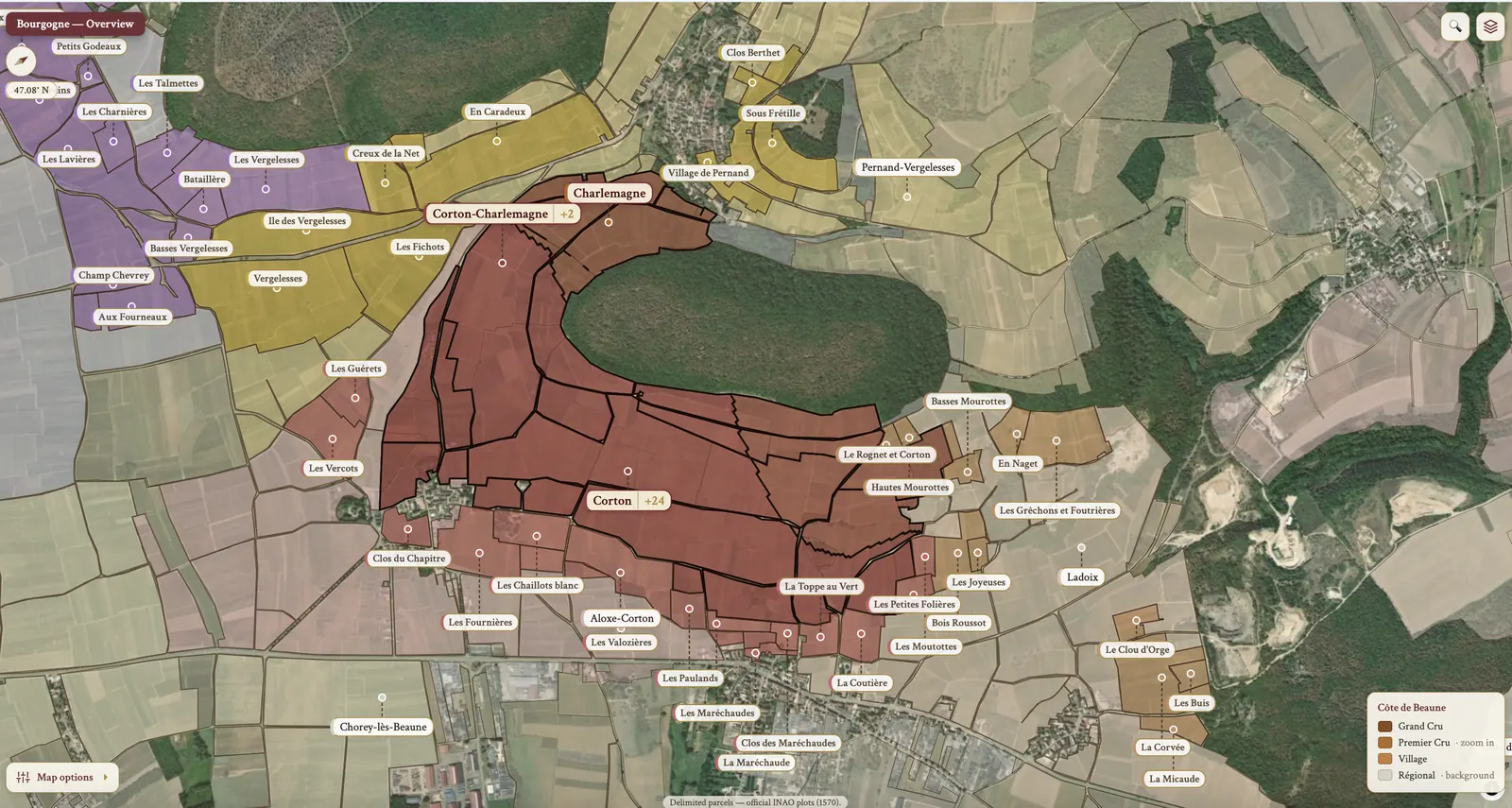
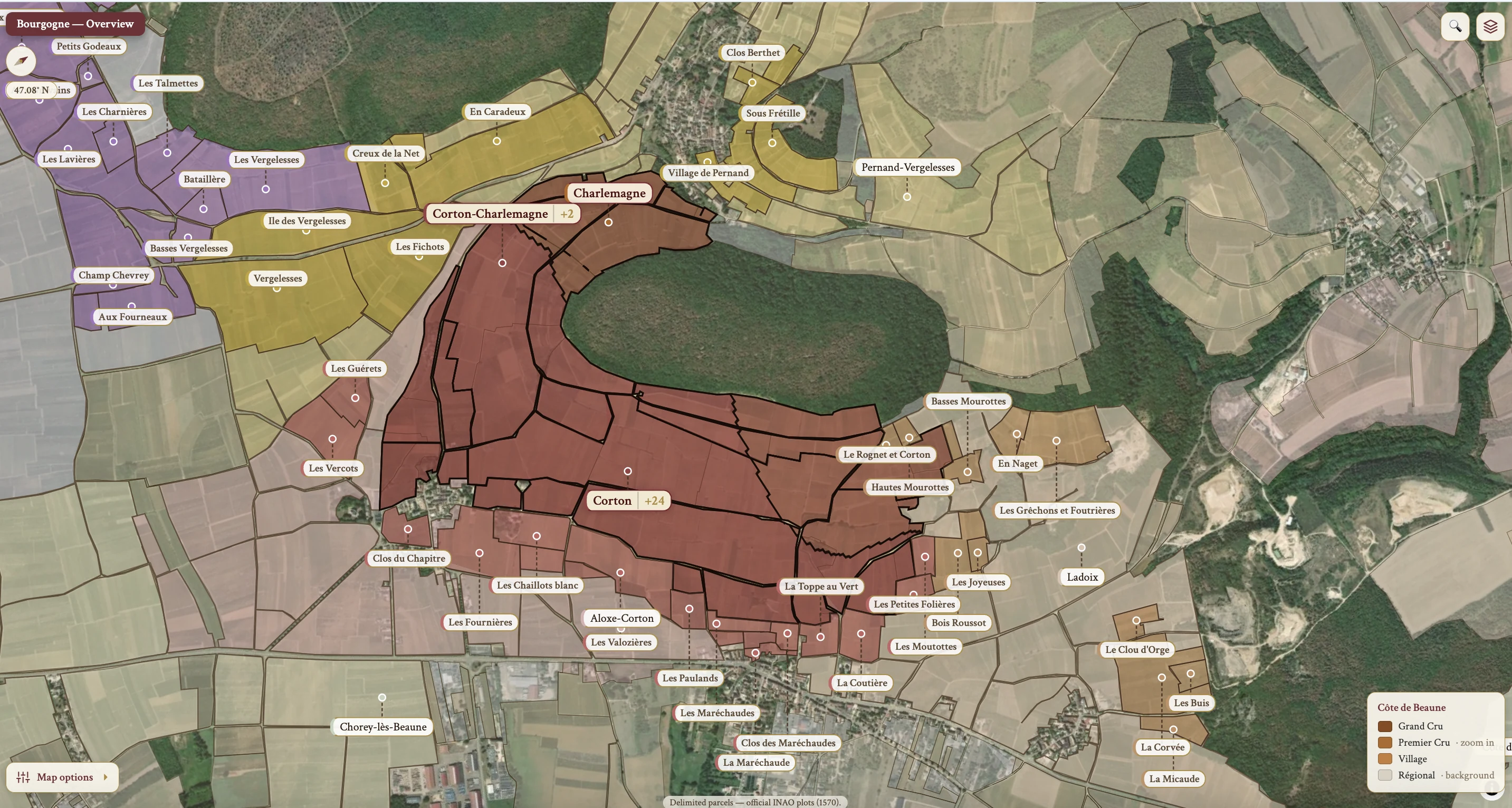
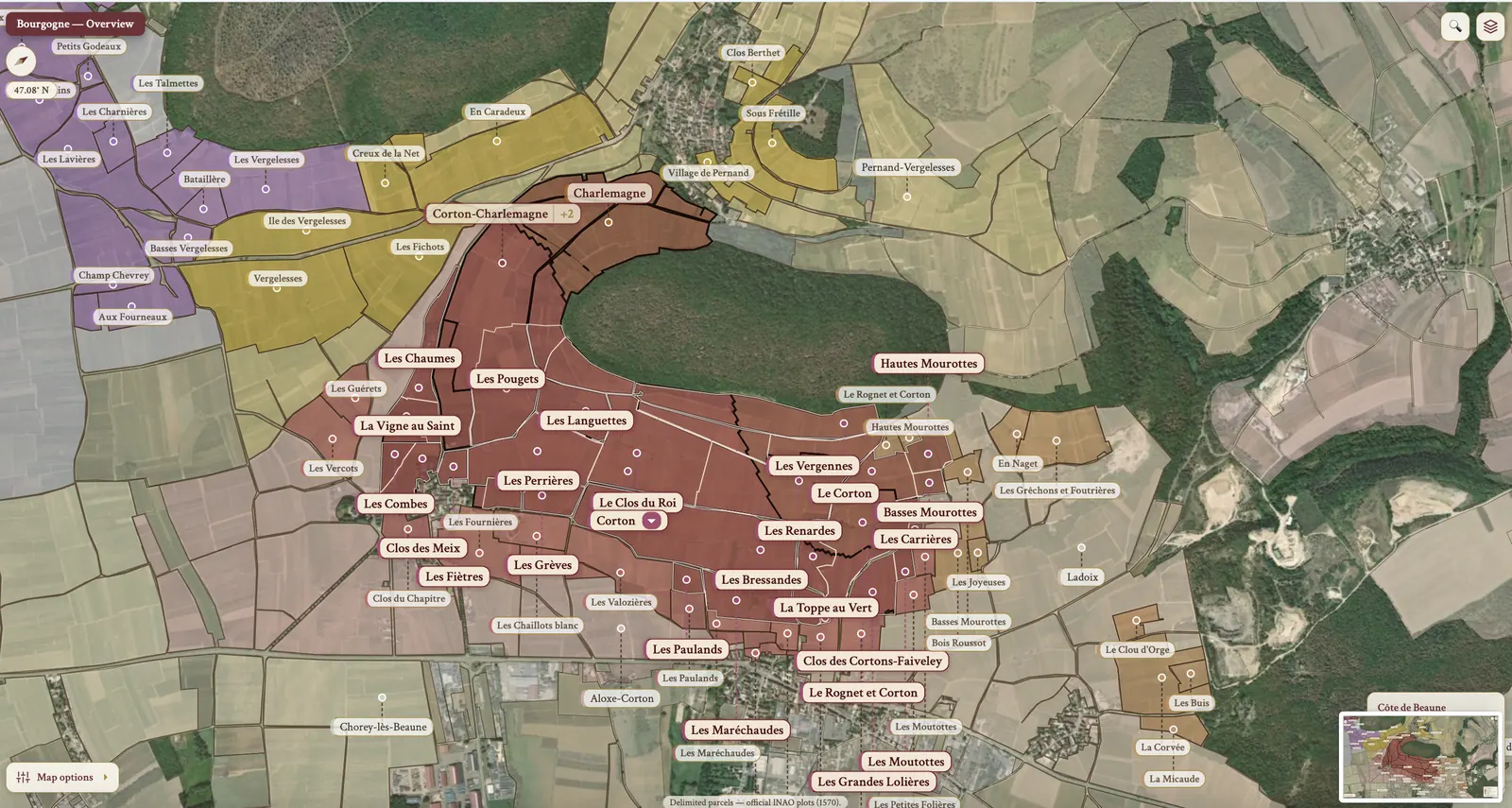
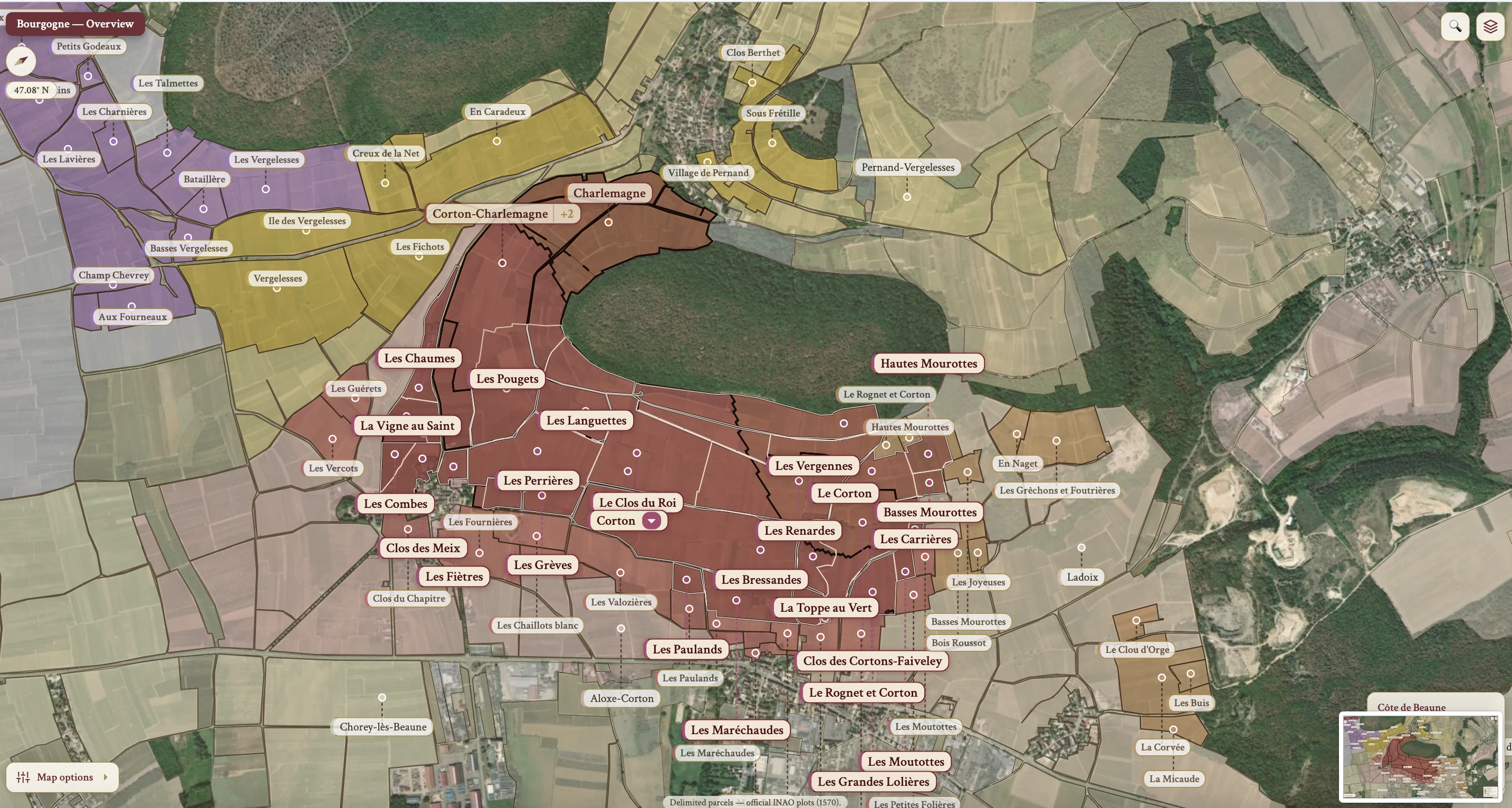
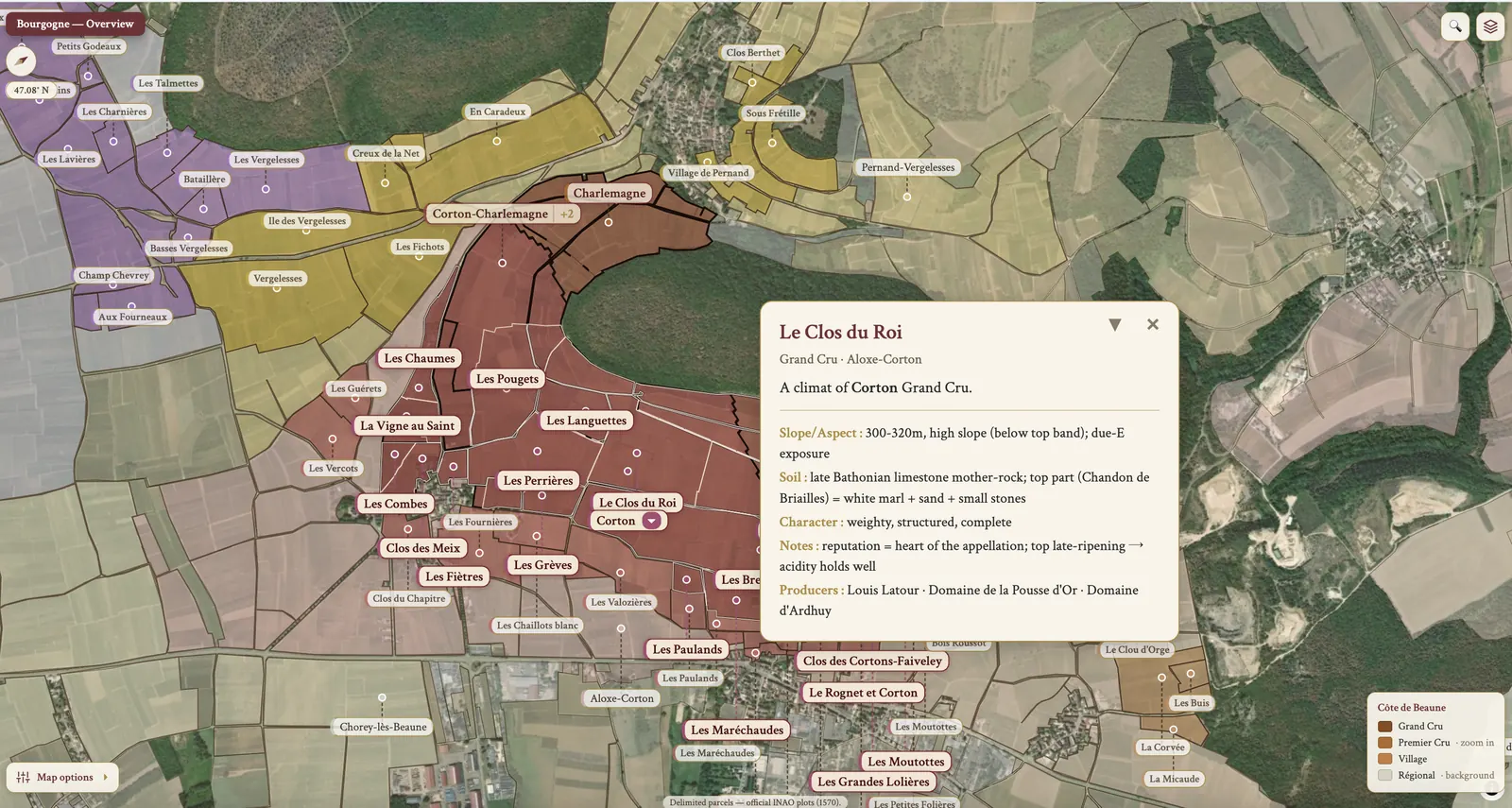
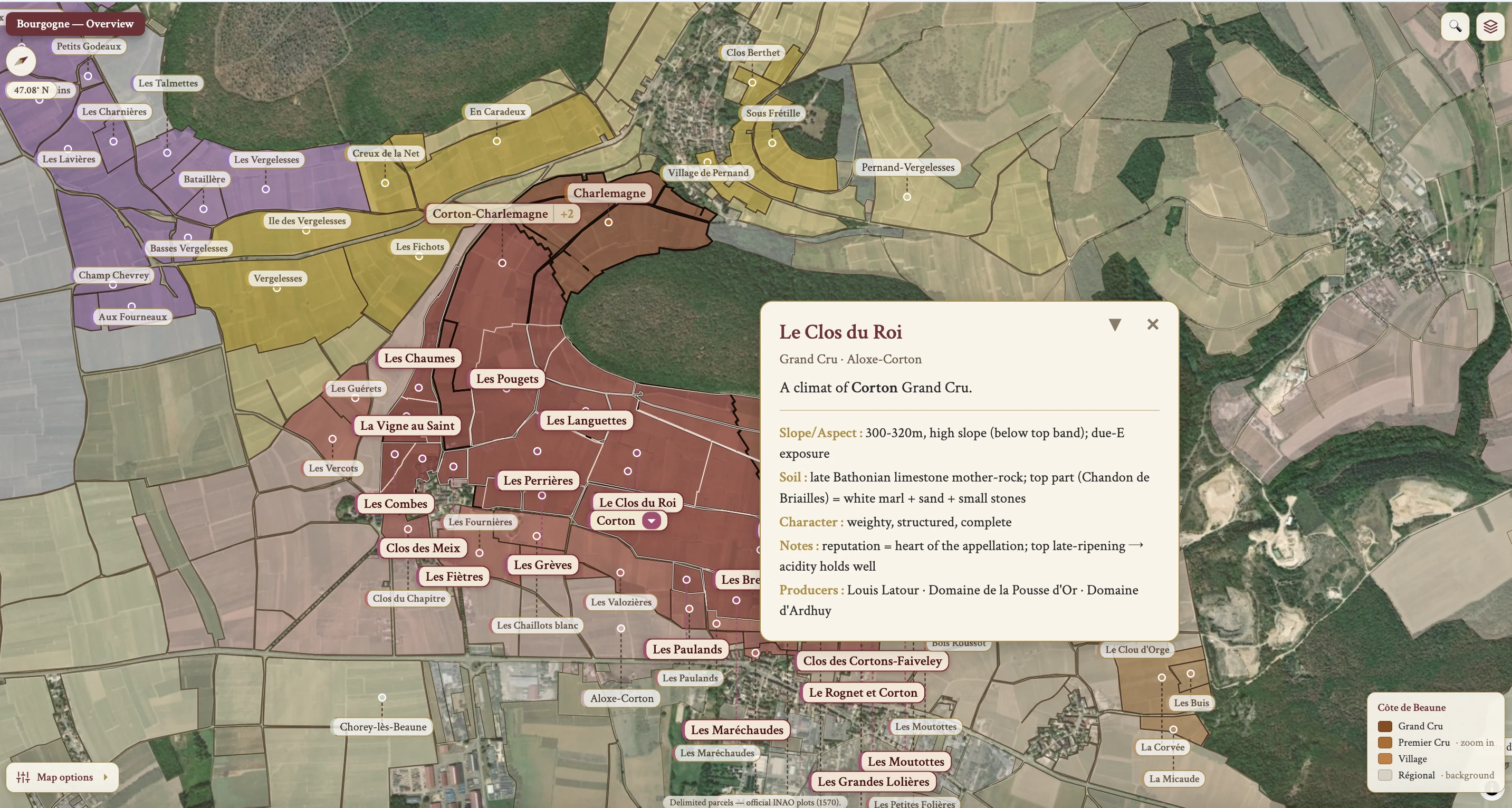
Aloxe-Corton received its AOC in 1938. For blanc, Pinot Blanc may not exceed 30% of the blend. There are 14 premiers crus and 3 grands crus shared with Ladoix-Serrigny and Pernand-Vergelesses, and 73% of the commune belongs to the Corton and Corton-Charlemagne grand cru appellations. Village-level wine is more widely known and more expensive than Ladoix or Pernand-Vergelesses.
Clos des MeixGrand Cru
Clos des Meix is a climat of the grand cru Corton, in Aloxe-Corton, combining two lieux-dits — Les Meix and Le Meix Lallemand. It is a monopole of Comte Senard, and the designation is for red only. The east-facing continuation of Les Meix is Aloxe-Corton premier cru. The grower is Comte Senard, as a monopole.
La Vigne au SaintGrand Cru
La Vigne au Saint is a climat of the grand cru Corton, in Aloxe-Corton, with south exposure and a touch of west, on the lower slopes of Aloxe. It is a graceful expression of Corton. The former Belland holding has been shared by Domaine des Croix and Méo-Camuzet since 2009; it was long best known as Louis Latour's Clos de la Vigne-au-Saint. Growers here include Louis Latour, Domaine des Croix and Domaine Méo-Camuzet.
Le CharlemagneGrand Cru
Le Charlemagne is a climat of the grand cru Corton-Charlemagne, in Aloxe-Corton. Its south-west exposure avoids due-south over-ripeness. The white is slightly deeper in flavour and fleshier than En Charlemagne. Labelling is legal as Corton-Charlemagne or Le Charlemagne, and it is the core sector of the appellation. Some Pinot Noir is planted, though in the author's view a grand cru red is not justified. Growers here include Bonneau du Martray, Louis Latour and Coche-Dury.
Le Clos du RoiGrand Cru
Le Clos du Roi is a climat of the grand cru Corton, in Aloxe-Corton. It sits at 300 to 320 metres on the high slope, below the top band, with due-east exposure. The mother-rock is late Bathonian limestone, and the top part, held by Chandon de Briailles, is white marl with sand and small stones. The wine is weighty, structured and complete. Its reputation is as the heart of the appellation, and the top is late-ripening, so acidity holds well. Growers here include Louis Latour, Domaine de la Pousse d'Or and Domaine d'Ardhuy.
Le CortonGrand Cru
Le Corton is a climat of the grand cru Corton, in Aloxe-Corton. It lies just below the woods, a band at the hilltop on the east-south-east flank. The soil is marly and white, which suits Corton-Charlemagne over Corton. The definite article, Le Corton, means the wine comes only from this named top parcel. The largest owner by far is Bouchard Père & Fils, in both colours.
Les BressandesGrand Cru
Les Bressandes is a climat of the grand cru Corton, in Aloxe-Corton. It is mid-slope and east-facing, even and slightly steep. The wine is long-lived, characterful and graceful. The name possibly comes from three spinsters from Bresse, earlier owners, and the climat lies below Clos du Roi and Renardes. Growers here include Louis Latour, Hospices de Beaune and Chandon de Briailles.
Les ChaumesGrand Cru
Les Chaumes is a climat of the grand cru Corton, in Aloxe-Corton, just below the Pernand-Aloxe road and relatively low on the slope. The wine is soft and rounded. It goes into Rapet's Corton blend and the Hospices Cuvée Docteur Peste; the Aloxe-Pernand road separates off Chaumes et la Voierosse, 3.88 hectares. Growers here include Louis Latour, Domaine Meuneveaux and Domaine Jean Fery & Fils.
Les CombesGrand Cru
Les Combes is a climat of the grand cru Corton, in Aloxe-Corton, low on the slope with good south-west exposure. Most of Les Combes is Aloxe-Corton premier cru; the plot lies just below the wall of Comte Senard's Clos des Meix, and its low position makes its grand cru merit debatable. Growers here include Domaine Tollot-Beaut, Domaine Génot-Boulanger and Domaine Rapet.
Les FiètresGrand Cru
Les Fiètres is a climat of the grand cru Corton, in Aloxe-Corton — the first vineyard on the right leaving Aloxe for Pernand, and fairly low-lying. The name comes from an old word for coffin, after a Gallo-Roman tomb on the site. High walls and a gazebo make Clos labelling permitted, though the official name is Les Fiètres. Growers here include Hospices de Beaune, Au Pied de Mont Chauve and Vincent Bouzereau.
Les GrèvesGrand Cru
Les Grèves is a climat of the grand cru Corton, in Aloxe-Corton. It is south-east-facing mid-slope, neighbouring Bressandes and sitting below Perrières. The texture is light, gravelly and sandy. The wine is tannic and structured. It is less well known than either neighbour — Perrières above and Bressandes beside. Growers here include Louis Latour, Domaine des Croix and Domaine Louis Jadot.
Les LanguettesGrand Cru
Les Languettes is a climat of the grand cru Corton, in Aloxe-Corton, just under the Bois de Corton on the upper slope. Red Languettes now comes from Chapuis alone; it is mainly white territory, a Corton-Charlemagne source for Ardhuy, Bichot and Drouhin. The name means little tongues. The grower is Maurice Chapuis.
Les MaréchaudesGrand Cru
Les Maréchaudes is a climat of the grand cru Corton, in Aloxe-Corton. The grand cru section is a mini-plateau on the lower slopes, under Bressandes, and its soil is iron-rich clay, giving an orangy-brown colour. Clos des Maréchaudes, held by Bichot, is part grand cru and part premier cru, extending sideways over the border into Ladoix; part of the climat is premier cru. The name comes from marais, marshland. Growers here include Château de Meursault, Domaine du Pavillon of Bichot and Chandon de Briailles.
Les PaulandsGrand Cru
Les Paulands is a climat of the grand cru Corton, in Aloxe-Corton; the grand cru is the upper part, behind the Hôtel des Paulands. The wine is youthfully rough and ages exceptionally well. Senard advises little new oak. The grand cru is limited to the upper part — premier cru and village Paulands also exist. Growers here include Comte Senard and Domaine Denis.
Les PerrièresGrand Cru
Les Perrières is a climat of the grand cru Corton, in Aloxe-Corton. It has good south and east exposure, mid-slope, with Clos du Roi to the north. The soil is stony, which gives excellent drainage. The wine is austere and firm with little flesh when young, and it ages well. Méo destems and then puts about 10% of stems back in, which builds flesh. It is among the better Corton sites. Growers here include Louis Latour, Michel Juillot and Domaine Méo-Camuzet.
Les PougetsGrand Cru
Les Pougets is a climat of the grand cru Corton, in Aloxe-Corton. It is south-facing, with warmth sufficient for full Pinot ripeness. There is more marl than limestone, which favours Chardonnay. Domaine Rapet is now the main red source; Montille and Javillier switched plots to Chardonnay, and the trend is toward white territory. Growers here include Héritiers Louis Jadot, Louis Latour and Domaine Rapet.
Les RenardesGrand Cru
Les Renardes is a climat of the grand cru Corton, in Aloxe-Corton. It is steep, running from 340 metres at the top to 280 metres mid-slope. Solid limestone slabs lie under a thin brown clay-limestone. A musky note emerges about 10 years on. The name possibly comes from foxes; the north end is split into individual blocks and terraces, and the climat largely continues Clos du Roi with a similar aspect. Growers here include Domaine d'Ardhuy, Hospices de Beaune and Domaine Maillard.
The premiers crus
Clos des MaréchaudesPremier Cru
Clos des Maréchaudes is a premier cru of Aloxe-Corton. It is part grand cru and part premier cru, belongs to Maison Albert Bichot, and is sold as Aloxe-Corton premier cru. The grower is Maison Albert Bichot, as a monopole.
Clos du ChapitrePremier Cru
Clos du Chapitre is a premier cru of Aloxe-Corton, a very early site among the houses and cellars just below the church. The ground is stone-filled and dries out quickly after rain. On the cadastral map the name is Les Meix. Growers here include Follin-Arbelet and Génot-Boulanger.
La CoutièrePremier Cru
La Coutière is a premier cru of Aloxe-Corton, actually in Ladoix, just below Corton Grandes Lolières, and a warm site. It is rarely seen; Capitain-Gagnerot make a rare, rich white Aloxe here. Growers here include Domaine Nudant, Capitain-Gagnerot and Domaine Petitot.
La MaréchaudePremier Cru
La Maréchaude is a premier cru of Aloxe-Corton — the Ladoix part of the Maréchaudes group, with Les Maréchaudes in Aloxe and Clos des Maréchaudes straddling, under the grand cru Corton Maréchaudes. It is sold as Aloxe-Corton premier cru.
La Toppe au VertPremier Cru
La Toppe au Vert is a premier cru of Aloxe-Corton, a stone-filled dip between south and north that makes a very warm site — a Ladoix vineyard given Aloxe-Corton premier cru status. Toppe means cleared land left as pasture. Growers here include Michel Mallard and Capitain-Gagnerot.
Les Chaillots blancPremier Cru
Les Chaillots blanc is a premier cru of Aloxe-Corton; the upper part sits just below Corton Grèves, and the lower part shades into village Aloxe. The soil is decomposed shale, which gives the name. It is one of the more elegant Aloxe premiers crus. The lower part is classified village, 1.90 hectares. Growers here include Louis Latour and Domaine d'Ardhuy.
Les FournièresPremier Cru
Les Fournières is a premier cru of Aloxe-Corton, on the eastern side of the village. The ground is particularly stony. It is one of the better-known Aloxe premiers crus. Charcoal-burners gave the site its name. Growers here include Louis Latour, Antonin Guyon and Arnoux Père & Fils.
Les GuéretsPremier Cru
Les Guérets is a premier cru of Aloxe-Corton, on flattish ground between the village and the Vergelesses hillside — one of two Aloxe premiers crus there. Growers here include Louis Latour and Domaine Rollin.
Les MaréchaudesPremier Cru
Les Maréchaudes is a premier cru of Aloxe-Corton — the Aloxe part of a group with La Maréchaude in Ladoix and Clos des Maréchaudes straddling the two, all lying under the grand cru Corton Maréchaudes and all sold as Aloxe-Corton premier cru. Growers here include Domaine du Pavillon of Bichot, Château de Meursault and JP Maldant.
Les MoutottesPremier Cru
Les Moutottes is a premier cru of Aloxe-Corton. The northern portion is premier cru and the southern section grand cru; Capitain-Gagnerot, who holds both, normally blends as premier cru. Growers here include Edmond Cornu and Capitain-Gagnerot.
Les PaulandsPremier Cru
Les Paulands is a premier cru of Aloxe-Corton: the vines a little up the slope from the Hotel Paulands are premier cru, while the top of the lieu-dit is grand cru Corton. The Hotel Paulands back garden plot is village level, 2.48 hectares. The grower is Château Corton C.
Les Petites FolièresPremier Cru
Les Petites Folières is a premier cru of Aloxe-Corton, a continuation north of the grand cru Corton Grandes Lolières, above the village of Ladoix. It is spelt Les Petites Lolières in the book. Growers here include Christian Gros, Domaine Maillard and Château Corton C.
Les ValozièresPremier Cru
Les Valozières is a premier cru of Aloxe-Corton, just below Corton Bressandes. The soil is relatively humid and clay-rich. The quality is sound but somewhat rustic. The lower part, 7.81 hectares, is classified village. Growers here include Chevalier Père & Fils, Comte Senard and Michel Mallard.
Les VercotsPremier Cru
Les Vercots is a premier cru of Aloxe-Corton, the better-known of the pair with Les Guérets between the village and the Vergelesses hillside, at the foot of the slope. There is very little topsoil above the rock, an alluvial fan from the Pernand valley. Growers here include Follin-Arbelet, Antonin Guyon and Dubreuil-Fontaine.
Corton AOP — Grand Cru
Corton received its AOC in 1937. It is made in both colours, predominantly red, with white a small minority, across the communes of Aloxe-Corton, Ladoix-Serrigny and Pernand-Vergelesses. At 160 ha it is the largest grand cru in the Côte d'Or. Its climats are Bressandes, Clos du Roi, Chaume, Grèves, Renardes, Perrières, Pougets, Clos de la Vigne au Saint, Le Charlemagne and Le Corton. For blanc the encépagement is Chardonnay plus a maximum 10% Pinot Blanc; for rouge it is Pinot Noir plus a maximum 15% mixed plantings of Pinot Gris, Pinot Blanc and Chardonnay, and Aligoté may be used as part of that mixed blend of supplementary grapes for Corton Rouge but may not be replanted. For blanc wines Pinot Blanc may not exceed 30% of the blend. Chardonnay grown in Corton grand cru outside the Corton-Charlemagne and Charlemagne zones may be labelled Corton Blanc, which is rarely used — Jean-Marc & Hugues Pavelot is one example. The rouge is usually the least expensive grand cru in négociant portfolios, of uncertain quality.
Corton-Charlemagne AOP — Grand Cru
Corton-Charlemagne received its AOC in 1937 and is blanc only, across Aloxe-Corton, Ladoix-Serrigny and Pernand-Vergelesses. The qualifying area is 71.88 ha, and the 2022 production area was 59.77 ha. Its 9 climats are En Charlemagne, Le Charlemagne, Les Pougets, Les Languettes, Le Corton, Les Renardes, part of Le Rognet et Corton, Basses Mourottes and Hautes Mourottes. The encépagement is Chardonnay plus a maximum 10% Pinot Blanc, and if planted prior to July 2009 Aligoté may be present at a maximum 15% in the vineyard; Pinot Blanc may not exceed 30% of the blend. The label cannot specify a climat or lieu-dit. Pinot Noir grown within the Corton-Charlemagne area may be labelled as Corton Grand Cru. Bonneau du Martray makes grand cru only — Corton-Charlemagne and Corton. Producers include Bonneau du Martray, Louis Latour, Bouchard Père et Fils, Coche-Dury, Roulot and Leflaive.
Charlemagne AOP — Grand Cru
Charlemagne received its AOC in 1937 and, together with Musigny Blanc, is the rarest of white grand crus. It is blanc only and seldom seen on labels today, with a maximum yield of 48 hl/ha. It covers Aloxe-Corton and Pernand-Vergelesses only — not Ladoix-Serrigny, which differs from Corton-Charlemagne — and its qualifying area of 62.94 ha is a subset of Corton-Charlemagne's 71.88 ha. Its 5 climats are En Charlemagne, Le Charlemagne, Les Pougets, Les Languettes and Le Corton. The encépagement is Chardonnay plus a maximum 10% Pinot Blanc, and Pinot Blanc may not exceed 30% of the blend. There has been a small resurgence from practically zero hl declared in the early 2000s. Declassification options are Pernand or Aloxe premier cru, Pernand or Aloxe villages depending on the climat, Bourgogne Côte d'Or, or Bourgogne. Only 2 producers currently use the Charlemagne label: Domaine de la Vougeraie, since the 2013 vintage, with 2 parcels — one Le Charlemagne and one En Charlemagne — totaling less than 0.5 ha; and Domaine Bonneau du Martray, since the 2021 vintage, under Kroenke ownership after the 2017 purchase, having previously bottled all as Corton-Charlemagne.