Chablis
Chablis, climat by climat. Site, soil, character and growers for all 48 crus, with the appellation map alongside.
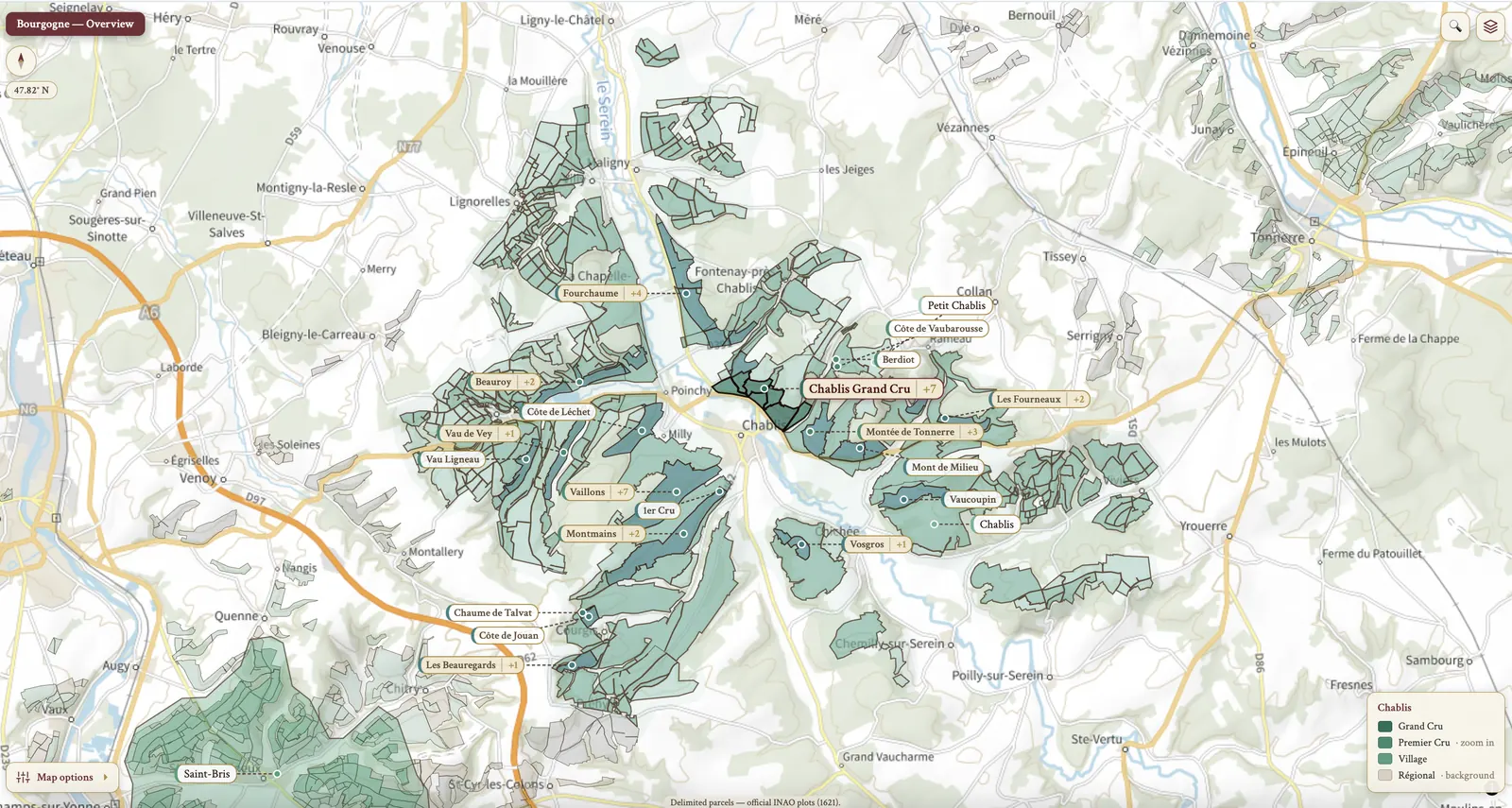
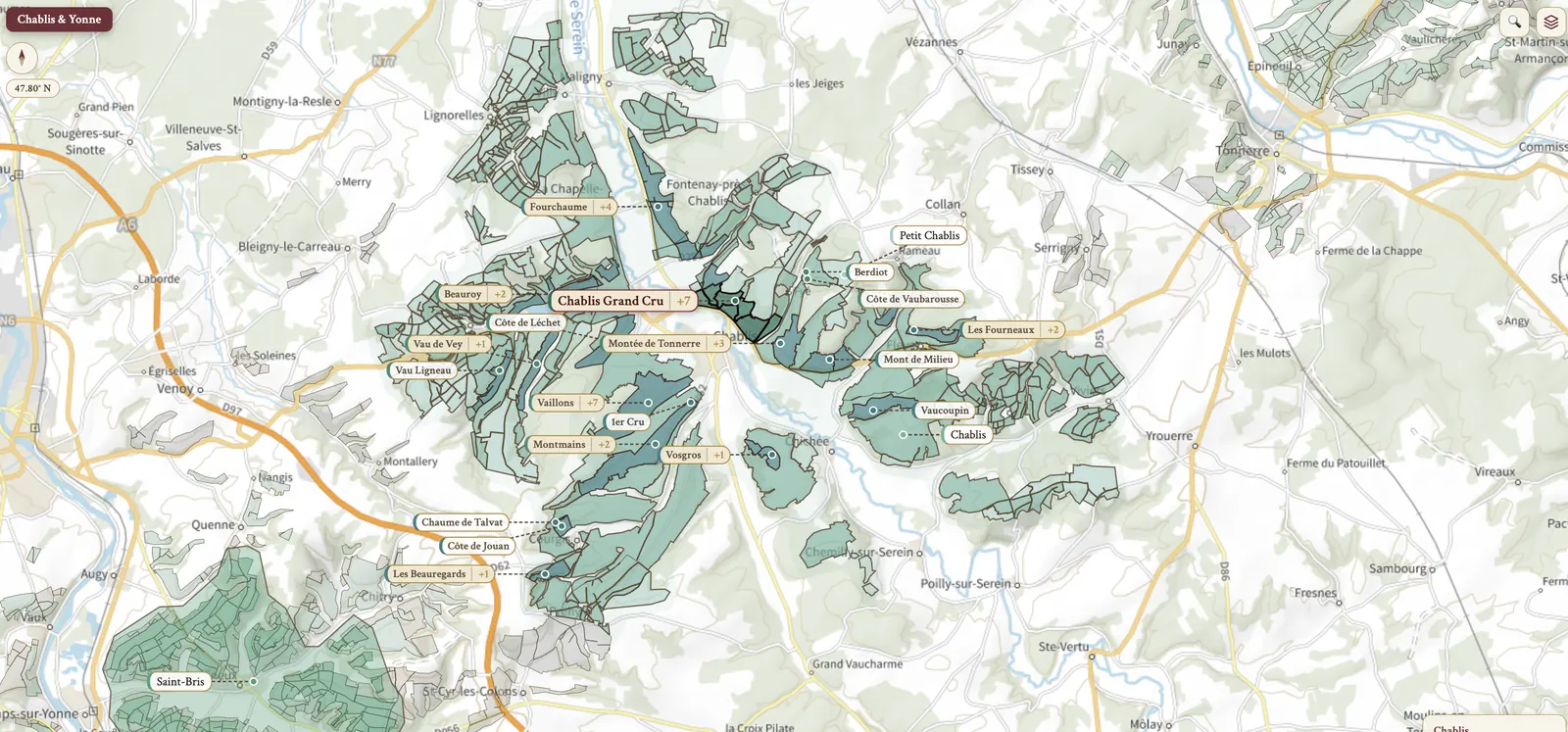
Chablis lies in the Yonne département, on the Serein River. It has three AOPs — Petit Chablis, created in 1944, Chablis including 1er cru, created in 1938, and Chablis Grand Cru — and a single grand cru AOC covers the 7 climats on one hill above the town. There are 40 premiers crus in total, grouped under 17 umbrella premiers crus; the umbrella grouping gives higher market visibility, and each climat may use either its own name or the umbrella name on the label. The 1980s brought an expansion into the plains to meet market demand, and while the slopes generally produce more characterful wines, skilled producers can make good Chablis from plains fruit.
The grands crus
| Climat | Size | Notes | Producers |
|---|---|---|---|
| Blanchot | 12.68 ha | east end of the hill | François Raveneau · Domaine Servin · La Chablisienne · Patrick Piuze · Daniel-Étienne Defaix · Billaud-Simon · Samuel Billaud |
| Les Clos | 25.87 ha | the largest | François Raveneau · Vincent Dauvissat · William Fèvre (largest holder, 4.14 ha) · Billaud-Simon · La Chablisienne · Christian Moreau · Louis Michel · Patrick Piuze · Laroche |
| Valmur | 15.43 ha | François Raveneau · Patrick Piuze · William Fèvre · Christian Moreau | |
| Grenouilles | 9.38 ha | the smallest | La Chablisienne · Louis Michel · William Fèvre · Jean-Marc Brocard · Patrick Piuze |
| Vaudésir | 15.43 ha | Christian Moreau · Louis Michel · Long-Depaquit · Jean-Paul & Benoît Droin · William Fèvre | |
| Preuses | 10.81 ha | Vincent Dauvissat · Billaud-Simon · Patrick Piuze · Domaine Servin · Samuel Billaud · William Fèvre | |
| Bougros | 15.07 ha | west end of the hill | William Fèvre (bottled as “Bougros” and “Côte Bouguerots”) · Patrick Piuze · Albert Bichot · Domaine Servin · Bernard Defaix |
Chablis Grand CruGrand Cru
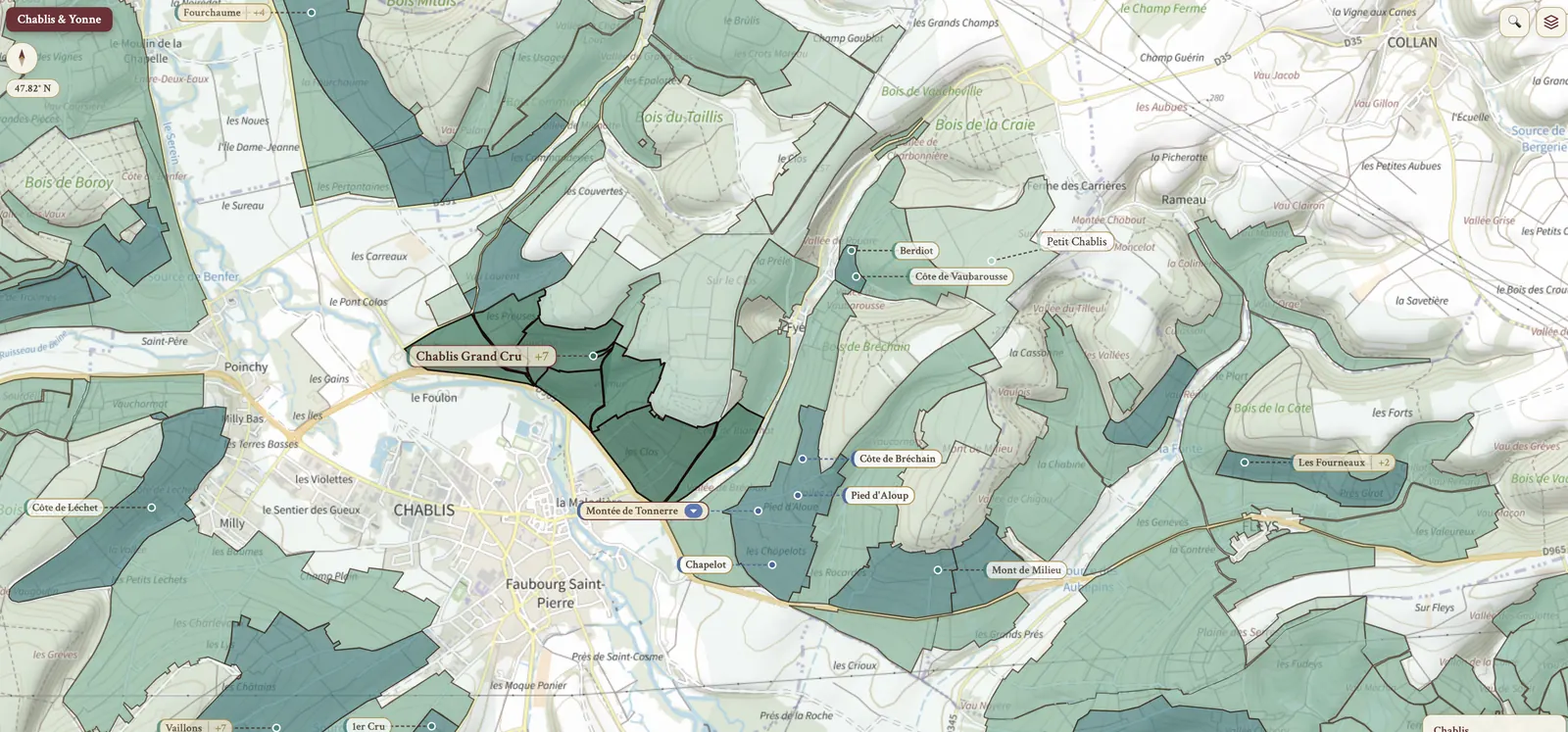
Chablis Grand Cru is steep and predominantly south-west-facing, though aspect varies climat to climat, and forms one contiguous block above the Serein and the town of Chablis. The soil is Kimmeridgian marl. The wine is steely and dry, and it needs long ageing — roughly 6–10 years minimum — before it shows; it is unrewarding drunk young. Five climats were classified in 1935, with Bougros and Preuses added in 1938.
BlanchotGrand Cru
Blanchot is a grand cru of Chablis at the south-east end of the grand cru block, one of its two bookends. It is steep, sitting above the Vallée de Bréchain running up to Fyé, across the valley from Montée de Tonnerre; cool airflow and an early loss of the afternoon sun make it one of the cooler grand crus. The soil is a white soil or marl, the source of the name. It is driven by finesse rather than power. It lies in the commune of Fleys; Droin bottles it unoaked, all fresh white flowers, and Laroche makes an oak-aged Réserve de l'Obédiencerie.
BougrosGrand Cru
Bougros is a grand cru of Chablis at the north-west end of the grand cru block, its other bookend. It sits a little lower on the slope, so there is a historic frost risk, and the steep stony Côte de Bougerots sector just above the road runs to a 1-in-2 gradient. The topsoil is deeper on the plateau part, and pure Kimmeridgian on the steep road-side sector. The regular bottling is broad, round, soft and fleshy from that deeper plateau topsoil, while the steep Côte de Bougerots is far denser and sharply mineral. It was added to grand cru in 1938, and is also written Bouguerots or Bouqueyreaud.
GrenouillesGrand Cru
Grenouilles is a grand cru of Chablis whose lower part is a steep slope beside the D965 Chablis bypass just above the Serein, while the upper part flattens into a mini-plateau with deeper soil. The plateau fruit is fuller and heavier, the steep-slope fruit leaner and more mineral, and the upper plots, Droin's among them, are spicy with a hint of liquorice. The name comes from the river's proximity and its frogs, and Château de Grenouilles is the La Chablisienne bottling.
Les ClosGrand Cru
Les Clos is the largest grand cru of Chablis, about a quarter of the total grand cru surface, fairly uniform in shape and even in slope, with a south-west exposure and a small due-south sector on the Blanchot border; it is stonier at the top and has deeper soil at the foot. The soil is very compact white clay with minimal marlstone, and hard to work. It is the most consistent and most highly rated of the grand crus, intense yet never heavy, in the white-fruit spectrum with no yellow plum, and it is usually poured last in a grand cru line-up. It was the first grand cru site planted by the monks. Clos des Hospices dans Les Clos, 0.82 ha bought from the Hospices de Chablis in 1904, lies at the foot and is now split between Christian and Louis Moreau.
PreusesGrand Cru
Preuses is a grand cru of Chablis whose bulk sits above Bougros on a gentle slope, with one small sector — Dauvissat's and Drouhin-Vaudon's — belonging effectively to the steep, south-facing, heat-retaining Vaudésir amphitheatre. Its topsoil is deeper than that of the other grand crus, and fractured bedrock gives excellent drainage. The wine is typically low in aroma young but very long-lived, fleshy yet not heavy. It was added to grand cru in 1938, was formerly written Perreuses, perhaps from Pierreuses, meaning stony, and is ranked by Patrick Piuze as his top site.
ValmurGrand Cru
Valmur is a grand cru of Chablis set between Grenouilles and Les Clos, a steep-sided valley with both south- and north-facing flanks; exposure matters less here than the meso-climate, since the enclosure and poor air drainage bring very hot summers and very cold winters. There is more clay than in Vaudésir, in white and blue marl with Kimmeridgian fossils. The wine is large-scaled, dense and weighty, less overtly Chablis and closer to a rich Côte d'Or white, with less white fruit than Vaudésir, and it suits white meat and poultry over fish. Christian Moreau's is about 80% from roughly 78-year-old south-east-exposed vines and about 20% from the opposite north-west flank.
VaudésirGrand Cru
Vaudésir is a grand cru of Chablis, an enclosed valley with little air circulation, which brings strong summer heat and wind shelter — a heat-trap. One flank carries over from the Grenouilles crest, while the opposite one, steeper and more southerly, drops from the Les Preuses edge. It is firm-framed yet elegant, with pretty floral aromatics, and keeps a strong mineral backbone alongside heat-driven fruit richness. It is commonly rated the top grand cru after Les Clos. La Moutonne, the unofficial 8th grand cru, lies mostly within it, 2.24 ha, spilling into Preuses for 0.11 ha, and is a Long-Depaquit monopole.
The premiers crus
BeauroyPremier Cru
Beauroy is a premier cru of Chablis that clothes three sides of a hill, mostly on south-west and due-east flanks, with a 6 ha core in the hamlet of Poinchy. It is sunny and early-ripening, needs early picking to keep its freshness, and can lack top-division precision. The name is also a blanket one running west to Beine, and the umbrella includes the sub-climats Troesmes and Côte de Savant, Troesmes rated the most interesting sector. Growers here include La Chablisienne, Domaine Laroche and Domaine de la Motte.
Beauroy is a left-bank umbrella including Troesmes and Côte de Savant.
BerdiotPremier Cru
Berdiot is a premier cru of Chablis, steep but west-facing, in the commune of Fyé, and geologically sound. It is tiny and effectively unused, possibly part of Montée de Tonnerre before 1978; its declared fruit goes into La Chablisienne's blended 1er La Grande Cuvée.
Berdiot is a right-bank umbrella that stands alone and is rarely used on labels.
BeugnonsPremier Cru
Beugnons is a premier cru of Chablis at the south-west tip of Vaillons, about 12 ha within Vaillons and usually declared as Vaillons. Long-Depaquit and Sébastien Dampt use the Beugnons name, and Daniel-Etienne Defaix has 1950s Pinot Noir here, sold as Bourgogne Rouge only. Growers here include Domaine Long-Depaquit and Sébastien Dampt.
ButteauxPremier Cru
Butteaux is a premier cru of Chablis at the south-west tip of Montmains, straddling Courgis and Chablis in an enclosed valley that traps heat. The soil is a firm white clay bench, especially in the old-vine block. It is often the most powerful sector of Montmains, with a Left-Bank nose and Right-Bank weight. It runs to about 40 ha and is increasingly declared under its own name; Louis Michel bottles a regular cuvée and a vieilles vignes from 1955. Growers here include Domaine Pattes Loup, Louis Michel and Domaine Raveneau.
Butteaux producers include François Raveneau, Louis Michel, Patrick Piuze, Jean-Marc Brocard and Domaine Servin.
ChapelotPremier Cru
Chapelot is a premier cru of Chablis, a chunk of about 20 ha of Montée de Tonnerre in the commune of Fyé, with grand cru-like exposure on a gentler slope. It is a sub-climat of Montée de Tonnerre, also written Les Chapelots. Raveneau is the only 1er-level example seen, recently grubbed for replanting and not made every year, while Billaud-Simon, William Fèvre and Moreau-Naudet also hold plots. Growers here include Domaine Raveneau, Billaud-Simon and Moreau-Naudet.
ChatainsPremier Cru
Chatains is a premier cru of Chablis near the top of the slope, facing south-east. It is a 15 ha enclave within Vaillons and is never bottled under its own name; its two parts, Les Chatains and Chatains, are linked by a band called Les Grandes Chaumes.
Chaume de TalvatPremier Cru
Chaume de Talvat is a premier cru of Chablis sitting above Côte de Jouan, in the commune of Courgis. It is a 1978 promotion and is rarely if ever bottled under its own name.
Chaume de Talvat is a left-bank umbrella that stands alone and is rarely used on labels.
Côte de BréchainPremier Cru
Côte de Bréchain is a premier cru of Chablis, a steep, west-facing extension of Montée de Tonnerre of about 10 ha. It is richer in clay than the rest of the vineyard, which brings more weight and less elegance. It is a sub-climat of Montée de Tonnerre, promoted in 1978, and is never seen under its own name; it is the source of Benoît Droin's and Vincent Dauvissat's Montée de Tonnerre, and Dampt of Collan makes a straight Chablis lieu-dit Bréchain.
Côte de CuissyPremier Cru
Côte de Cuissy is a premier cru of Chablis lower on the slope where the valley widens, in the commune of Courgis, with a reasonable depth of topsoil. It is less mineral than Côte de Jouan across Courgis. It is a sub-climat attached to Les Beauregards, promoted in 1978, and so far has been tasted only from Domaine Angst. Growers here include Domaine de la Tour and Vignoble Angst.
Côte de FontenayPremier Cru
Côte de Fontenay is a premier cru of Chablis, the part of Fourchaume sliding up the side valley toward Fontenay, with perfect south-east exposure, though the opposing hillside limits its value. It is generally seen as a weaker sector of Fourchaume. It is a sub-climat of Fourchaume, including the sub-climat Dine-Chien, and is offered separately only by Domaine Vrignaud.
Côte de JouanPremier Cru
Côte de Jouan is a south-facing premier cru of Chablis, relatively mineral despite few visible stones in the topsoil, and one of the more interesting 1978 promotions. It lies in the commune of Courgis and was called Les Landes et Verjuts until 1987. Growers here include Domaine des Marronniers, Domaine de la Tour and Domaine Pattes Loup.
Côte de Jouan is a left-bank umbrella that stands alone and is rarely used on labels.
Côte de LéchetPremier Cru
Côte de Léchet is a premier cru of Chablis, perfectly exposed south-east and overlooking Milly, with more clay than limestone toward the back of the valley. It is early-ripening, in a white-fruit style, with a little more intensity than Beauroy and less saline tension than Vaillons. Most of its owners — Barat, Dampt, Defaix — are based in Milly. Growers here include La Chablisienne, Bernard Defaix and Daniel-Etienne Defaix.
Côtes de Léchet is a left-bank umbrella that stands alone.
Côte de SavantPremier Cru
Côte de Savant is a long, south-facing premier cru of Chablis in the commune of Beine, on the slope above the road to Chablis and the Lac de Beine. It is the third part of Beauroy, promoted 1er in 1978, the year the Lac de Beine reservoir was built for anti-frost water aspersion.
Côte de VaubaroussePremier Cru
Côte de Vaubarousse is a little-known premier cru of Chablis, adjacent to Berdiot in the commune of Fyé, and rarely if ever seen.
Côte de Vaubarousse is a right-bank umbrella that stands alone and is rarely used on labels.
Côte des Prés-GirotsPremier Cru
Côte des Prés-Girots is a sunny, south-facing premier cru of Chablis on limestone with white clay. It is a sub-climat of Les Fourneaux and the source of part of Domaine Grossot's Fourneaux; Château de Fleys, of Philippon, also notes the sun and clay here. Growers here include Domaine Grossot and Château de Fleys.
ForêtsPremier Cru
Forêts is a premier cru of Chablis on clay of all colours with abundant stones, which drain very effectively; the site heats slowly and retains heat well. The wine is rich and complex with a touch of liquorice, softer, deeper and more harmonious than the leaner, steelier, saline Montmains proper. It is the favourite part of Montmains, also written La Forêt, Les Forêts or Forest, and about 75% is declared under this name rather than Montmains. Growers here include Domaine Vocoret, Vincent Dauvissat and Louis Michel.
FourchaumePremier Cru
Fourchaume is a premier cru of Chablis, mostly south-west-facing and at low altitude, below 200 m. It is a Kimmeridgian escarpment set in a sea of Portlandian. It is early-ripening and predominantly white-fruit, with a softer texture over minerality and the bacon-fat and spice notes of a warm site. It is the northern extension of the grand cru line on the right bank of the Serein, a long thin northward finger, and the umbrella includes the sub-climats L'Homme Mort, Vaupulent, Vaulorent and Côte de Fontenay. Growers here include La Chablisienne, Domaine N&G Fèvre and Daniel Seguinot & Filles.
Fourchaume is a right-bank umbrella including L'Homme Mort, the northernmost 1er cru lieu-dit, Vaulorent, the only 1er cru touching grand cru, Vaupulent and Côte de Fontenay.
L'Homme MortPremier Cru
L'Homme Mort is a premier cru of Chablis, the northernmost part of Fourchaume, exposed south-west over the Serein valley, with two bumps turning to a south exposure. It is more mineral, firmer and more severe than the rest of Fourchaume. It is a sub-climat of Fourchaume, and Domaine Adhémar Boudin has old vines across both southern bumps. Growers here include Le Domaine d'Henri, Domaine Laroche and La Chablisienne.
L'Homme Mort is the northernmost 1er cru lieu-dit in Chablis.
Les BeauregardsPremier Cru
Les Beauregards is a premier cru of Chablis at the far upper end of the valley, up to 300 m altitude, its top plots facing south-east. It is one of the coolest 1er sites and late-ripening. It lies in the commune of Courgis, was promoted in 1978 and largely planted afterwards, and its umbrella includes the sub-climat Côte de Cuissy. Growers here include Domaine Pattes Loup and Jean-Marc Brocard.
Les Beauregards is a left-bank umbrella including Côte de Cuissy.
Les FourneauxPremier Cru
Les Fourneaux is a premier cru of Chablis whose Fourneaux and Morein plots are mostly east- or south-east-facing, in a side valley set back from the Serein, unusual for a right-bank 1er. The soil is limestone with white clay. The wine is not exceptionally structured but has a strong iodine content. It is mostly owned by vignerons of Fleys, and is an umbrella of three plots including the sub-climats Morein and Côte des Prés-Girots. Growers here include Louis Moreau, Alain & Cyril Gautheron and Charly Nicolle.
Les Fourneaux is a right-bank umbrella including Morein and Côte des Prés-Girots.
Les LysPremier Cru
Les Lys is a premier cru of Chablis whose vines lie on the far side of the Vaillons crest, exposed north or north-east. It is noticeably different from the rest of Vaillons, with an iodine character. Officially a sub-section of Vaillons, it is best considered on its own, and is mostly worked by Milly vignerons such as Defaix and Dampt. Growers here include Daniel-Etienne Defaix, Long-Depaquit and Daniel Dampt.
Les ÉpinottesPremier Cru
Les Épinottes is a premier cru of Chablis on the lower slopes of Vaillons, closest to the town of Chablis. It lies within Vaillons and is essentially always sold as Vaillons; the sole solo example seen is Verget's Vaillons, Vignes de l'Epinottes.
Mont de MilieuPremier Cru
Mont de Milieu is a premier cru of Chablis facing almost due south, in the communes of Fleys and Fyé, east of Chablis. The topsoil is predominantly red clay, with more stones and less clay at the west end and the reverse at the east. It is one of the most powerful 1er, fleshy, opulent and exotic in mirabelle and peach, with a trenchant mineral core that emerges with age. The eastern, Fleys section is the fleshiest. It is the next hill along after Montée de Tonnerre, hence middle, and the name perhaps comes from meilleurs.
Mont de Milieu is a right-bank umbrella that stands alone. Producers include Billaud-Simon, Domaine Servin, La Chablisienne and Alice et Olivier de Moor.
MontmainsPremier Cru
Montmains is a premier cru of Chablis on the south-east-facing side of a rolling hill, separated from Vaillons to the north by a valley. The eastern end, Montmains proper, has the most chalk, with more white clay toward Butteaux. It is benchmark Chablis and ages well; the eastern end is the most precise and ethereal, it is cooler than Vaillons and picked later, and it often shows a toasted-hazelnut reduction. It is a headline cru whose subdivisions Forêts and Butteaux are usually bottled under their own names. Growers here include Domaine Besson, La Chablisienne and Denis Race.
Montmains is a left-bank umbrella including the lieux-dits Forêts, also known as La Forest, and Butteaux.
Montée de TonnerrePremier Cru
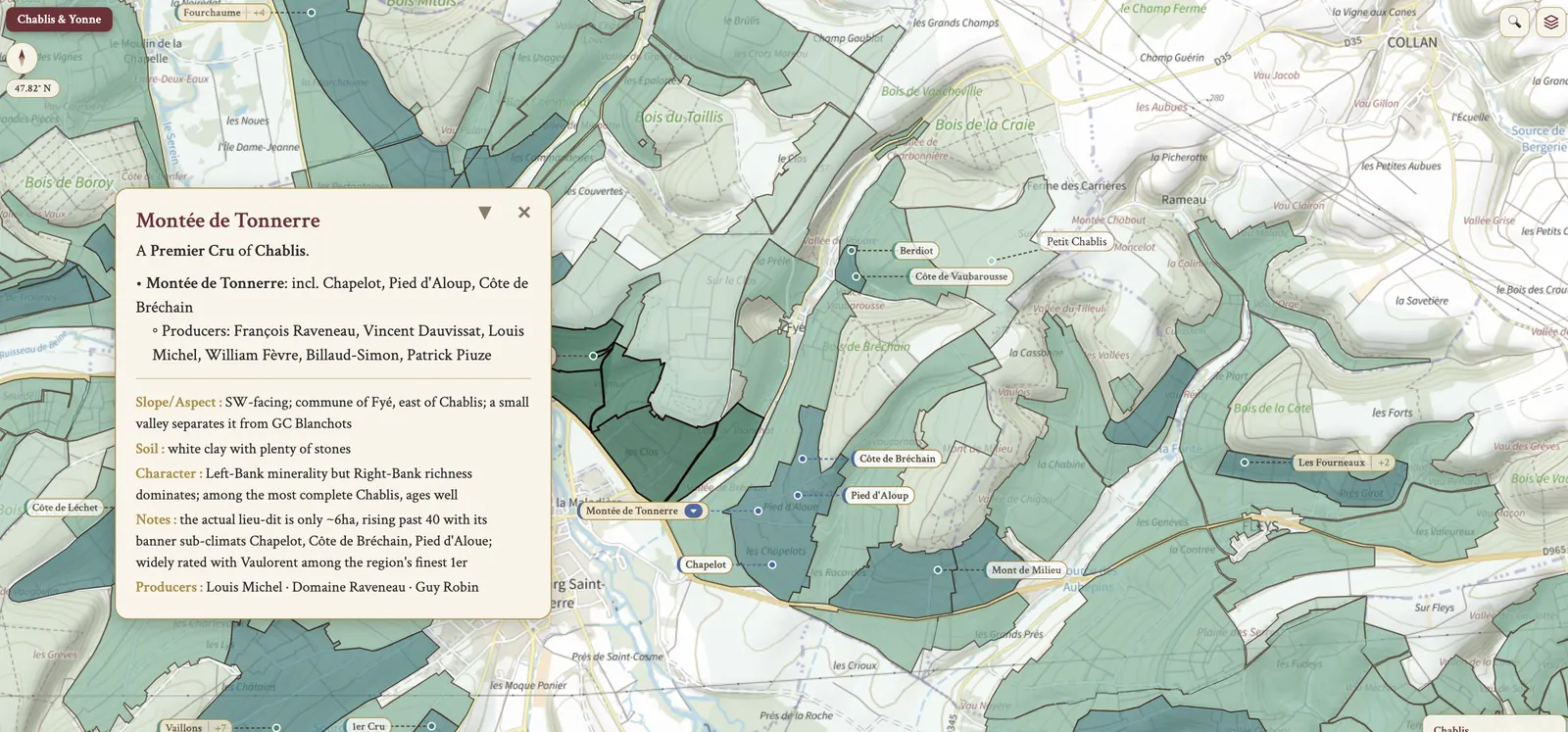
Montée de Tonnerre is a premier cru of Chablis, south-west-facing, in the commune of Fyé east of Chablis, with a small valley separating it from grand cru Blanchots. The soil is white clay with plenty of stones. It has Left-Bank minerality, but Right-Bank richness dominates; it is among the most complete Chablis and ages well. The actual lieu-dit is only about 6 ha, rising past 40 with its banner sub-climats Chapelot, Côte de Bréchain and Pied d'Aloue, and it is widely rated with Vaulorent among the region's finest 1er. Growers here include Louis Michel, Domaine Raveneau and Guy Robin.
Montée de Tonnerre is a right-bank umbrella including Chapelot, Pied d'Aloup and Côte de Bréchain. Producers include François Raveneau, Vincent Dauvissat, Louis Michel, William Fèvre, Billaud-Simon and Patrick Piuze.
MoreinPremier Cru
Morein is a premier cru of Chablis, mostly east- or south-east-facing, cooler and more open to the wind, on limestone with white clay. It is a sub-climat of Les Fourneaux, and part of Domaine Grossot's Fourneaux comes from here.
MélinotsPremier Cru
Mélinots is a premier cru of Chablis at the south-west tip of Vaillons. It is useful in a Vaillons blend and undistinguished bottled alone. Its own lieu-dit is often called Minots; before 1978 the name was an umbrella over Épinottes, Roncières and the whole lower Vaillons band, and since then it covers just the Minots part. Verget and Patrick Piuze bottle it as Vaillons Les Minots.
Pied d'AloupPremier Cru
Pied d'Aloup is a premier cru of Chablis, west-facing for the afternoon sun, at relatively high altitude and exposed to cool north winds down the Bréchain and Vauxvillien valleys. It is a sub-climat of Montée de Tonnerre, also written d'Aloue, and is not seen on its own; a Billaud-Simon plot here dates from 1935.
RoncièresPremier Cru
Roncières is a premier cru of Chablis on the lower slopes of Vaillons, between Mélinots and Épinottes. It is a large chunk of Vaillons and usually sold as Vaillons; Patrick Piuze bottles it solo, from an east–west-planted plot, and it is the principal source of Domaine Laroche's Vaillons.
SéchetPremier Cru
Séchet is a premier cru of Chablis, the south-east-facing part of Vaillons at the top of the hill. The rock is dense and compact white, with excellent drainage. It shows mineral purity and lemongrass notes. It lies within Vaillons; the book headline spelling is Sécher, Vincent Dauvissat bottles it solo as Séchet, and the name evokes dryness. Growers here include Drouhin-Vaudon, Louis Michel and Samuel Billaud.
TroesmesPremier Cru
Troesmes is a premier cru of Chablis, mostly an even SSE-facing slope with one steep south-west flank. It is noted for finesse and is rated the most interesting sector of Beauroy. It is a sub-climat of Beauroy, also written Troësmes or Troêmes, and Domaines Pommier and d'Henri switched from declaring Beauroy to Troesmes. Growers here include Isabelle & Denis Pommier, Domaine d'Henri and Domaine Grossot.
VaillonsPremier Cru
Vaillons is a premier cru of Chablis on the south-east-facing side of a hill, with thinner soil on the upper slope. It is one of the most incisive, classic Left-Bank 1er — white flowers, hawthorn, white stone-fruit, lemon, dry, marine and mineral — its upper parts the most classic and its lower parts more exotic. It runs to about 15 ha in its own right and 120 or more with the sub-climats Beugnons, Chatains, Les Épinottes, Les Lys, Mélinots, Roncières and Séchet. Growers here include Domaine Jean Collet, Domaine Vocoret and J-P & Benoît Droin.
Vaillons is a left-bank umbrella including Châtains, Séchet — also spelled Sécher — Roncières, Beugnons, Mélinots, Les Lys and Les Épinottes.
Vau LigneauPremier Cru
Vau Ligneau is a premier cru of Chablis on the steep south-east-facing side of a narrow valley dropping from Beine, parallel to Vau de Vey. It is a cool site, and the facing hillside blocks the early-morning sun. It is a 1978 addition, and Louis Moreau prefers the spelling Vaulignot. Growers here include Louis Moreau, Domaine de la Motte and Alain Geoffroy.
Vau Ligneau is a left-bank umbrella that stands alone.
Vau de VeyPremier Cru
Vau de Vey is a premier cru of Chablis, a long, narrow, steep east-facing strip with a hint of south, before Beines on the road to Auxerre. It is mostly late-ripening, as the valley loses the evening sun. It was scarcely planted before its 1978 promotion; the early proprietors were Jean Durup and Domaine Laroche, who held nearly half, along with Jean-Marc Brocard and Pascal Bouchard, now Domaine de l'Enclos. Its sub-climat is Vaux Ragons. Growers here include Domaine Laroche, Domaine des Malandes and Domaine de l'Enclos.
Vau de Vey is a left-bank umbrella including Vaux Ragons.
VaucoupinPremier Cru
Vaucoupin is an exceptionally steep, south-facing premier cru of Chablis, steeper toward the base, its east end curling into a heated amphitheatre. There is blue clay and marlstone at the west end. It is cool and Left-Bank in style despite its right-bank siting — clear, crisp, chalky and tinglingly mineral — and it needs early picking because of the valley-floor heat. It is one of two 1er in Chichée, south of Chablis. Growers here include Long-Depaquit, Domaine Grossot and Domaine du Colombier.
Vaucoupin is the southernmost umbrella on the right bank and stands alone.
VaugirautPremier Cru
Vaugiraut is a premier cru of Chablis on the northern rim of the Vosgros combe and part of the plateau above. It is stylistically distinct from the rest of Vosgros. It is a sub-climat of Vosgros and is often sold under the Vosgros name. Growers here include Domaine Oudin, Gérard Duplessis and Domaine Pinson.
VaulorentPremier Cru
Vaulorent is the southernmost slice of Fourchaume, across the valley toward Fontenay, almost adjoining grand cru Les Preuses; its best slope and top saddle face away from the grand cru, and a mid alluvial dip faces north. It is a premier cru of Chablis with a higher clay content than the rest of Fourchaume, its best plots akin to Les Preuses. It is exceptionally opulent yet balanced and structured — halfway to grand cru. It is a sub-climat of Fourchaume, cut off from it by arable land, also written Vaulaurent or Vau Laurent; all of William Fèvre's Fourchaume lies here, as Vignoble de Vaulorent, and it is rated with Montée de Tonnerre among the region's outstanding 1er. Growers here include La Chablisienne, William Fèvre and N&G Fèvre.
Vaulorent is the only 1er cru touching grand cru.
VaupulentPremier Cru
Vaupulent is a premier cru of Chablis at the southern tip of the main body of Fourchaume, before it turns east into Côte de Fontenay. It is very well exposed, and a mid dip gives a warm meso-climate with opposed flanks. The wine is rich and ripe. It is a sub-climat of Fourchaume and the source of the Billaud-Simon and Duplessis Fourchaume bottlings; Domaine Vrignaud labels it, spelling it Les Vaupulans.
Vaux RagonsPremier Cru
Vaux Ragons is a premier cru of Chablis at the deeper, cooler southern end of the Vau de Vey valley, with steep sides. It is a sub-climat of Vau de Vey and is not seen under its own name.
VosgrosPremier Cru
Vosgros is a premier cru of Chablis that wraps around three sides of a combe, its principal exposure west. There is no clay and an unusual number of small stones. It is cooler than Vaucoupin, fleshier and less chiselled, and its style varies with exposure. It lies in the commune of Chichée, local pronunciation stresses the first S, and its umbrella includes the sub-climat Vaugiraut. Growers here include Gilbert Picq & Fils, Domaine du Chardonnay and Domaine Gueguen.
Vosgros is a left-bank umbrella including Vaugiraut.
Yields
Petit Chablis requires a minimum 9.5% alcohol at a maximum 60 hl/ha; Chablis 10% at 60 hl/ha; Chablis 1er Cru 10.5% at 58 hl/ha; and Chablis Grand Cru 11% at 54 hl/ha. In style, the premiers crus show pronounced acidity, medium body and lees character, intensely mineral and steely, unencumbered by new oak, while the grands crus are richer and riper, with significant new oak entering the equation.
Key producers
Key producers are Domaine Vincent Dauvissat and Domaine François Raveneau, the oak users; Louis Michel & Fils, who works in stainless steel; William Fèvre, the largest owner of grand cru land in Chablis; and the cooperative La Chablisienne.
The two soil formations
Two formations underlie Chablis. Kimmeridgian marl is limestone and clay with millions of oyster fossils: the grand cru sites sit on it, and so do all the premier cru sites, which are spread along both banks of the Serein River on slopes near the river. Portlandian limestone is younger and purer, with less clay and no fossils; Petit Chablis sites sit on Portlandian toward the hilltops, or on less propitiously sited land away from the principal slopes and valleys. The vineyards directly above the grand crus sit on Portlandian rather than on the Kimmeridgian below them, and are therefore classified as Petit Chablis.
The 17 umbrella premiers crus
17 flag-bearing umbrella premiers crus group the 40 named climats — 24 on the left bank and 16 on the right bank of the Serein — and a climat may be labelled under its own name or under its umbrella name. The 7 right-bank umbrellas are Fourchaume, Montée de Tonnerre, Mont de Milieu, Vaucoupin, Les Fourneaux, Berdiot and Côte de Vaubarousse. The 10 left-bank umbrellas are Vaillons, Montmains, Beauroy, Vau de Vey, Vosgros, Les Beauregards, Côtes de Léchet, Vau Ligneau, Chaume de Talvat and Côte de Jouan.
La Moutonne
La Moutonne is an unofficial grand cru, excluded from the official decree but recognised on the grand cru hill. It lies 95% in Vaudésir and 5% in Preuses, and is a monopole of Domaine Long-Depaquit, of Albert Bichot.
The houses in detail
François Raveneau holds the grands crus Les Clos, Valmur and Blanchot, the premiers crus Montée de Tonnerre, Chapelot, Vaillons, Montmains, Butteaux and Forêt — also known as La Forest — and makes Chablis and Petit Chablis at regional level; François retired in 1995. Vincent Dauvissat holds the grands crus Les Clos and Preuses and the premiers crus Forêt, Vaillons, Séchet and Montée de Tonnerre, and makes Chablis, Petit Chablis and Irancy; Laurent Tribut married Marie-Clotilde Dauvissat, daughter of René Dauvissat. William Fèvre holds Bougros — bottled as Bougros and as Côte Bouguerots — Les Clos, where it is the largest holder with 4.14 ha, Valmur, Grenouilles and Preuses, and is the largest owner of grand cru vineyards in Chablis; it was acquired by Domaines Barons de Rothschild (Lafite) from Artémis Domaines in January 2024, having previously been part of Maisons & Domaines Henriot, whose wine estates merged into Artémis Domaines in 2022. La Chablisienne is the important Chablis cooperative, with grand cru holdings in Les Clos, Grenouilles and Blanchot.