Chassagne-Montrachet
Chassagne-Montrachet, climat by climat. Site, soil, character and growers for all 34 crus, with the appellation map alongside.
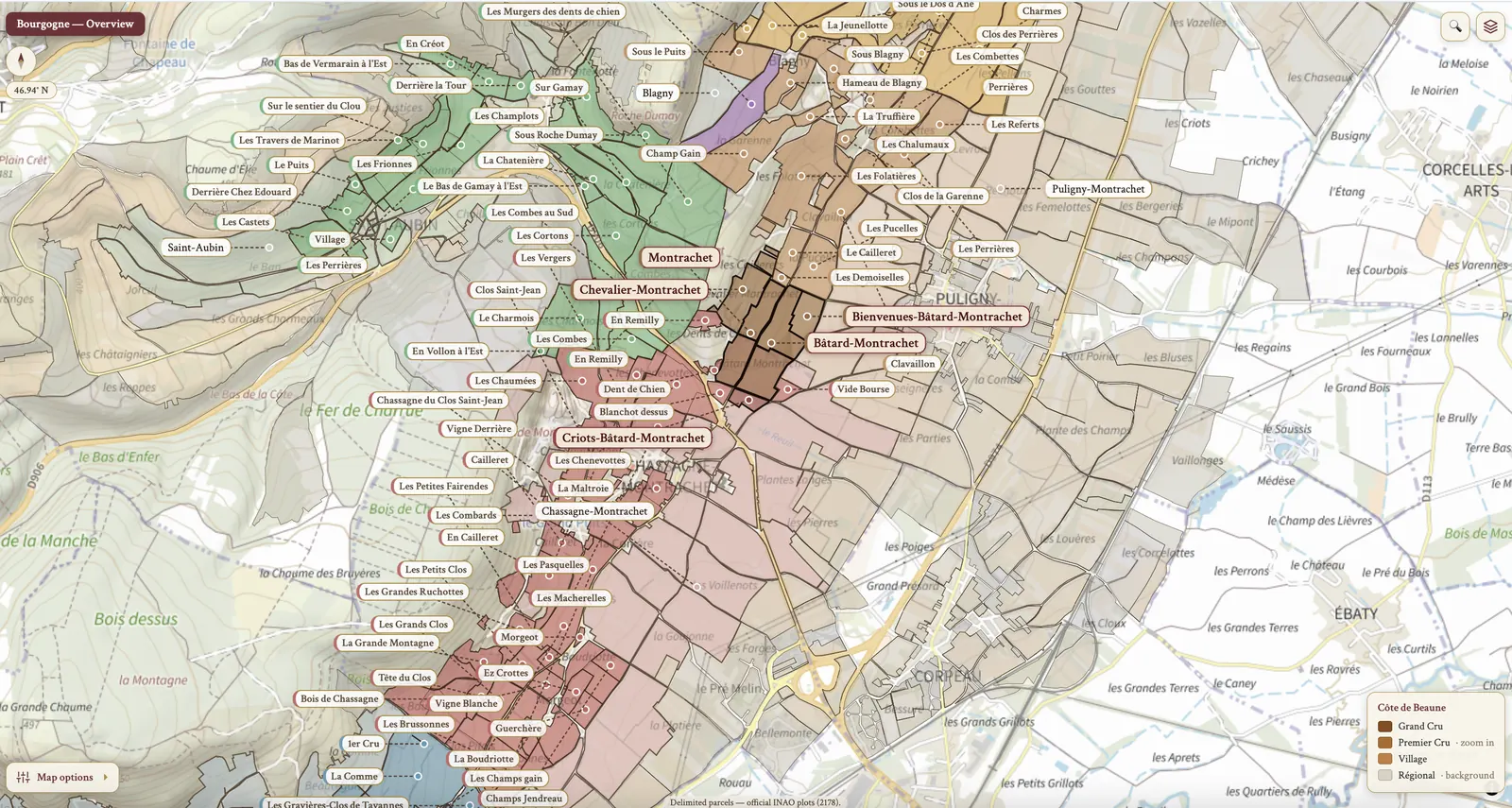
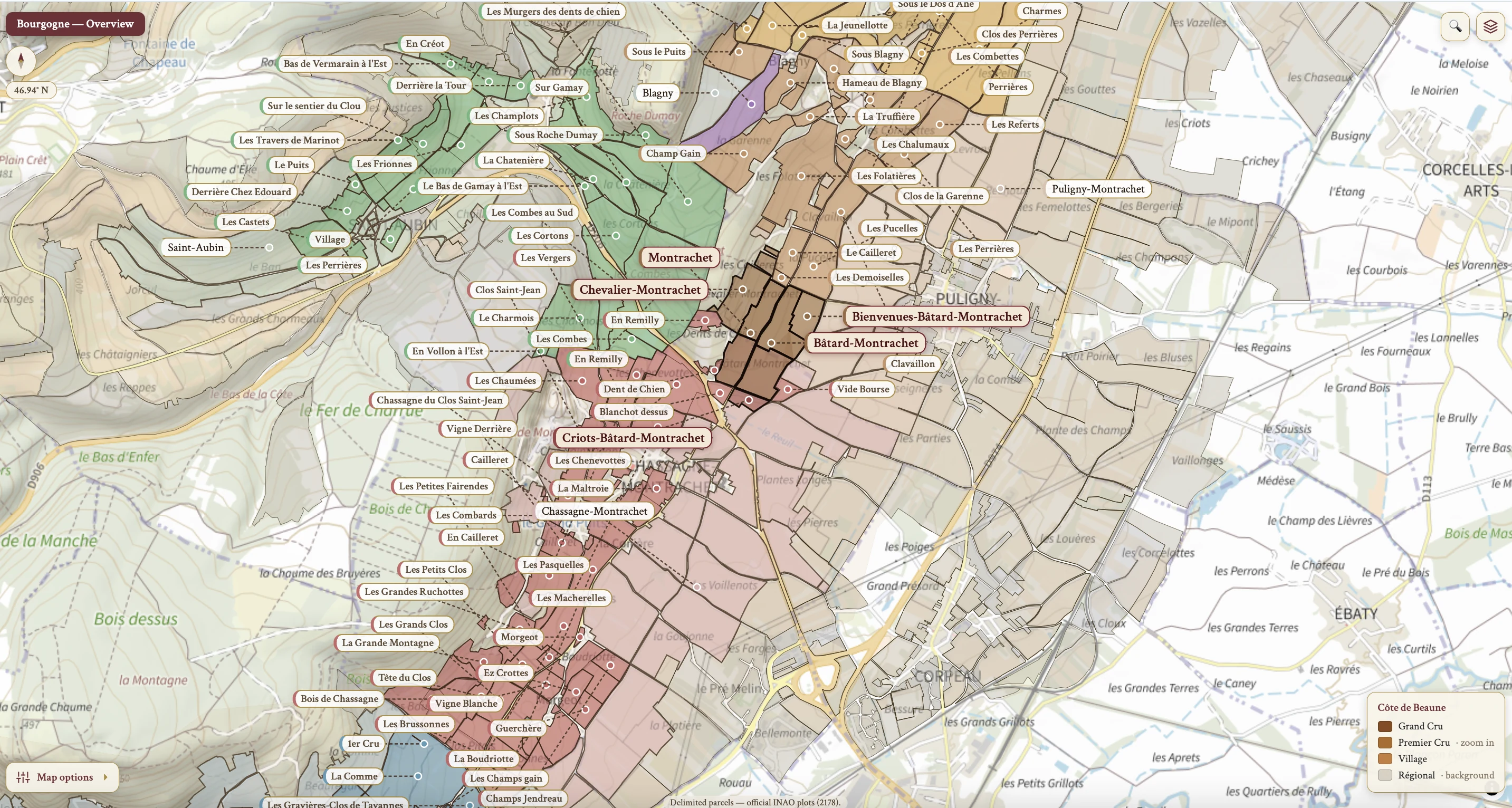
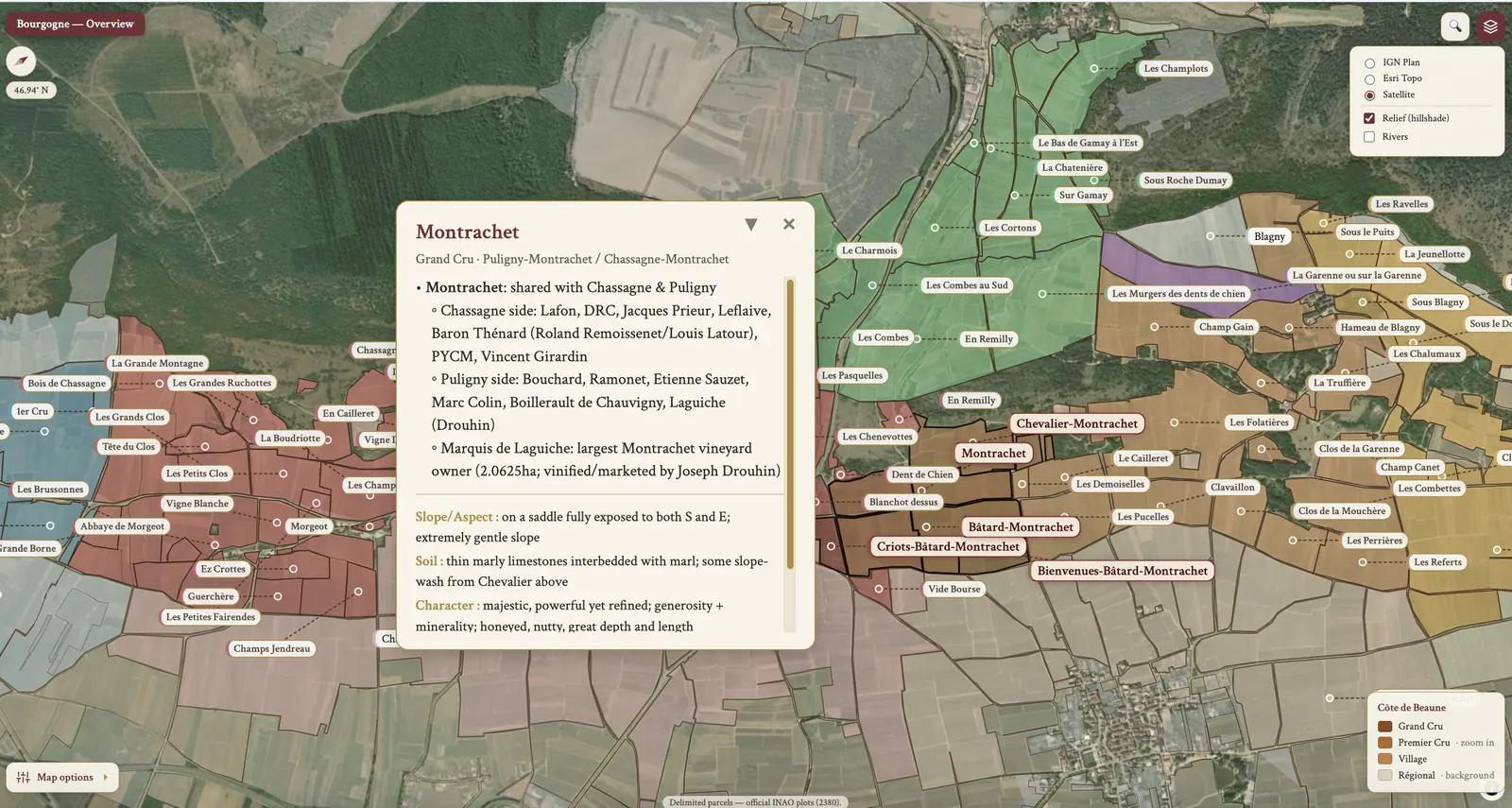
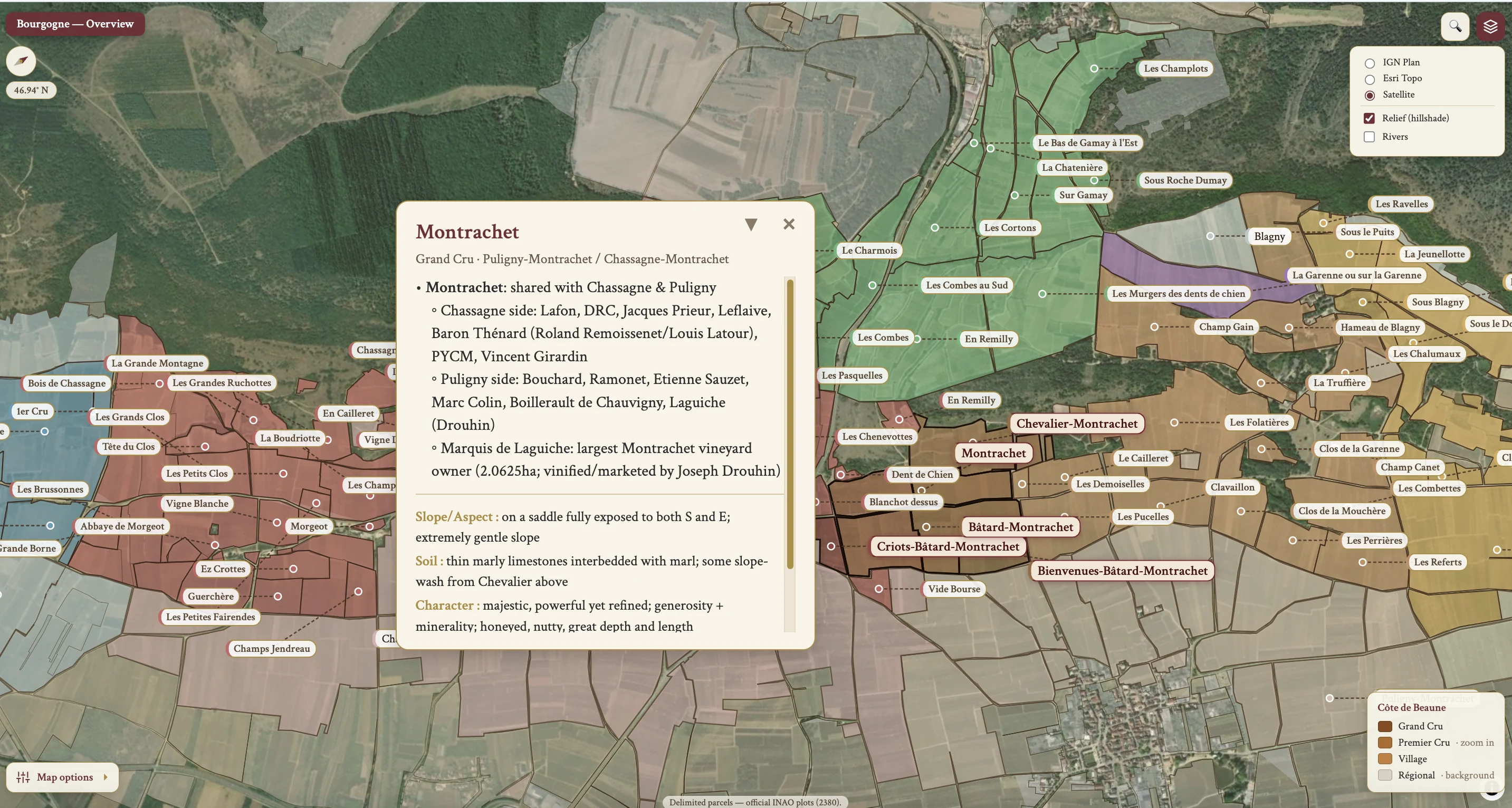
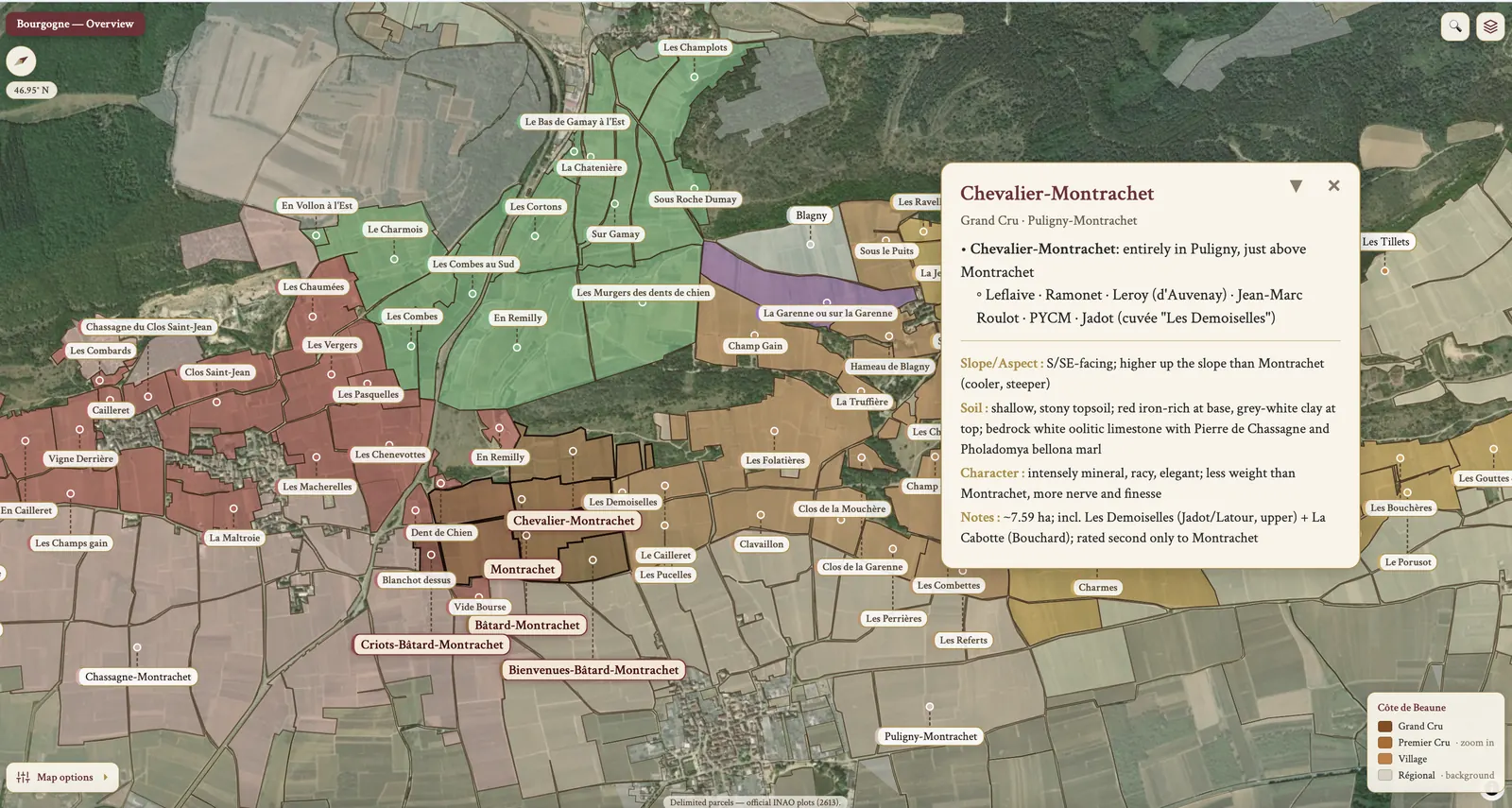
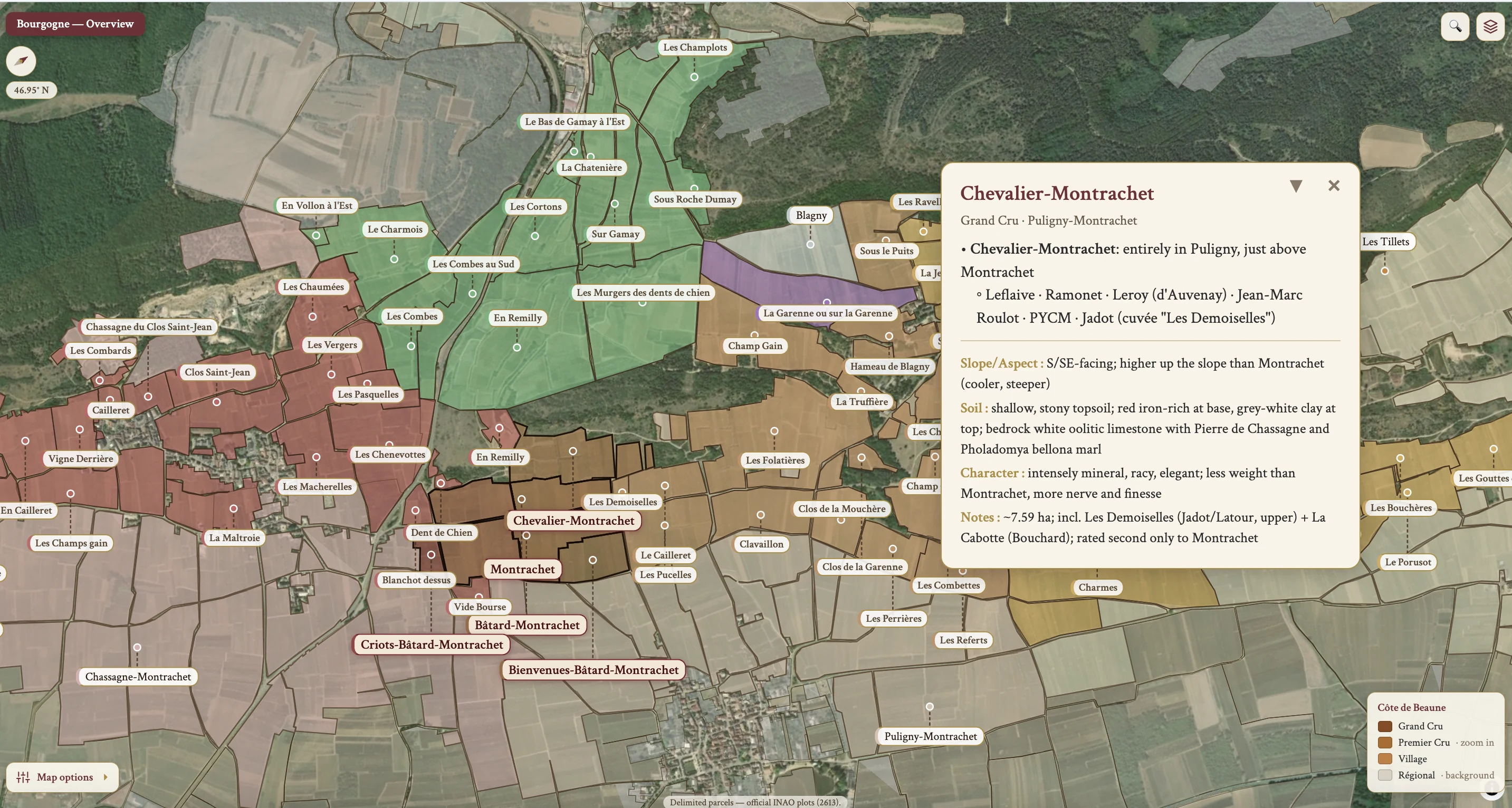
Chassagne-Montrachet received its AOC in 1937. It has 55 premiers crus and 3 grands crus, 2 of them shared with Puligny-Montrachet. Production runs about 2/3 white and 1/3 red; the reds were historically important and were compared to Nuits-Saint-Georges, but Chardonnay expansion in the 20th century shifted the emphasis to white. In style the village sits closer to Meursault than to Puligny. The largest premier cru is Morgeot at 54.23 ha, which encompasses 15 smaller premiers crus including La Boudriotte, Clos Chareau and Clos Pitois.
The grands crus
| Climat | Size | Notes | Producers |
|---|---|---|---|
| Criots-Bâtard-Montrachet | 1.75 ha | entirely in Chassagne; smallest white Grand Cru in the Côte de Beaune | Fontaine-Gagnard · d'Auvenay · Hubert Lamy · Caroline Morey · PYCM · Lucien Le Moine |
| Bâtard-Montrachet | shared | ||
| Montrachet | shared |
Criots-Bâtard-MontrachetGrand Cru
Criots-Bâtard-Montrachet is a grand cru of Chassagne-Montrachet, on a south-facing slope — the southern extension of Bâtard on the Chassagne side. The ground is stonier with less clay than Bâtard. The wine is more elegant, lighter, less rich and shorter-lived than Bâtard, and delicate. It is rarely seen, often less than 1 barrel per grower.
The premiers crus
Abbaye de MorgeotPremier Cru
Abbaye de Morgeot is a premier cru of Chassagne-Montrachet. It is not itself a distinct premier cru: parts of Morgeot, 3.98 hectares, and La Chapelle, 4.57 hectares, may be labelled Abbaye de Morgeot, a name used by Jadot, Olivier Leflaive and Vincent Girardin. Growers here include Pierre-Yves Colin-Morey, Domaine Berthelemot and Domaine Jadot.
Blanchot DessusPremier Cru
Blanchot Dessus is a premier cru of Chassagne-Montrachet. It is flat, most south-facing at the north-east corner, on oolitic limestone marble slabs, heavier at the south-west corner. At its best it approaches Criots-Bâtard-Montrachet quality. It is tucked at the foot of Le Montrachet, and its north-east corner touches Le Montrachet and Criots-Bâtard; Blanchot Dessous, 1.86 hectares, is village Chassagne. Growers here include Darviot-Perrin, Jean-Noël Gagnard and Bruno Colin.
Bois de ChassagnePremier Cru
Bois de Chassagne is a premier cru of Chassagne-Montrachet, an umbrella that Embrazées and Baudines may use but rarely do. It is virtually never bottled under its own name; some plots are unplanted scrub, others are declared as Grande Montagne.
CailleretPremier Cru
Cailleret is a premier cru of Chassagne-Montrachet, high on the slope above the village. It is stony with little earth; the upper marl gives weight and the lower white calcareous ground gives elegance. The wine is mineral and complex, built to age, with grand cru-level refinement on a lighter, less weighty frame. Cailleret is the overall name covering the subdivisions En Cailleret, Chassagne, Les Combards and Vigne Derrière. It is now entirely white and one of the best expressions of Chassagne. Growers here include Jean-Noël Gagnard, Domaine Ramonet and Guy Amiot.
Les Caillerets, as a premier cru, encompasses 4 smaller terroirs: En Caillerets at 5.11 ha, Vigne Derrière at 3.76 ha including Clos du Caillerets, Chassagne at 1.14 ha, and Les Combards at 0.65 ha.
Champs JendreauPremier Cru
Champs Jendreau is a premier cru of Chassagne-Montrachet, very stony in the upper part with red-wine soil below. It is a subdivision of Morgeot forming its north-east corner, and it is not seen under its own name. It is the source of Bruno Colin's white Boudriotte. Growers here include Bruno Colin and Jean-Marc Blain.
Chassagne du Clos Saint-JeanPremier Cru
Chassagne du Clos Saint-Jean is a premier cru of Chassagne-Montrachet, on shallow, notably red soil. It is a 2.02 hectare subdivision of Clos Saint-Jean; Domaine Paul Pillot largely keeps it in Pinot Noir, and it may also be labelled village Chassagne. The grower is Paul Pillot.
Clos Saint-JeanPremier Cru
Clos Saint-Jean is a premier cru of Chassagne-Montrachet, on shallow, notably red soil. The reds are paler-hued, with tannins finer and smoother than Morgeot or Maltroie, and they are long-ageing. It comprises Clos Saint-Jean, Les Rebichets, Les Murées and Chassagne du Clos Saint-Jean, and its nickname is notre Volnay de Chassagne. It was a former holding of the Benedictine nuns of Saint-Jean-le-Grand, Autun, in 589. Growers here include Paul Pillot, Domaine Ramonet and Au Pied du Mont Chauve.
Clos Saint-Jean is among the village's best for red.
Dent de ChienPremier Cru
Dent de Chien is a premier cru of Chassagne-Montrachet, mostly naked rock with very little soil. The wine has extraordinary breadth and length. The site is mostly unplantable rock with just two vine corners, above Les Blanchots Dessus and above Le Montrachet; it was considered part of Montrachet before classification, and part was included in the grand cru delineation. Growers here include Coffinet-Duvernay, Château de la Maltroye and Morey-Coffinet.
En CailleretPremier Cru
En Cailleret is a premier cru of Chassagne-Montrachet, high on the slope above the village, stony with little earth. The wine is rich, complex, mineral and age-worthy. At 5.11 hectares it is the largest subdivision of the Cailleret climat, and some producers and authors do not distinguish it from Cailleret. Growers here include Jean-Noël Gagnard, Domaine Ramonet and Guy Amiot.
En RemillyPremier Cru
En Remilly is a premier cru of Chassagne-Montrachet, with very little topsoil over Bathonian limestone. Hot, dry years can mean a struggle. It links the Saint-Aubin premier cru En Remilly, of the same name, with Chevalier-Montrachet. Growers here include Bruno Colin, Morey-Coffinet and Bouard-Bonnefoy.
Ez CrottesPremier Cru
Ez Crottes is a premier cru of Chassagne-Montrachet, a 2.36 hectare subdivision of Morgeot and a source of Domaine Marc Morey's red Morgeot. It is rarely bottled under its own name. The grower is Marc Morey.
GuerchèrePremier Cru
Guerchère is a premier cru of Chassagne-Montrachet, a 2.18 hectare subdivision of Morgeot and a source of Domaine Marc Morey's red Morgeot. It is rarely seen under its own name. The grower is Marc Morey.
La BoudriottePremier Cru
La Boudriotte is a premier cru of Chassagne-Montrachet, on red soil, especially lower down. The whites are floral and fresh; the reds concentrated with fine bone structure, less rustic than other red Chassagnes. It may be sold as Morgeot, and the actual Boudriotte plot is only 2.23 hectares. Ramonet's Clos de la Boudriotte recalls the Côte de Nuits. Growers here include Domaine Ramonet, Blain-Gagnard and Fontaine-Gagnard.
La Grande BornePremier Cru
La Grande Borne is a premier cru of Chassagne-Montrachet, low by the Santenay road on the village border. It is a subdivision of Morgeot, and Vincent Dancer's plot was replanted at double density, 20,000 vines per hectare, in 2012. The grower is Vincent Dancer.
La Grande MontagnePremier Cru
La Grande Montagne is a premier cru of Chassagne-Montrachet, a steep, bare hillside of bare rock with almost no topsoil. It is mostly too rocky for viticulture; one part is called Tonton Marcel. It subsumes subdivisions such as La Romanée, Les Grandes Ruchottes and En Virondot, usually sold under their own names. Growers here include Paul Pillot, Fontaine-Gagnard and Lamy-Caillat.
La MaltroiePremier Cru
La Maltroie is a premier cru of Chassagne-Montrachet, on an Argovian marlstone subsoil. It is about 50:50 red and white, the marlstone leaning toward Pinot. The lieu-dit is a walled 4 hectare vineyard split into the Clos de la Maltroie in the south and the Château's monopole Clos du Château de la Maltroye in the north, spelled with a 'y'. The sections Chassagne, Les Places and Ez Crets also sell as Maltroie. Growers here include Château de la Maltroye, Fontaine Gagnard and Heitz-Lochardet.
Les BrussonnesPremier Cru
Les Brussonnes is a premier cru of Chassagne-Montrachet, rarely declared under its own name. It is an umbrella designation of about 15.76 hectares against 2.88 hectares for the plot itself, covering Clos Pitois, Francemont, La Grande Borne, La Cardeuse, Clos Chareau and Les Boirettes — each sellable as Brussonnes or Morgeot.
Les Champs GainPremier Cru
Les Champs Gain is a premier cru of Chassagne-Montrachet, mid-slope at the centre of the appellation. The soil is relatively rich, and the site is warm and well-protected. The wine is opulent and exotic, for early drinking. The name may mean fields reclaimed from scrubland, or a field so fine a second hay crop could be harvested. It was noted for reds in the 19th century and is now white territory. Growers here include Sylvain Morey, Marc Colin and Michel Niellon.
Les ChauméesPremier Cru
Les Chaumées is a premier cru of Chassagne-Montrachet, at the north end of the village on a marked slope, on light, stony ground. The white is vibrant and relatively complex. There is possible confusion with Les Chaumes, a separate climat. Its sub-parts are Clos de la Truffière, worked by Michel Niellon and Jouard, and Clos Saint-Abdon; it sits at the north end toward Saint-Aubin. Growers here include Philippe Colin, Jean-Noël Gagnard and Michel Niellon.
Les ChenevottesPremier Cru
Les Chenevottes is a premier cru of Chassagne-Montrachet, relatively flat and cool, with very little topsoil. The white is fine and supple. The name comes from chanvre, hemp. It borders the former RN6 and includes the lieux-dits Les Commes and Les Bondues, which have heavier soil and some Pinot. Growers here include Domaine Chanson, Marc Morey and Philippe Colin.
Les CombardsPremier Cru
Les Combards is a premier cru of Chassagne-Montrachet, at the top of the Caillerets vineyard, stony with little earth. It is a tiny part, 0.65 hectares, the highest of the Caillerets, always sold under its own name, and it makes up 25% of Jean-Noël Gagnard's Caillerets. Growers here include Jean-Noël Gagnard, Au Pied de Mont Chauve and Coffinet-Duvernay.
Les Grandes RuchottesPremier Cru
Les Grandes Ruchottes is a premier cru of Chassagne-Montrachet, on the upper slope at 260 to 280 metres, on marly limestone rock with small stones. It is one of Chassagne's finest whites. Ruchottes comes from small stones or beehives. It lies within La Grande Montagne yet is sold under its own name; the Ramonet label reads plain Ruchottes. Growers here include Domaine Ramonet, F&L Pillot and Bernard Moreau.
Les Grands ClosPremier Cru
Les Grands Clos is a premier cru of Chassagne-Montrachet, Morgeot's upper section above the Route des Grands Crus. It works in red or white. Only Domaine Coffinet-Duvernay currently bottles it. Dr Lavalle recorded much Pinot Beurot, Pinot Gris, here in the 19th century. The grower is Coffinet-Duvernay.
Les MacherellesPremier Cru
Les Macherelles is a premier cru of Chassagne-Montrachet, on the north side of the village on flatter terrain, on reddish, iron-rich clay. The white is subtle but can lack power. It is middle-ranking. The name may relate to market gardening, mâche, or be a nickname for Chassagne people. It lies near Les Vergers and Les Chenevottes. Growers here include François Carillon, Jean-Claude Bachelet and Guy Amiot.
Les PasquellesPremier Cru
Les Pasquelles is a premier cru of Chassagne-Montrachet, the more north-east-facing part of Les Vergers. It is a 2.45 hectare subdivision of Les Vergers, and Philippe Bouzereau of Château de Cîteaux bottles his holding under this name. The grower is Château de Cîteaux, Philippe Bouzereau.
Les Petites FairendesPremier Cru
Les Petites Fairendes is a premier cru of Chassagne-Montrachet, along the Route des Grands Crus, sticking into Les Petits Clos. The soil is red below and whitish clay higher up. It is a 0.82 hectare extension of Les Fairendes, and its owners fold it into their Morgeot rather than use the name. Growers here include Bernard Moreau and Château de la Maltroye.
Les Petits ClosPremier Cru
Les Petits Clos is a premier cru of Chassagne-Montrachet, on ground lighter than the heavy Morgeot soils. It is prime white-wine terroir, a sub-sector of Morgeot increasingly labelled under its own name, and among the best white sectors after Tête du Clos. Growers here include Bachey-Legros, Jean-Noël Gagnard and Bouard-Bonnefoy.
Les VergersPremier Cru
Les Vergers is a premier cru of Chassagne-Montrachet, mid-slope and east-facing where the hill turns toward Saint-Aubin. The rock is close to the surface, and the ground is lighter than Les Macherelles. The wine is lean in youth, gaining flesh with age. It is a good white source and includes the subdivisions Petingeret and Les Pasquelles and the Clos Saint-Marc enclosure, held by Olivier Leflaive Frères and Jean-Marc Pillot. Growers here include Marc Morey, F&L Pillot and Fontaine-Gagnard.
MorgeotPremier Cru
Morgeot is a premier cru of Chassagne-Montrachet. The soil is heavy, much of it better suited to Pinot. The whites are weighty, powerful and age-worthy; the reds rich, sturdy and tannic, a vin de garde. The top whites come from Tête du Clos. It is a very large climat with many subdivisions — Boudriotte, Fairendes, La Grande Borne, Vigne Blanche, Ez Crottes, Guerchère, Tête du Clos, Les Petits and Grands Clos among them. Growers here include Marquis de Laguiche of Drouhin, Domaine Bachey-Legros and Domaine Ramonet.
Morgeot is among the village's best for red.
Tête du ClosPremier Cru
Tête du Clos is a premier cru of Chassagne-Montrachet, higher on the slope than the bulk of Morgeot, on white marl full of small stones. It is mineral, the finest white sector of Morgeot. It is quite distinct though saleable under the Morgeot name. The Vincent Dancer parcel, vines from 1954, echoes his Chevalier-Montrachet at the same altitude. Growers here include Vincent Dancer and Heitz-Lochardet.
Vide BoursePremier Cru
Vide Bourse is a premier cru of Chassagne-Montrachet, the down-slope continuation of Bâtard-Montrachet. The soil is relatively heavy but stony and well-drained. The wine is full-bodied and racy, a petit Bâtard. The climat is shaped like an arrow-head dipping into village vineyards, and the name evokes highwaymen who would empty your purse. It drinks earlier than the grands crus. Growers here include G&P Jouard, F&L Pillot and Marc Colin.
Vigne BlanchePremier Cru
Vigne Blanche is a premier cru of Chassagne-Montrachet and one of Morgeot's best white sectors. Château de la Maltroye's Morgeot comes from here, and the Marquis de Laguiche owns the rest, marketed as Morgeot by Joseph Drouhin under the Laguiche name. Growers here include Château de la Maltroye and Marquis de Laguiche.
Vigne DerrièrePremier Cru
Vigne Derrière is a premier cru of Chassagne-Montrachet, high on the slope above the village, stony with little earth. It is a 3.76 hectare subdivision of Cailleret, and its north-east quadrant is Ramonet's monopole Clos du Cailleret, formerly Vincent Girardin, with walls built in 2003. Growers here include Domaine Ramonet and Jean-Noël Gagnard.
Key producers
Key producers in Chassagne-Montrachet are Ramonet and Pierre-Yves Colin-Morey.