Gevrey-Chambertin
Gevrey-Chambertin, climat by climat. Site, soil, character and growers for all 34 crus, with the appellation map alongside.
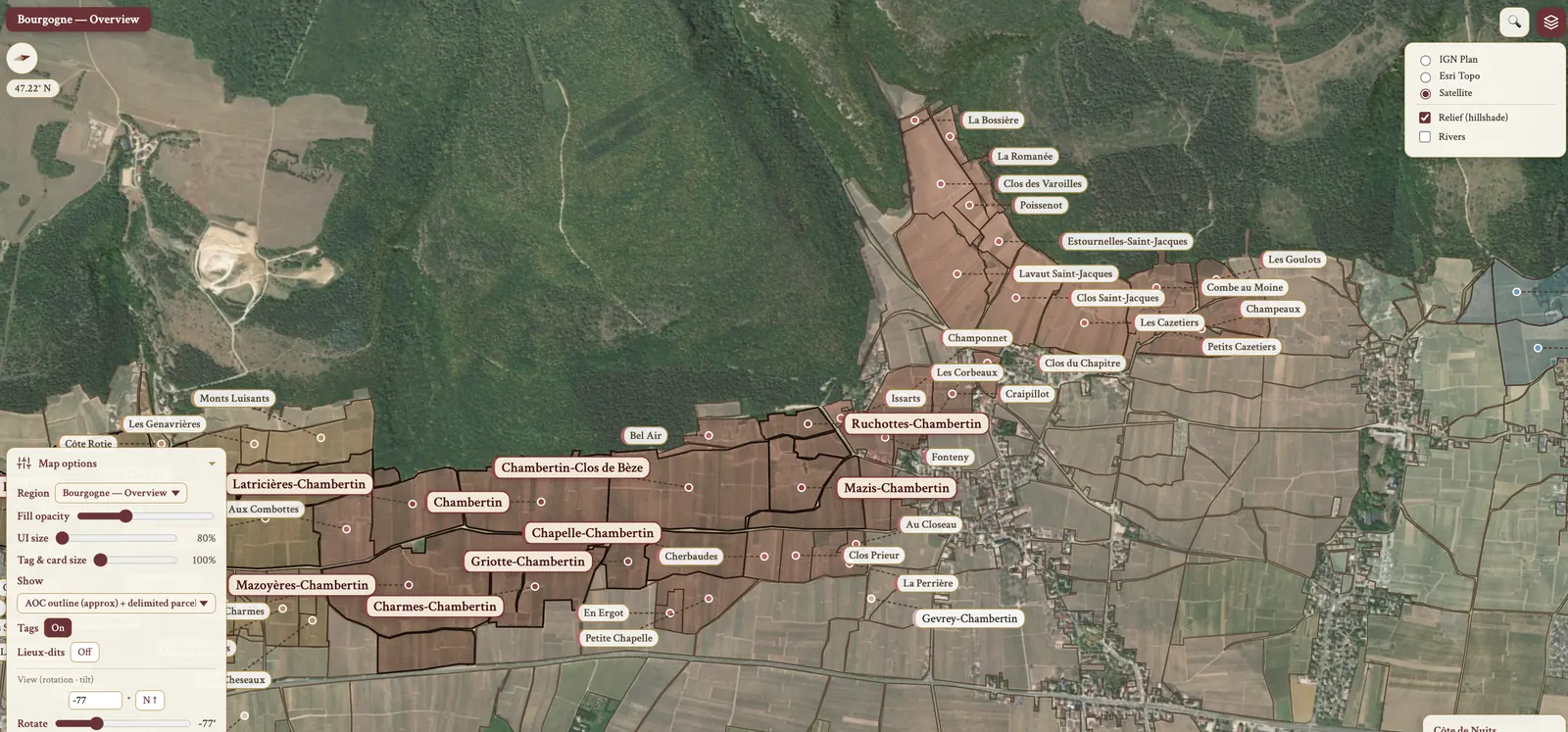
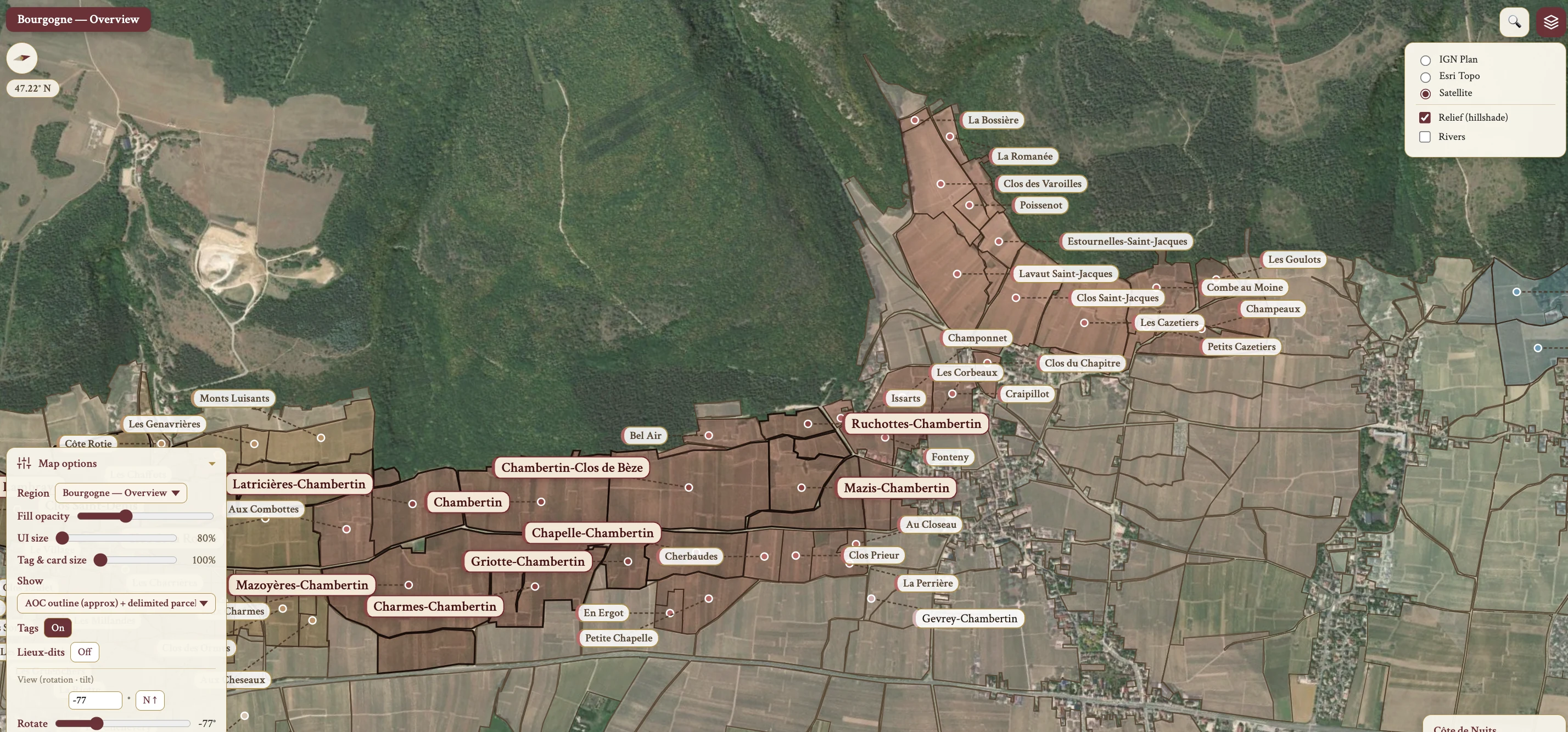
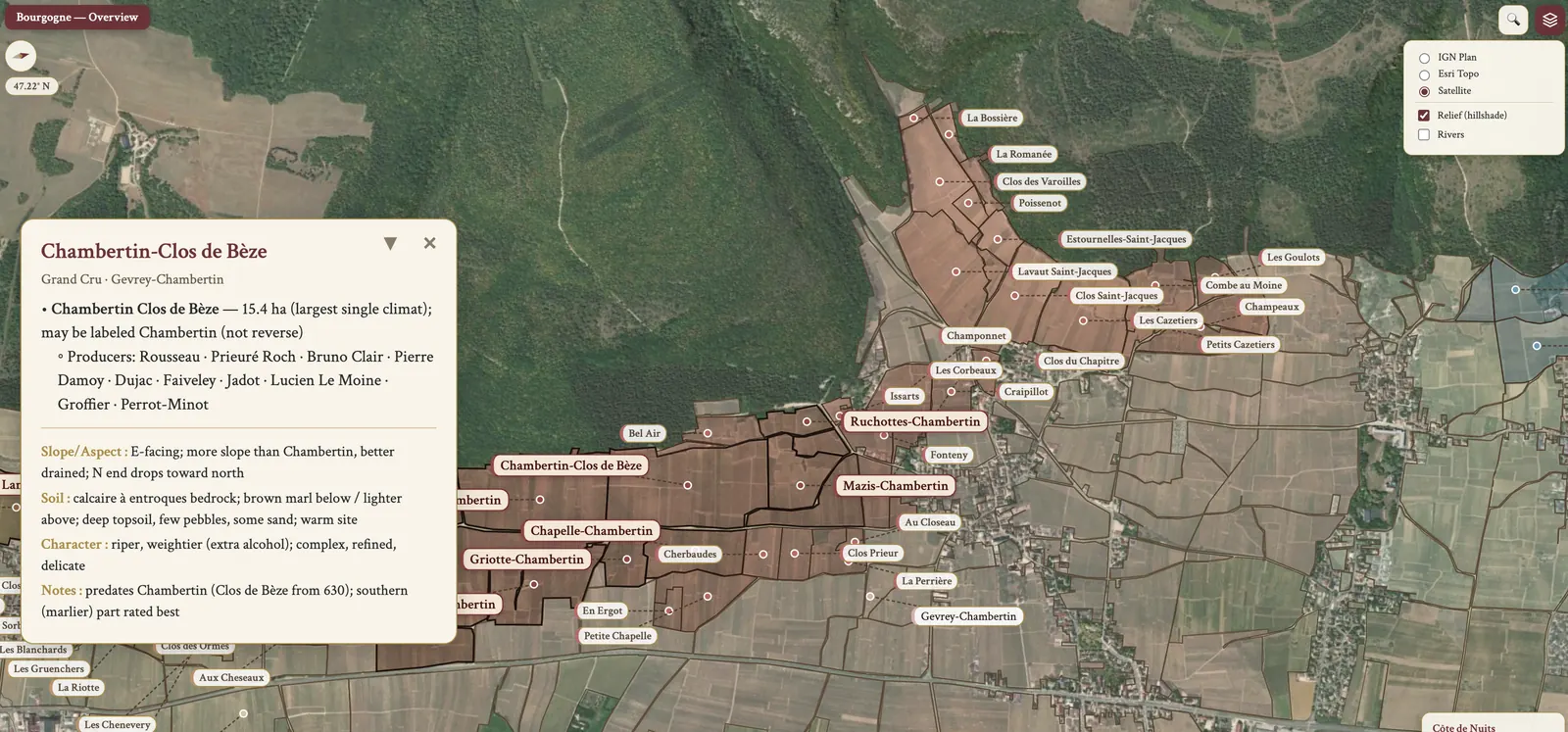
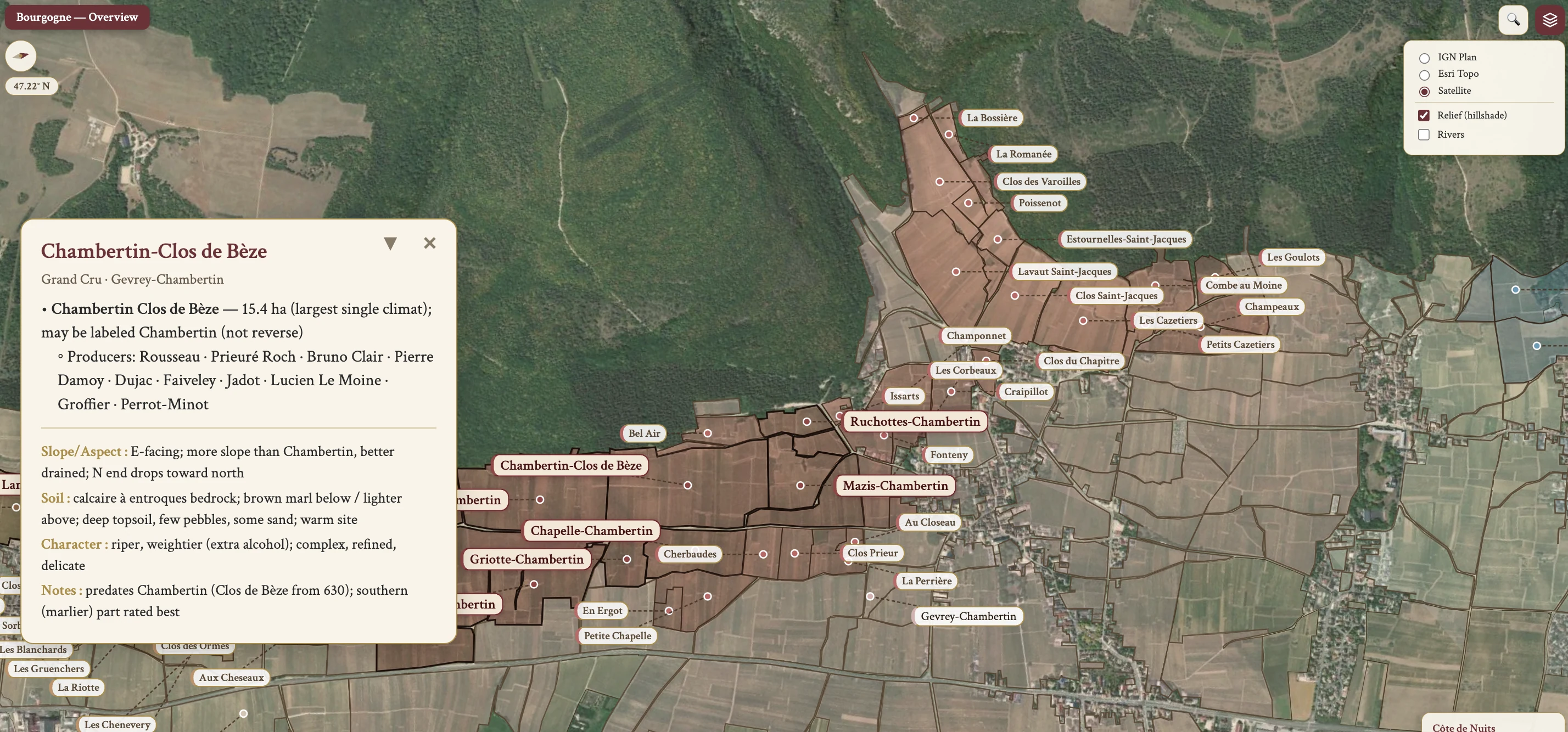
Gevrey-Chambertin received its AOC in 1936 and makes red wine only, across 26 premiers crus and 9 grands crus. It is the largest village appellation in the Côte d'Or and has more grands crus than any other, with 20% of its vineyards classified as premier cru. The wines tend to be fuller-bodied. Chambertin is reputed to have been Napoléon's favorite wine, and Gevrey petitioned to add the vineyard name in 1847, becoming Gevrey-Chambertin.
The grands crus
| Climat | Size | Notes | Producers |
|---|---|---|---|
| Mazis-Chambertin | 9.1 ha | ||
| Ruchottes-Chambertin | 3.3 ha | Armand Rousseau monopole “Clos des Ruchottes” | Rousseau (monopole Clos des Ruchottes) · Mugneret · Esmonin · Roumier · Pacalet |
| Chambertin Clos de Bèze | 15.4 ha | largest single climat; may be labeled Chambertin (not reverse) | Rousseau · Prieuré Roch · Bruno Clair · Pierre Damoy · Dujac · Faiveley · Jadot · Lucien Le Moine · Groffier · Perrot-Minot |
| Chapelle-Chambertin | 5.5 ha | ||
| Griotte-Chambertin | 2.7 ha | smallest | |
| Chambertin | 12.9 ha | Napoléon's favorite wine | Rousseau · Trapet · Leroy · Dujac · Dugat-Py · Denis Mortet · Bertagna · Ponsot · Fourrier · Olivier Bernstein |
| Charmes-Chambertin | 30.8 ha | incl. Mazoyères (largest); may be labeled by the Mazoyères portion | Rousseau · Dugat-Py · Perrot-Minot · Dujac · Ponsot · Faiveley · Pacalet · Magnien · Jadot · Taupenot-Merme · Fourrier |
| Latricières-Chambertin | 7.4 ha | coldest Grand Cru (Combe Grisard cool air) | |
| Mazoyères-Chambertin | ~18.6 ha | almost all sold as Charmes (only ~1.7 ha typically declared as Mazoyères); may be labeled Charmes (not reverse) |
ChambertinGrand Cru
Chambertin is a grand cru of Gevrey-Chambertin. It is east-facing, and a small band at the top runs north–south, shaded by the forest above. The bedrock is calcaire à entroques of the Bajocian, with whiter marl on the upper slopes and small stones in the topsoil. The wine is powerful, structured and majestic yet capable of grace, and it is long-ageing. With Clos de Bèze it forms the 28.3 hectares core of Gevrey. The top holdings are shaded and cooler. The wine may be sold as Chambertin from Clos de Bèze, not the reverse.
Chambertin-Clos de BèzeGrand Cru
Chambertin-Clos de Bèze is a grand cru of Gevrey-Chambertin. It is east-facing, with more slope than Chambertin and better drainage, and its north end drops toward the north. The bedrock is calcaire à entroques, with brown marl below and lighter marl above; the topsoil is deep, with few pebbles and some sand, and the site is warm. The wine is riper and weightier, with extra alcohol, and it is complex, refined and delicate. Clos de Bèze predates Chambertin, dating from 630, and the southern, marlier part is rated best.
Chapelle-ChambertinGrand Cru
Chapelle-Chambertin is a grand cru of Gevrey-Chambertin. It is east-facing and lies below Clos de Bèze. The topsoil is sparse and thin, which makes the site drought-sensitive and better in cool or wet years — the opposite of Latricières. The wine is elegant, perfumed and finesse-led. The cru includes the 1.79 hectares of Les Gémeaux, and it is named after the chapel of Nôtre-Dame de Bèze; the Gémeaux part is more drought-resistant. Growers here include Pierre Damoy, Trapet, Rossignol-Trapet, Drouhin-Laroze and Ponsot.
Charmes-ChambertinGrand Cru
Charmes-Chambertin is a grand cru of Gevrey-Chambertin. It is east-facing, its heart lying at Chambertin's contour and dropping to the south and sharply to the north. The topsoil is red and iron-rich with limestone pebbles over a chalky mother-rock, and the Mazoyères part is lighter, deeper and has fewer pebbles. The wine shows plump red fruit and is concentrated and powerful, but less complex. The cru covers 12.24 hectares of Charmes proper plus 18.59 hectares of Mazoyères, usually labelled Charmes; it is heterogeneous, and it is often rated least of the Gevrey grand crus.
Griotte-ChambertinGrand Cru
Griotte-Chambertin is a grand cru of Gevrey-Chambertin. It is east-facing, a low-lying amphitheatre with two wings around a flatter centre. The Bajocian rock is fissured and less compact, so roots penetrate the blocks, and the topsoil is notoriously shallow and drought-prone. The wine is light-bodied and exquisitely perfumed, with floral peony and red cherry. It lies between Charmes and Chapelle, and production is about 1,000 cases. Growers here include Ponsot, Leclerc, Joseph Drouhin, Fourrier and Claude Dugat.
Latricières-ChambertinGrand Cru
Latricières-Chambertin is a grand cru of Gevrey-Chambertin. It is east-facing and cooled by breezes from the Combe Grisard, and it is the southern continuation of Chambertin. The topsoil is deep and dark, deeper than most Gevrey grand crus, over hard silica-rich Jurassic limestone bedrock; an alluvial cone from the Combe Grisard runs through it, and the site is damp-prone. The wine is airy and ethereal, with rich pure fruit and less tannin, and it develops earth, truffle and humus. It adjoins Morey-Saint-Denis, with only the premier cru Les Combottes between, and it needs warmer vintages. Growers here include Hubert Camus, Faiveley, Trapet, Rossignol-Trapet and Drouhin-Laroze.
Mazis-ChambertinGrand Cru
Mazis-Chambertin is a grand cru of Gevrey-Chambertin. It is east-facing at the northern end of the grand cru group, closest to the village, and it divides into Mazis-Haut above and Mazis-Bas below. The soil is predominantly brown with few stones over a fissured-slab bedrock; Mazis-Haut has thin topsoil, like Ruchottes, while Mazis-Bas is deeper under the alluvial influence of the Combe de Lavaux. The wine is firm, powerful and structured, with wild aromatics of tannin, leather, menthol and liquorice, and it is long-ageing. Of the two parts, Mazis-Haut sits on Clos de Bèze rock and is superior. The name is also spelled Mazy. Growers here include Hospices de Beaune, Faiveley, Henri Rebourseau, Harmand-Geoffroy and Tawse.
Ruchottes-ChambertinGrand Cru
Ruchottes-Chambertin is a grand cru of Gevrey-Chambertin. It is east-facing with ideal exposure, and it has an upper part, Clos des Ruchottes, and a lower part. The soil is infertile, stony and thin, oolitic white marlstone above Bathonian éboulis, or scree. The wine is light in colour, subtle and nuanced rather than powerful or weighty. The upper part, Clos des Ruchottes, covers 1.10 hectares, and the name comes from rochots, little rocks.
The premiers crus
Au CloseauPremier Cru
Au Closeau is a premier cru of Gevrey-Chambertin, in the north-west corner of La Perrière. It is a tiny premier cru. The majority owner is Drouhin-Laroze, long the sole bottler, with a sliver going to Château de Santenay from 2019. Growers here include Drouhin-Laroze and Château de Santenay.
Aux CombottesPremier Cru
Aux Combottes is a premier cru of Gevrey-Chambertin. It lies in a dip compared with its grand cru neighbours, between Clos de la Roche to the south and the Gevrey grand crus to the north, and it keeps the evening sun longer than Latricières. Its top-left segment sits on decomposed grèzes litées with sandy topsoil, and the rest lies over calcaire à entroques. The wine can be exceptionally fine, especially from Dujac. It is often argued to merit grand cru, and it has been held at premier cru possibly for political reasons, its owners historically coming from Morey, and for lying in a dip; Georges Lignier sought promotion in 1983. Growers here include Dujac, Pierre Amiot and Leroy.
Bel AirPremier Cru
Bel Air is a premier cru of Gevrey-Chambertin, on a high, cool, steep slope. The soil is thin and mostly white marl, and the lower part sits atop Clos de Bèze. The wine has higher acidity than most, with a slight blackcurrant tint to the fruit. The vines were replanted in the 1960s after the forest was cleared; the upper 0.84 hectares is classified village and the lower part premier cru, and boar defences are needed against the forest above. Growers here include Domaine de la Vougeraie, Taupenot-Merme and Château de Marsannay.
ChampeauxPremier Cru
Champeaux is a premier cru of Gevrey-Chambertin, mid-slope at the north end of the Côte Saint-Jacques, with an easterly exposure turning slightly north. The soil is jumbled, a mix of red and brown earth with the mother-rock near the surface and purple veins. The wine is very fruity, with ripe cherry, and has less precision and nobility than the finest. The name means the fields, and the cru is broken into many small, often walled plots. Growers here include Domaine Olivier Guyot, Tortochot and Coudray-Bizot.
ChamponnetPremier Cru
Champonnet is a premier cru of Gevrey-Chambertin, with more slope than neighbouring Craipillot. The soil is less heavy, with clay in the lower part and more gravel at the top, up toward Ruchottes-Chambertin. The bunches are small and concentrated, and the wine is a sound mid-range Gevrey premier cru. The name is officially the singular Champonnet but is used in the plural, Les Champonnets. Growers here include Domaine du Couvent, Heresztyn-Mazzini and Louis Boillot.
CherbaudesPremier Cru
Cherbaudes is a premier cru of Gevrey-Chambertin, below Mazis-Chambertin and next to Chapelle-Chambertin. The soil is red with big plate-shaped stones broken from the bedrock. It is slightly the richest of the lower-slope Gevrey premiers crus, with some complexity. It is reputedly the site of an ancient cemetery. Growers here include Fourrier, Domaine des Beaumont and Lucien Boillot & Fils.
Clos PrieurPremier Cru
Clos Prieur is a premier cru of Gevrey-Chambertin, below Mazis-Chambertin in the alluvial fan of the Combe de Lavaux. The soil is heavy clay in the lower, village part, with more depth and class in the upper premier cru part. The wine is relatively easy and accessible. Only 1.98 hectares is classified premier cru, alongside 3.66 hectares of village, and the name comes from the Prior of Cluny. Growers here include Drouhin-Laroze, Rossignol-Trapet and Pierre Gelin.
Clos Saint-JacquesPremier Cru
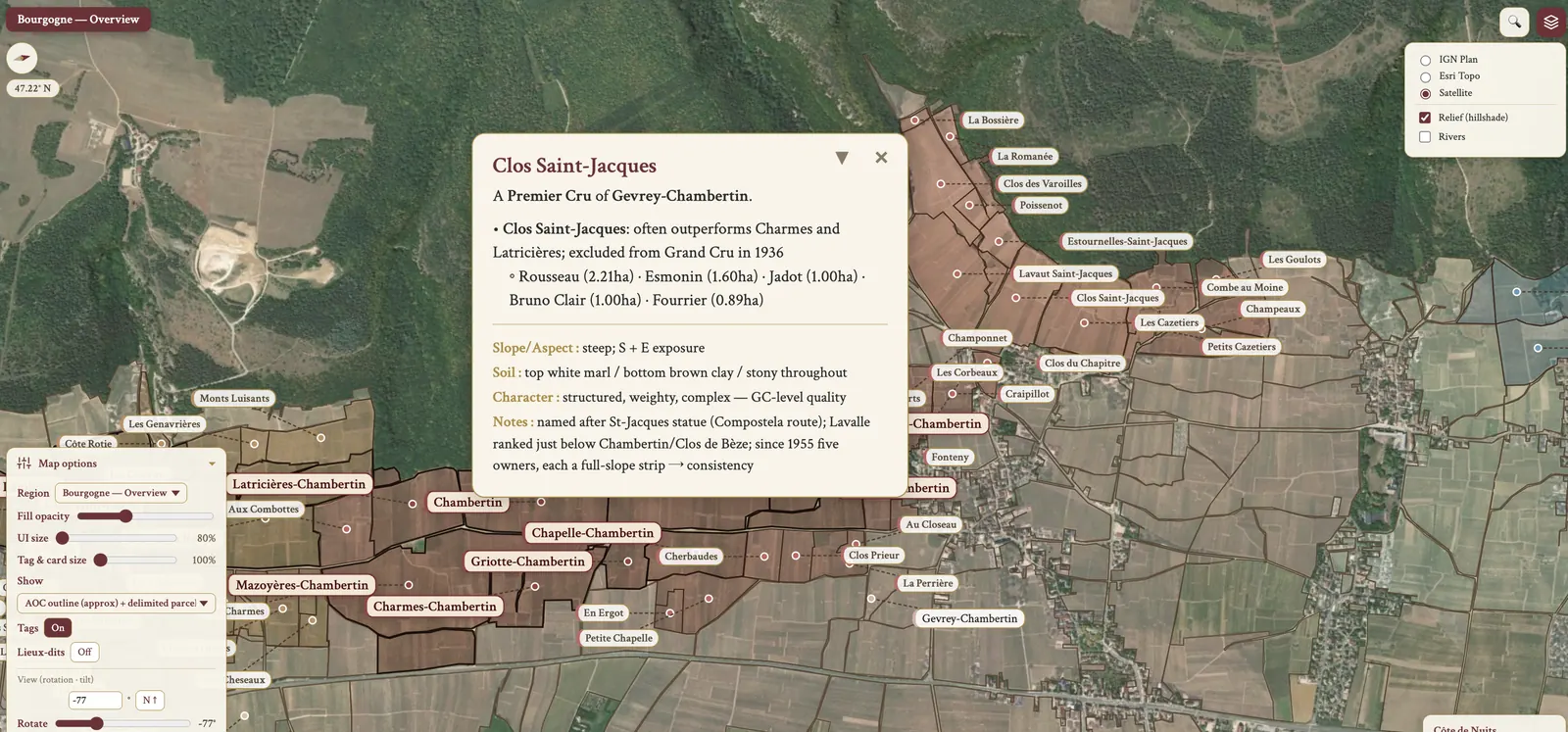
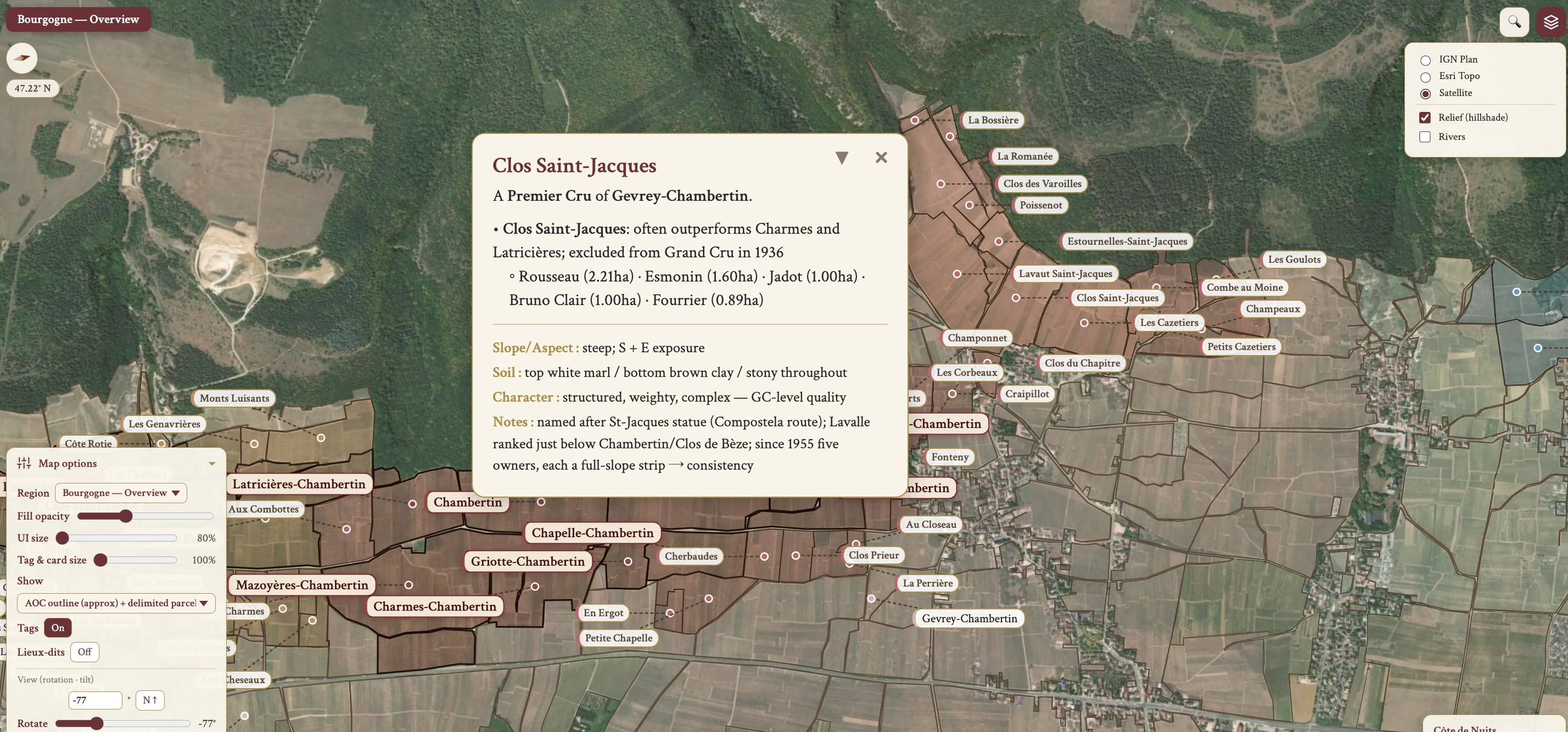
Clos Saint-Jacques is a premier cru of Gevrey-Chambertin. The slope is steep, with south and east exposure. There is white marl at the top and brown clay at the bottom, stony throughout. The wine is structured, weighty and complex, of grand cru-level quality. It is named after the Saint-Jacques statue on the Compostela route. Lavalle ranked it just below Chambertin and Clos de Bèze. Since 1955 it has had five owners, each holding a full-slope strip, which gives consistency.
Clos Saint-Jacques often outperforms Charmes and Latricières, and it was excluded from grand cru in 1936. Holdings are Rousseau with 2.21 ha, Esmonin with 1.60 ha, Jadot with 1.00 ha, Bruno Clair with 1.00 ha and Fourrier with 0.89 ha.
Clos des VaroillesPremier Cru
Clos des Varoilles is a premier cru of Gevrey-Chambertin, tucked into the entry of the Combe de Lavaux; it is enclosed and gets less warmth than exposed sites. The wine is firm and tannic, and needs time to evolve. The lieu-dit is Les Verroilles, of which 0.05 hectares lies in Estournelles, while the cru is Clos des Varoilles, a monopole. It was held as a clos by the Chapter of Langres from 1272 to 1329, and until the Revolution. The grower is Domaine des Varoilles, as a monopole.
Clos du ChapitrePremier Cru
Clos du Chapitre is a premier cru of Gevrey-Chambertin, below Clos Saint-Jacques and opposite Domaine Rousseau. The wine is attractive and for early drinking. It is a monopole of the Cave-Coopérative of the Hautes-Côtes, which absorbed the Gevrey coop in 1989; Chapître refers to the Chapter of Langres, the former owner of Clos de Bèze. The grower is Cave Nuiton-Beaunoy, as a monopole.
Combe au MoinePremier Cru
Combe au Moine is a premier cru of Gevrey-Chambertin, the continuation of the Côte Saint-Jacques slope past Cazetiers; the plain lies east, the slope is steep, and quarry walls form a warm amphitheatre. There is white marl at the top and redder, iron-rich soil lower down. The wine is powerful and ages well, with slightly rustic tannins and a gamey richness with age. It was reputedly planted by Benedictine monks in the 7th century, and it was held by the monks of Cluny until the French Revolution. Growers here include Faiveley, Fourrier and René Leclerc.
CraipillotPremier Cru
Craipillot is a premier cru of Gevrey-Chambertin, on relatively flat ground. The soil is influenced by downwash from the Combe de Lavaux, and is less heavy on the Champonnet side. It is rarely seen under its own name. Gérard Seguin has vines over 70 years old, some over a century. Growers here include Domaine Gérard Seguin, Drouhin-Laroze and Faiveley.
En ErgotPremier Cru
En Ergot is a premier cru of Gevrey-Chambertin, the continuation of Petite Chapelle to the south with a touch more slope. It is a constituent of Trapet's premier cru Capita bottling, and Laurent Ponsot has made a cuvée from 2019; it is rarely bottled solo. Growers here include Laurent Ponsot and Trapet.
Estournelles-Saint-JacquesPremier Cru
Estournelles-Saint-Jacques is a premier cru of Gevrey-Chambertin. It is south-facing and steep, high above Lavaux Saint-Jacques at the turn of the hillside into the Combe de Lavaux. The soil is white marl with many small stones and very little topsoil, possibly a white-wine soil. The wine has charm, perfume and delicacy, though it is not as deep or complex as the best of the Côte Saint-Jacques. It appears as Etournelles on the cadastral map and Estournelles on labels, and the name comes perhaps from prehistoric round huts. Growers here include Jadot, Henri Magnien and Duroché.
FontenyPremier Cru
Fonteny is a premier cru of Gevrey-Chambertin, with gradations from the higher plateau at the south end down to flat land at the north. The rock is calcaire à entroques in veritable slabs, broken up before planting. The wine is powerful and full of fruit yet elegant, and among the most interesting Gevrey premiers crus. The name comes from fountain, a spring since dried up. The upper plateau, worked by Dugat-Py, Haisma and Bruno Clair with his Clos de Fonteny, contrasts with the lower section. Growers here include Henri Rebourseau, Bruno Clair and Joseph Roty.
IssartsPremier Cru
Issarts is a premier cru of Gevrey-Chambertin, its vines planted north–south, which makes for slower ripening. The topsoil is relatively white with oolitic limestone, shared with Ruchottes-Chambertin. The wine is perfumed and fine-boned. The lieu-dit is also called La Plantigone, and the vineyard is Clos des Issarts, held by Faiveley since 2003. The grower is Faiveley.
La BossièrePremier Cru
La Bossière is a premier cru of Gevrey-Chambertin. It is late-ripening, with cool airflow, shaded by the surrounding forest. There is more soil at the east end and stonier ground at the west. Only the eastern rows abutting Les Véroilles are premier cru, 0.45 hectares; the rest of La Bossière, 1.44 hectares, is village. It is picked about a week after the rest of the harvest. The grower is Domaine Harmand-Geoffroy, as a monopole.
La PerrièrePremier Cru
La Perrière is a premier cru of Gevrey-Chambertin. The ground is stony, a former shallow quarry filled with earth and planted. The singular La Perrière comes from that single old quarry. Little is owned by any one grower, and there are many négociant cuvées; it forms part of Claude Dugat's Gevrey premier cru blend. Growers here include Arnaud Mortet, Heresztyn-Mazzini and Harmand-Geoffroy.
La RomanéePremier Cru
La Romanée is a premier cru of Gevrey-Chambertin. It is south-facing with partial forest shade, a narrow top-of-slope band above Clos de Varoilles. The ground is stony and drains well despite a water-course beneath. Its potential is similar to Le Poissenot. A further 0.23 hectares in the valley carries village classification. It was formerly a monopole of Domaine des Varoilles and is now held by Domaine du Couvent. The grower is Domaine du Couvent, as a monopole.
Lavaut Saint-JacquesPremier Cru
Lavaut Saint-Jacques is a premier cru of Gevrey-Chambertin, on a gentle south-facing slope; it is a cooler site toward the Combe de Lavaux, in a cool-air stream, and partly shaded by the opposite flank. The wine is fine-boned, precise and elegant, more red-fruited than dense, and it was strong in the hot 2018 and 2019 vintages. It is priced below Clos Saint-Jacques but above all other Gevrey premiers crus. The spellings Lavaux and Lavaut are both used. Growers here include Duroché, Denis Mortet and Faiveley.
Lavaux-Saint-Jacques, also known as Combe Lavaux, covers 9.53 ha and is the largest premier cru. Growers include Rousseau, Claude Dugat, Dugat-Py, Arnaud Mortet, Denis Mortet, Dupont-Tisserandot and Jadot.
Les CazetiersPremier Cru
Les Cazetiers is a premier cru of Gevrey-Chambertin, on a steep slope running from 360 down to 300 metres, due east. The small stones give drainage and heat reflection; the topsoil is pale in the upper part and reddish-brown lower down, over ostrea acuminata white marl, calcaire à entroques, Premeaux limestone under clay, and sandy marl at the base. The wine is fine, elegant and complex, rarely deep in colour, with refinement and precision. It is the most interesting Côte Saint-Jacques cru after Clos Saint-Jacques, with a higher pH and faster maturing than adjacent Clos Saint-Jacques, from the same 1957–8 Bruno Clair planting.
In Les Cazetiers the growers are Faiveley, Rousseau, Bruno Clair, Serafin, Philippe Leclerc, Lucien Le Moine, Olivier Bernstein and Jadot.
Les CorbeauxPremier Cru
Les Corbeaux is a premier cru of Gevrey-Chambertin, below the grand cru Mazis-Chambertin, between it and the village. The wine is fine and attractive, with less depth than Mazis or Fonteny. The name means the crows, and the site is a former medieval cemetery. Growers here include Sérafin, Lucien Boillot & Fils and Denis Bachelet.
Les GoulotsPremier Cru
Les Goulots is a premier cru of Gevrey-Chambertin, the last Gevrey premier cru before Brochon; it extends north from Combe aux Moines on the slope above Les Champeaux. The soil is rich clay from former quarries, the clay once used for bread ovens. The wine is lighter, in a hillside style. It is rarely encountered, and the name comes from an old word for running water. Growers here include Heresztyn-Mazzini, Fourrier and Dominique Gallois.
Petite ChapellePremier Cru
Petite Chapelle is a premier cru of Gevrey-Chambertin, the down-slope continuation of the grand cru Chapelle-Chambertin, with only a faint slope. The wine is elegant, silky and middle rank, without the intensity or tannic structure of top Gevrey. It may also be declared as Champitenois. Growers here include Marchand-Grillot, Rossignol-Trapet and Bruno Clair.
Petits CazetiersPremier Cru
Petits Cazetiers is a premier cru of Gevrey-Chambertin, the continuation north of Les Cazetiers, under La Combe aux Moines. It is usually sold as Cazetiers, and only Dominique Gallois labels the Petits Cazetiers name. The grower is Domaine Dominique Gallois.
PoissenotPremier Cru
Poissenot is a premier cru of Gevrey-Chambertin. It is south-facing but tucked high under the eaves of the forest, where the hillside turns toward the Combe de Lavaut. There are many stones and some sand. The wine is lighter and more mineral. It is the continuation of La Romanée, and the name comes from a medieval fishpond for the monks of Cluny. Growers here include Géantet-Pansiot, Humbert Frères and Jadot.
Yields
Maximum yields for grand cru are generally 45 hl/ha; Chambertin Clos de Bèze and Chambertin are held to 42 hl/ha.
Key producers
Key producers in the village are Armand Rousseau, Claude Dugat, Dugat-Py, Jean-Marie Fourrier, Pierre Damoy, Ponsot, Philippe Charlopin and Trapet.