Vosne-Romanée
Vosne-Romanée, climat by climat. Site, soil, character and growers for all 23 crus, with the appellation map alongside.
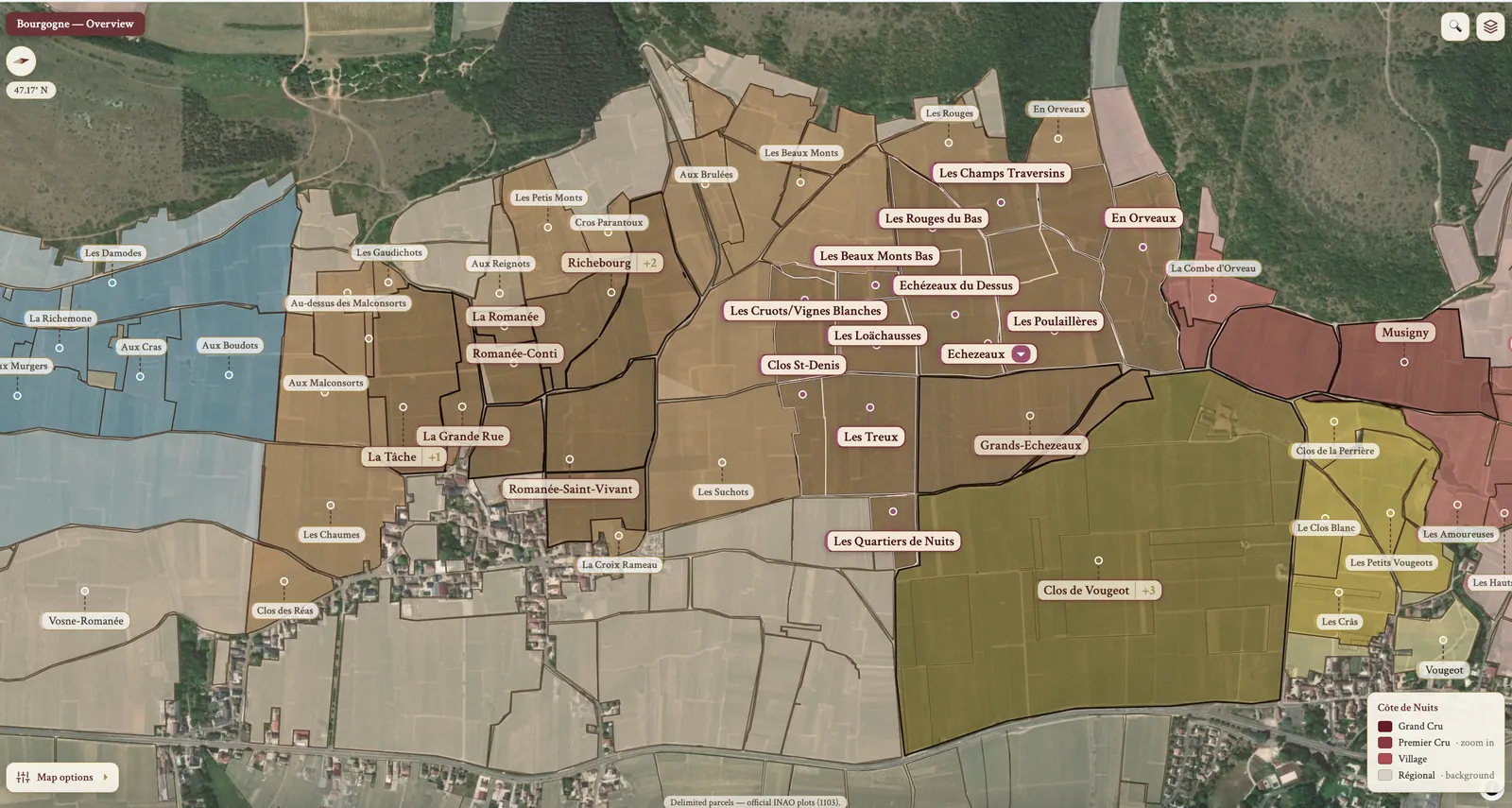
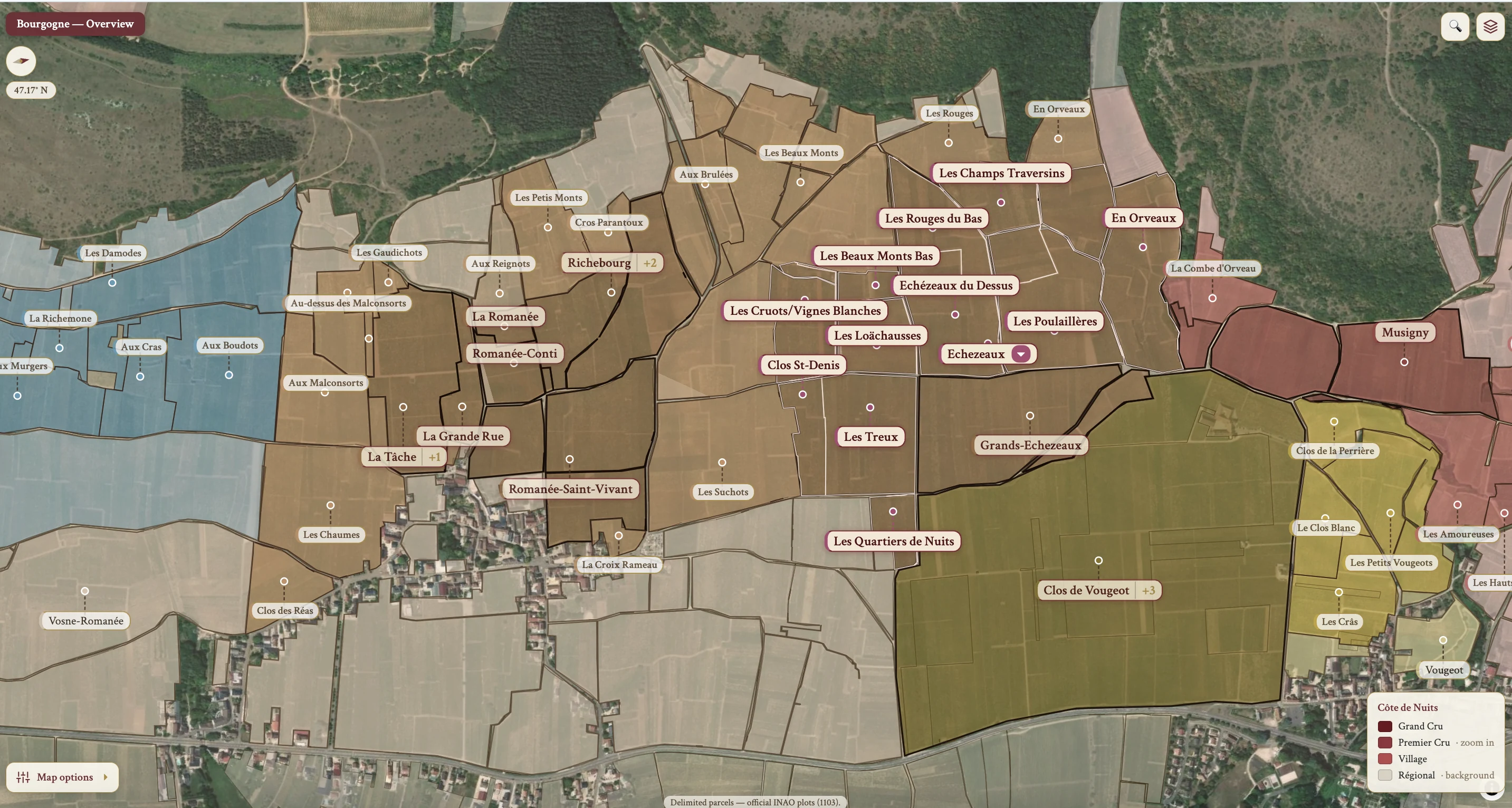
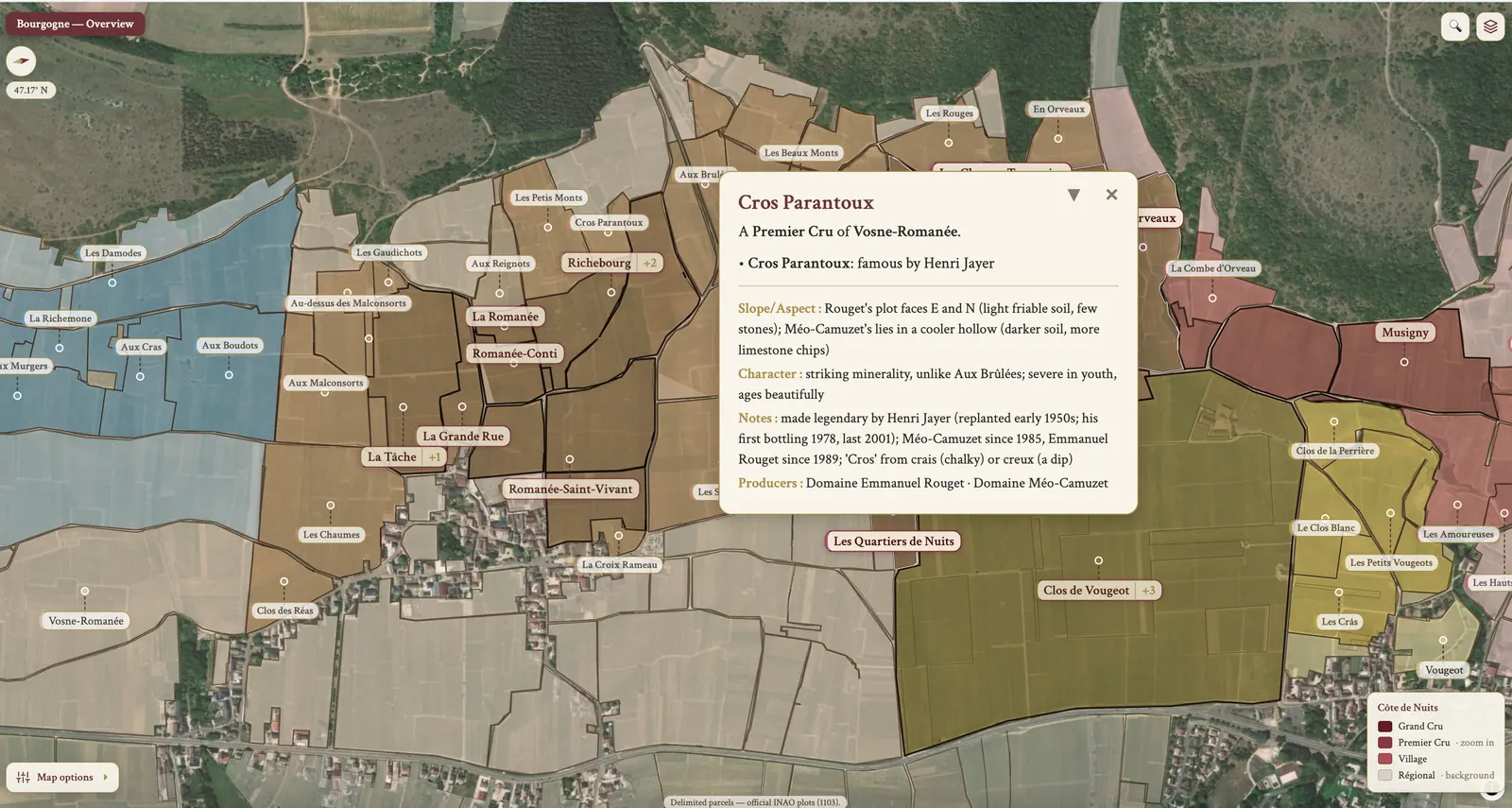
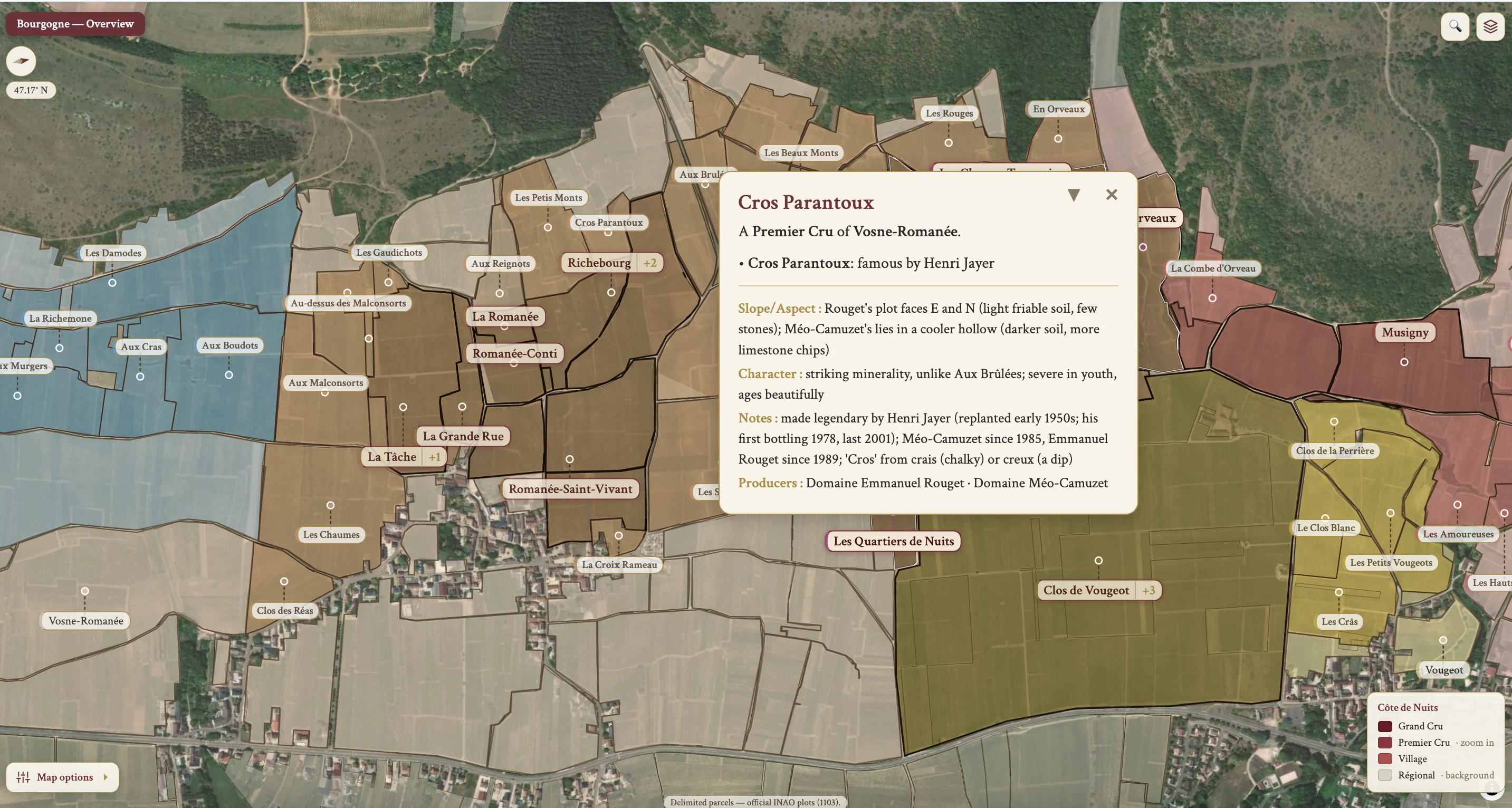
Vosne-Romanée received its AOC in 1936 and produces red wine only, with 14 premiers crus and 8 grands crus associated with the village. Allen Meadows of Burghound calls it the Pearl of the Côte: intensity of flavor with refinement, an iron fist in a velvet glove. Village and premier cru vineyards exist within the borders of Flagey-Échézeaux, but the town itself has no appellation, so producers use the more illustrious name of its neighbor, Vosne-Romanée; the commune does, however, contain two grands crus, Échézeaux and Grands Échézeaux. The monopoles among the grands crus are La Romanée, Romanée-Conti, La Tâche and La Grande Rue — 4 of the 8.
The grands crus
| Climat | Size | Notes | Producers |
|---|---|---|---|
| Grands Échézeaux | Flagey-Échézeaux commune; between Clos de Vougeot and Échézeaux | ||
| Échézeaux | Flagey-Échézeaux commune. Quality concern: too many producers, too variable, no cohesive terroir. Notable lieux-dits: En Orveaux, Les Poulaillères (centrally above Grands Échézeaux, near-monopole by DRC), Échézeaux du Dessus (historical “heart”) | DRC (largest owner, c. 4.7 ha) · Emmanuel Rouget · Jean Grivot · Anne Gros · Gros Frère et Soeur · Liger-Belair · François Lamarche · René Engel | |
| Richebourg | 8.03 ha | Lieux-dits: Les Richebourgs and Les Véroilles-sous-Richebourg (separate vineyards until 1924, then unified) | DRC · Leroy · Anne Gros · A.F. Gros · Gros Frère et Soeur · Méo-Camuzet |
| Romanée-Saint-Vivant | 9.44 ha | largest in Vosne | |
| Romanée-Conti | DRC monopole | ||
| La Romanée | 0.85 ha | smallest AOP in France; monopole of Domaine Liger-Belair | |
| La Grande Rue | monopole of Domaine François Lamarche; last Grand Cru promoted, in 1992 | ||
| La Tâche | DRC monopole. Parcels: La Tâche (lower, southerly corner) and Les Gaudichots — in 1932 DRC argued the right to use the La Tâche name, and in 1933 DRC purchased Liger-Belair's plot, giving the current monopole |
La Grande RueGrand Cru
La Grande Rue is a grand cru of Vosne-Romanée. It is east-facing, a narrow vertical strip up the slope, and the soil at its lower end is shallower and poorer. The wine is red-fruited, with some orange-blossom. It covers 1.65 hectares, a narrow strip between La Tâche and La Romanée and Romanée-Conti.
La RomanéeGrand Cru
La Romanée is a grand cru of Vosne-Romanée. It is east-facing on a healthy 12% slope directly above Romanée-Conti, and the vines are planted north–south, across the slope. The topsoil is friable and stony with rock fragments, and it holds less clay than Romanée-Conti. It has been estate-run since 2005.
La TâcheGrand Cru
La Tâche is a grand cru of Vosne-Romanée. It is east-facing on a steeper slope than the other Vosne monopoles, and it is larger and less homogeneous. The rock is hard Premeaux limestone and white oolitic limestone, and the soil depth varies from top to foot. The wine is powerful, spicy and exuberant yet perfumed, and it is more forward and accessible than Romanée-Conti. It covers 6.06 hectares, and the name comes from à la tâche, piece-work. It is a monopole of Domaine de la Romanée-Conti.
Les GaudichotsGrand Cru
Les Gaudichots is a grand cru parcel of Vosne-Romanée. Set against the other Vosne monopoles it has a bigger and steeper slope, and its rock is split between hard Premeaux limestone and white oolitic limestone. It now lies within the DRC monopole. In 1933 it was united with the original La Tâche as one vineyard, and in the 1860s Duvault-Blochet had acquired almost all of it; more than 2 hectares was historically sold as La Tâche or La Tâche-Romanée. It is a monopole of Domaine de la Romanée-Conti.
DRC's premier cru holdings are Les Gaudichots, Les Petits Monts and Au-Dessus des Malconsorts. Cuvée Duvault-Blochet, DRC's Vosne-Romanée premier cru, is named after the 19th-century founder Jacques-Marie Duvault-Blochet; it comes from younger vines on grand cru vineyards plus second-pass grapes, and its first vintage since 1934 was 1999.
Les RichebourgsGrand Cru
Les Richebourgs is a lieu-dit of the grand cru Richebourg, in Vosne-Romanée. It is the main body of the cru, east-facing. It covers 5.05 hectares and is the original and larger of Richebourg's two lieux-dits. The owner table is combined rather than split by lieu-dit, and the largest owner overall is Domaine de la Romanée-Conti with 3.51 hectares.
Les Verroilles ou RichebourgsGrand Cru
Les Verroilles ou Richebourgs is a lieu-dit of the grand cru Richebourg, in Vosne-Romanée. It faces east with a slight northern tilt, where the hillside turns at the combe; ripening runs +2–3 days later, and the top part catches longer late-season evening sun. It covers 2.98 hectares and is the smaller Richebourg lieu-dit. Its original designation was Les Verroilles-sous-Richebourgs, and 'sous' became 'ou' through marketing.
RichebourgGrand Cru
Richebourg is a grand cru of Vosne-Romanée. It is east-facing, and its Verroilles part turns toward the combe with a slight northern tilt, which makes it later-ripening with longer evening sun. It is made of two lieux-dits, Les Verroilles ou Richebourgs and Les Richebourgs. The wine is robust, sumptuous and powerful, with deep colour and full body — the grandest of Vosne after the monopoles. Les Richebourgs covers 5.05 hectares and Les Verroilles 2.98 hectares, and DRC is the largest owner.
Romanée-ContiGrand Cru
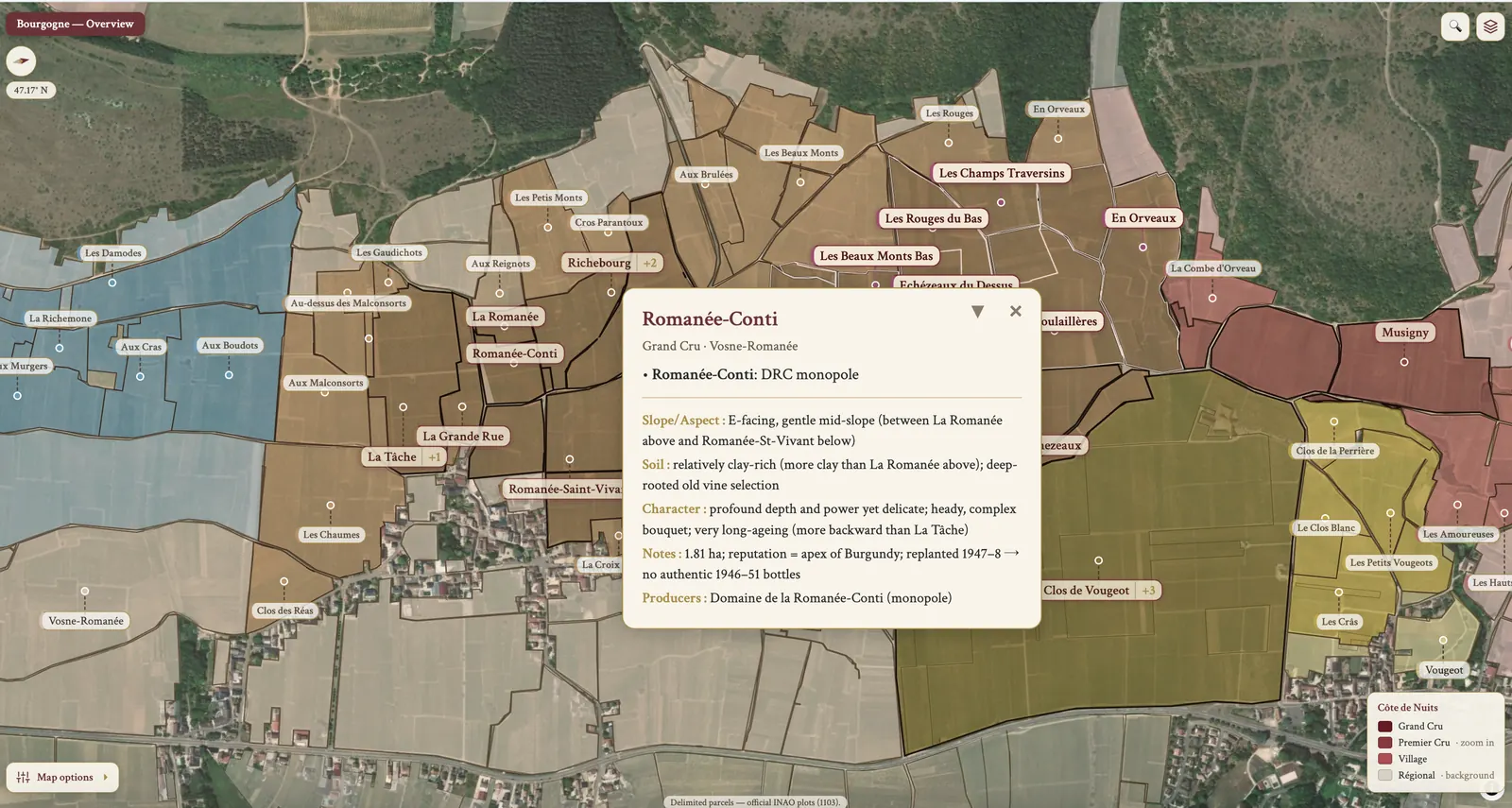
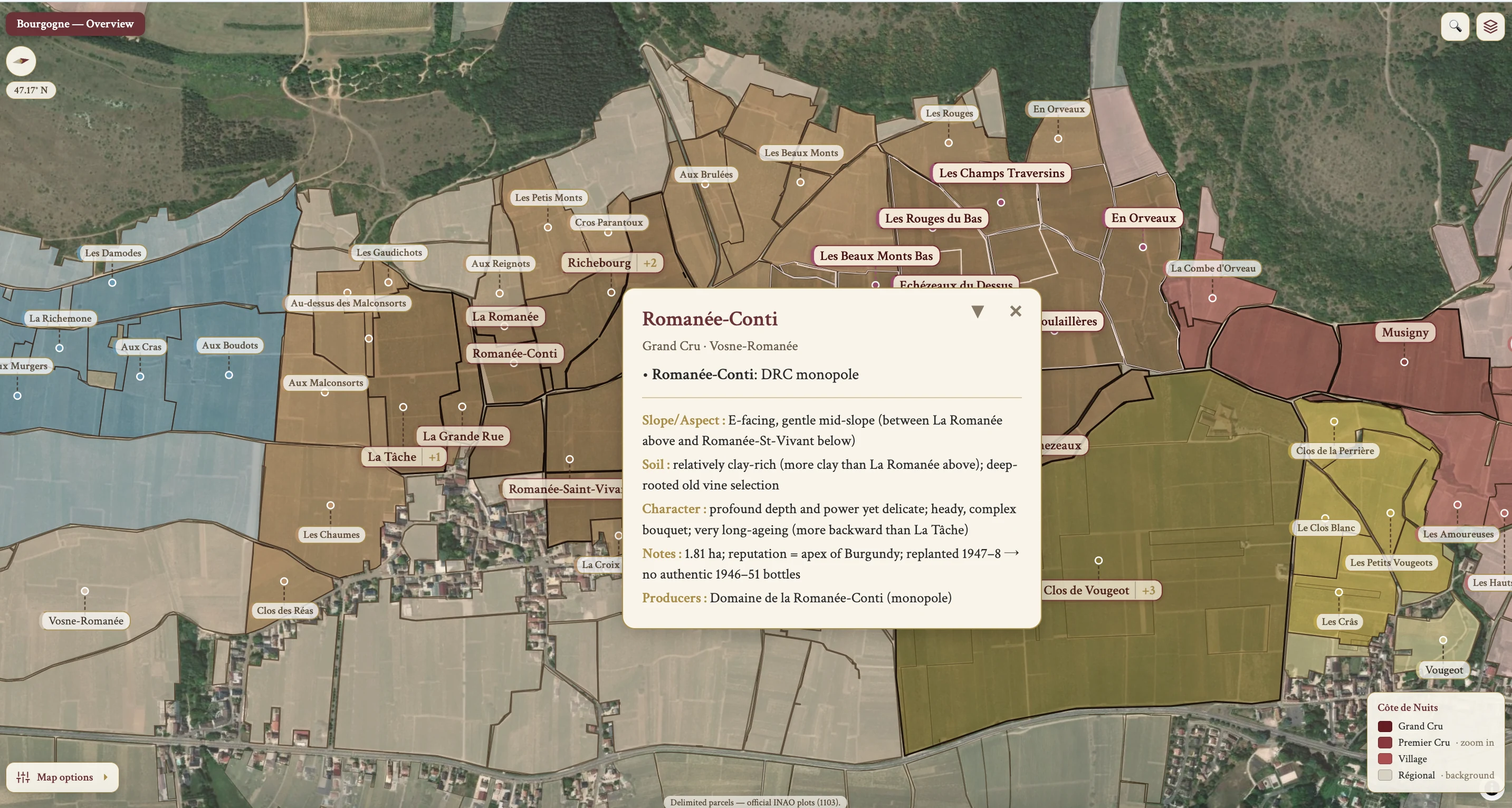
Romanée-Conti is a grand cru of Vosne-Romanée. It is east-facing on a gentle mid-slope, between La Romanée above and Romanée-Saint-Vivant below. The soil is relatively clay-rich, with more clay than La Romanée above, and the vines are a deep-rooted old vine selection. The wine has profound depth and power yet delicacy, with a heady, complex bouquet, and it is very long-ageing — more backward than La Tâche. The cru covers 1.81 hectares, and its reputation is as the apex of Burgundy. It was replanted in 1947–8, so there are no authentic 1946–51 bottles. It is a monopole of Domaine de la Romanée-Conti.
Romanée-Saint-VivantGrand Cru
Romanée-Saint-Vivant is a grand cru of Vosne-Romanée. It is east-facing with negligible slope, lower and flat near the village, and it drains poorly. The soil is relatively deep, about 90 cm, and rich in clay and active chalk. The wine is haunting and perfumed, silky, elegant and delicate — lighter than Richebourg but with great finesse. DRC is the largest owner, with its winery at the foot of the vineyard, and the cru is named after the Priory of Saint-Vivant. Growers here include DRC, Leroy, Louis Latour, Jean-Jacques Confuron and Poisot.
The premiers crus
Au-dessus des MalconsortsPremier Cru
Au-dessus des Malconsorts is a premier cru of Vosne-Romanée, a small vineyard lying just above Malconsorts. The wine is slightly lighter and lacks Malconsorts' sublime texture and depth. It was promoted to premier cru only in 1988, and other good sources are négociants such as Lucien Lemoine and Benjamin Leroux. The grower is Gille Remoriquet.
Aux BruléesPremier Cru
Aux Brulées is a premier cru of Vosne-Romanée, lying either side of the road up to Concoeur-et-Corboin, in a slight dip; most of the southern part is exposed due east and terraced with restored dry-stone walls. The site gives very ripe grapes, and there is a singed-stone smell after ploughing, marked in the hot 2018. The wine is full and rich, a summer wine. The name means burnt, and the cru includes a small block of La Combe Brûlée at the top, 0.76 hectares. Growers here include Domaine d'Eugénie, Méo-Camuzet and Michel Gros.
Aux Brûlées is among the village's notable premiers crus.
Aux MalconsortsPremier Cru
Aux Malconsorts is a premier cru of Vosne-Romanée, adjacent to La Tâche on the south; the main body is one rectangular block, with two thin slices at the north end cut from La Tâche. The lower plot is heavier, and the stone content is higher at the top of the vineyard. The wine has great density and luxury, structure and substance under exceptional layers of fruit — sublime rather than ethereal. It was put on the map by Sylvain Cathiard's 2000; de Montille bottles part as Christiane, and Hudelot-Noëllat offers only magnums. Growers here include Domaine du Clos Frantin of Bichot, Domaine Dujac and Domaine de Montille.
Aux Malconsorts is adjacent to La Tâche on the south, and next to the Nuits-Saint-Georges premier cru Les Boudots.
Aux ReignotsPremier Cru
Aux Reignots is a premier cru of Vosne-Romanée, just above La Romanée. There is noticeably little topsoil, 10 to 40 cm, over very hard limestone, the dalle de Comblanchien. The wine is pure, penetrating, ethereal and fine-boned in the hands of Comte Liger-Belair. It is also known as Aux Raignots. Canon Just Liger-Belair blasted the rock with explosive in 1968, and the Arnoux-Lachaux plot is planted en échalas at 17,000 vines per hectare. Growers here include Domaine du Comte Liger-Belair, Sylvain Cathiard & Fils and Arnoux-Lachaux.
Aux Reignots is among the village's notable premiers crus.
Clos des RéasPremier Cru
Clos des Réas is a premier cru of Vosne-Romanée, a triangle below Les Chaumes and the lowest-lying Vosne premier cru on the map; it is convex and drains very well, and it ripens early thanks to its enclosing walls and the nearby houses. The subsoil is pinkish marl, marnes saumons of the Oligocene, rather than ostrea acuminata. The wine is exceptionally elegant, soft and supple, and it ages well. It has belonged to the Gros family since 1860; the rest of Les Réas is village, and the final 's' is not pronounced.
Clos des Réas is the only premier cru not touching a grand cru; it is a Michel Gros monopole.
Cros ParantouxPremier Cru
Cros Parantoux is a premier cru of Vosne-Romanée. Rouget's plot faces east and north, on light friable soil with few stones, while Méo-Camuzet's lies in a cooler hollow with darker soil and more limestone chips. The wine has striking minerality, unlike Aux Brûlées, and it is severe in youth but ages beautifully. It was made legendary by Henri Jayer, who replanted it in the early 1950s and whose first bottling was 1978 and last 2001; Méo-Camuzet has been here since 1985 and Emmanuel Rouget since 1989. Cros comes from crais, chalky, or creux, a dip. Growers here include Domaine Emmanuel Rouget and Domaine Méo-Camuzet.
Cros Parantoux was made famous by Henri Jayer.
En OrveauxPremier Cru
En Orveaux is a premier cru of Vosne-Romanée, above Echézeaux — most of the climat Orveaux is a subsection of the grand cru — and it is a hillside site. The wine is fine and fragrant, classic hillside Vosne. Sébastien Cathiard's and Jean-Pierre Guyon's examples are especially praised. Growers here include Domaine Mongeard-Mugneret, Sylvain Cathiard & Fils and Château de Marsannay.
La Croix RameauPremier Cru
La Croix Rameau is a premier cru of Vosne-Romanée, an enclave in the lower part of Romanée Saint-Vivant. It was possibly once part of Romanée Saint-Vivant; its owners pushed for grand cru in 1930 and again, unsuccessfully, in the 1980s. The name honours Jean Rameau, a 17th-century cooper. Growers here include Lamarche, Coudray-Bizot and Jacques Cacheux.
Les Beaux MontsPremier Cru
Les Beaux Monts is a premier cru of Vosne-Romanée. It stretches from Les Beaux Monts Hauts, high on the slope and too cool for the very best, down to Les Suchots and Echézeaux; the lower Les Beaux Monts Bas, 7.80 hectares, straddles the Vosne and Flagey border. The wine has purity and is relatively fruit-forward, a winter-wine character in contrast to the summery Brûlées. It is also written Beaumonts, and a further 1.79 hectares is village; the upper parcels are too high, thin and cool for premier cru.
Growers in Les Beaux Monts include Hudelot-Noëllat, Dujac and Jean Grivot.
Les ChaumesPremier Cru
Les Chaumes is a premier cru of Vosne-Romanée, lower on the slope than most Vosne premiers crus apart from Clos des Réas and Cros Rameau; the upper part, just below Aux Malconsorts, makes the better wine. There is a little more clay, and a bench of hard rock runs through the middle. The wine is fuller-bodied for Vosne, and the haunting top-site fragrance is absent. It lies below and south of La Tâche, on the Nuits-Saint-Georges side of the village. Growers here include Méo-Camuzet, Arnoux-Lachaux and Lamarche.
Les GaudichotsPremier Cru
Les Gaudichots is a premier cru of Vosne-Romanée, in 3 sections: a peaked cap above La Tâche, a small nugget at the bottom, and a thin stripe on the southern edge that is declared as Malconsorts. Most of the former Gaudichots was amalgamated into the grand cru La Tâche in 1933, and Forey's holding sits above La Tâche. Growers here include Domaine Forey Père & Fils, Domaine Dujac and Domaine de la Romanée-Conti.
DRC's premier cru holdings are Les Gaudichots, Les Petits Monts and Au-Dessus des Malconsorts. Cuvée Duvault-Blochet, DRC's Vosne-Romanée premier cru, is named after the 19th-century founder Jacques-Marie Duvault-Blochet; it comes from younger vines on grand cru vineyards plus second-pass grapes, and its first vintage since 1934 was 1999.
Les Petis MontsPremier Cru
Les Petis Monts is a premier cru of Vosne-Romanée, the little mounts just above Richebourg. The wine is a slightly lighter version of Richebourg. Drouhin's holding is Véronique Drouhin's personal property, with a slightly different label, and Amélie Berthaut is earning plaudits. Growers here include Domaine Robert Sirugue, Berthaut-Gerbet and Joseph Drouhin.
Les RougesPremier Cru
Les Rouges is a premier cru of Vosne-Romanée. Its lowest part is a subsection of Echézeaux, the upper part is mostly premier cru, and a small section of 0.89 hectares is village where the slope swings north into the Combe d'Orveau. The ground is full of tiny pebbles. The grapes ripen about two weeks later than in nearby Echézeaux, according to Cécile Tremblay. Growers here include Domaine Jean Grivot, Cécile Tremblay and Clos Frantin.
Les SuchotsPremier Cru
Les Suchots is a premier cru of Vosne-Romanée. It lies in a slight downward dip between Richebourg and Romanée Saint-Vivant on one side and Echézeaux on the other, which is why it is premier cru and not grand cru. The wine is not powerful but of high quality, with delicate aromatics — light on the nose yet persistent on the palate. The top triangle, next to Les Brûlées, was the former Grand Suchots, a name revived by Arnoux-Lachaux from 2017.
Growers in Les Suchots include Hudelot-Noëllat, Liger-Belair and Arnoux-Lachaux.
Yields
Maximum yields are generally 42 hl/ha, with La Romanée at 38 and Romanée-Conti and La Tâche at 35 hl/ha.
Key producers
Key producers are DRC, Comtes Liger-Belair, Domaine Leroy, Domaine Bizot, Arnoux-Lachaux, Anne Gros, Michel Gros, Jean Grivot, Méo-Camuzet, Sylvain Cathiard, Gros Frère et Soeur and Emmanuel Rouget of Flagey-Échézeaux.
Notable village lieux-dits
Aux Réas is worked by A.F. Gros and Fourrier; La Colombière by Comte Liger-Belair and Georges Mugneret-Gibourg; Clos du Château is a Comte Liger-Belair monopole; Les Hautes Maizières is worked by Prieuré Roch and Arnoux-Lachaux, and Le Clos Goillotte by Prieuré Roch.