Vougeot
Vougeot, climat by climat. Site, soil, character and growers for all 8 crus, with the appellation map alongside.
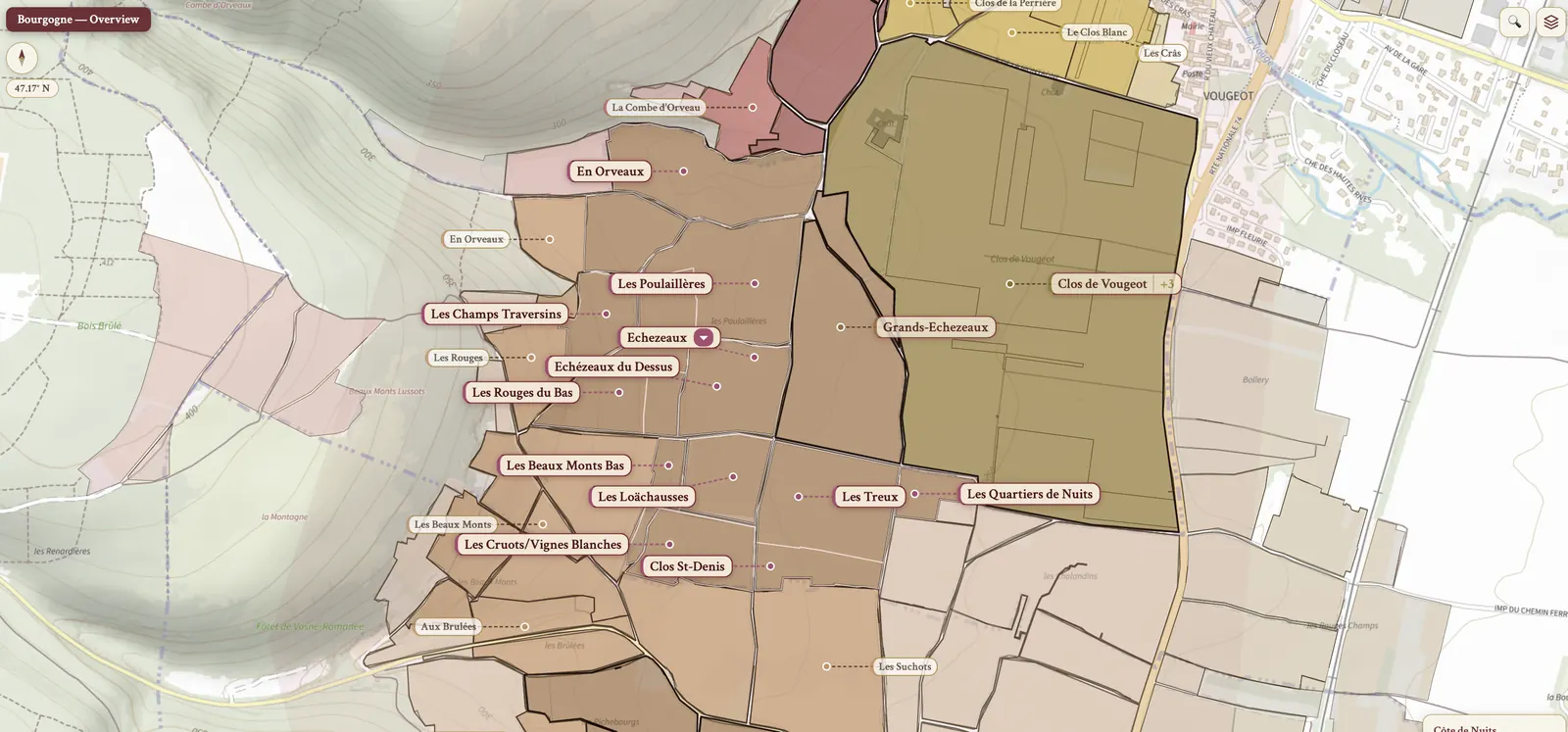
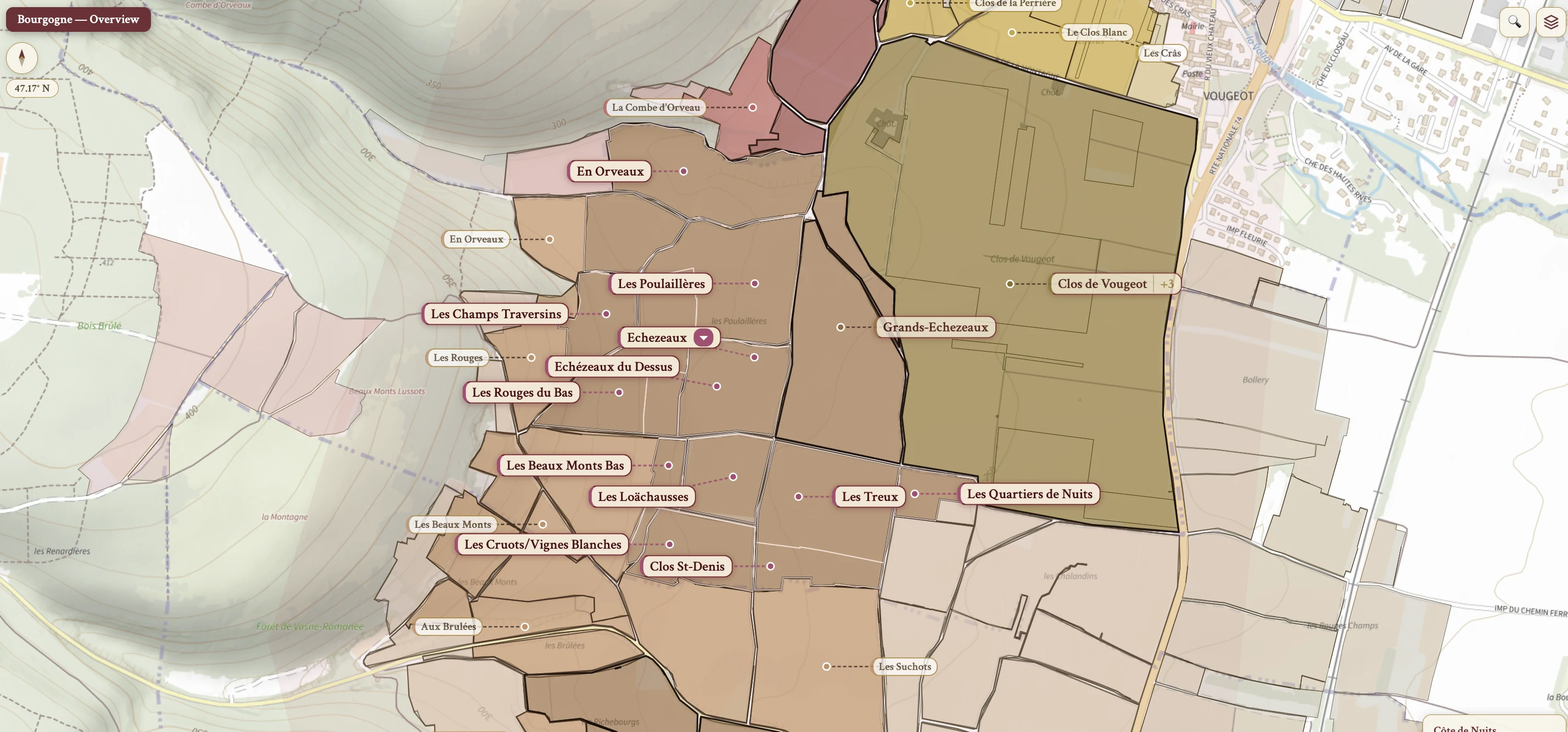
Vougeot received its AOC in 1936 and produces red and white, with 4 premiers crus and 1 grand cru. It is the smallest wine commune in the Côte d'Or, and three quarters of its production comes from that single grand cru, Clos de Vougeot — at 50.59 hectares the largest grand cru of the Côte de Nuits, shared among more than 80 growers, and the only grand cru in the Côte d'Or that rests at the bottom of the slope.
The grands crus
| Climat | Size | Notes | Producers |
|---|---|---|---|
| Clos de Vougeot | 50.59 ha | largest grand cru in the Côte de Nuits; the only grand cru in the Côte d'Or that rests at the bottom of the slope. Quality challenge: too many producers, too variable in quality, no cohesive terroir theme. Marked positional variation between the steeper, poorer top and middle sections and the flatter, richer bottom | 80+ growers; the owner table is combined, not split by lieu-dit |
| En Musigni | vineyard top, about 255 m, directly below Musigny; about 40 cm of topsoil over Bajocian limestone; the highest and most prized section of the Clos | ||
| Le Grand Maupertui | west upper side of the Clos, near Grands Échézeaux; among the few lieux-dits seen on labels | ||
| Le Petit Maupertui | west upper side of the Clos, near Grands Échézeaux; among the few lieux-dits seen on labels |
Clos de VougeotGrand Cru
Clos de Vougeot, or Clos Vougeot, is a grand cru of Vougeot. It is east-facing, with a gentle overall gradient from the top at 255 metres down to the foot, rippling across its width, and it is the only grand cru of the Côte d'Or that reaches the foot of the slope. The topsoil is thin at the top, about 40 cm, over Bajocian limestone; the middle holds more clay; the bottom is deep alluvial over marlstone. The wine is highly variable by parcel and by producer, standing between Vosne power and Chambolle grace, and it can lack cohesion.
En MusigniGrand Cru
En Musigni is a grand cru lieu-dit of Vougeot. It sits at the vineyard top, about 255 m, just below Musigny, on about 40 cm of topsoil over Bajocian limestone. It is among the few lieux-dits used on labels, and it is the highest and most prized section of the Clos, its position directly below Musigny.
Le Grand MaupertuiGrand Cru
Le Grand Maupertui is a grand cru lieu-dit of Vougeot. It lies on the west upper side of the Clos, near Grands Échézeaux. The owner table is combined rather than split by lieu-dit. It is among the few Clos de Vougeot lieux-dits appearing on labels; most of the others go unused.
Le Petit MaupertuiGrand Cru
Le Petit Maupertui is a grand cru lieu-dit of Vougeot. It lies on the west upper side of the Clos, near Grands Échézeaux. The owner table is combined rather than split by lieu-dit, and it is among the few Clos de Vougeot lieux-dits appearing on labels.
The premiers crus
Clos de la PerrièrePremier Cru
Clos de la Perrière is a premier cru of Vougeot. It is a steep drop below Chambolle's Les Amoureuses and Musigny. The name Perrière comes from a former Cistercian quarry, which gave stone for the Abbey, for Clos de Vougeot and for Château de Gilly. The wine has a velvety appeal, and it is red wine only.
Clos de la Perrière is a monopole of Bertagna.
Le Clos BlancPremier Cru
Le Clos Blanc is a premier cru of Vougeot, and a white premier cru. The lieu-dit is La Vigne Blanche; for the monks of Cîteaux it was Le Petit Clos Blanc, planted to white grapes from 1110. The wine has a natural sense of balance and detail, a standout white of the Côte de Nuits. The sole owner, Domaine de la Vougeraie, labels it Le Clos Blanc de Vougeot.
Le Clos Blanc is the official premier cru climat name in the INAO cahier des charges, and it covers the historic lieu-dit La Vigne Blanche, about 3 ha. It is a walled monopole — a clos — of Domaine de la Vougeraie, held since 1998, and is about 95% Chardonnay; it is the white-specialist premier cru of Vougeot.
Les CrâsPremier Cru
Les Crâs is a premier cru of Vougeot. It lies lower than the other Vougeot premiers crus; the upper rows run east–west, following the gradient, and the lower rows north–south, the slope tilting slightly north from Clos de Vougeot. It sits directly above a layer of hard limestone, hence Les Cras. The wine is a firm style. Domaine Bertagna produces both colours here. Growers are Domaine de la Vougeraie, Domaine Bertagna and François Legros.
Les Petits VougeotsPremier Cru
Les Petits Vougeots is a premier cru of Vougeot. The soil is strongly limestone, perhaps stylistically more typical of Chambolle. A further 0.20 hectares is classified village. Hudelot-Noëllat and Jean-Marie Fourrier make excellent wines here. Growers are Domaine Bertagna, Hudelot-Noëllat and Christian Clerget.
Key producers
Clos de Vougeot is shared among more than 80 growers, and its owner table is combined rather than split by lieu-dit. Among the premiers crus, Domaine de la Vougeraie is the sole owner of Le Clos Blanc and Bertagna holds Clos de la Perrière as a monopole; Domaine Bertagna, Hudelot-Noëllat, Christian Clerget, François Legros and Jean-Marie Fourrier work Les Crâs and Les Petits Vougeots.
The four premiers crus, north to south
The four premiers crus run Clos de la Perrière, a monopole of Bertagna; Les Petits Vougeots; Le Clos Blanc, labelled Le Clos Blanc de Vougeot and the white-specialist premier cru of the commune; and Les Cras, which the climat data carries as Les Crâs.
Notable lieux-dits seen on labels
Only a few Clos de Vougeot lieux-dits appear on labels; most go unused. Le Grand Maupertuis, adjacent to Grands Échézeaux, is usually bottled by the Gros family, Anne or Michel; Le Petit Maupertuis is the second; and Le Musigni, which borders Musigny grand cru and is carried in the climat data as En Musigni, is bottled only by Gros Frère et Soeur.
Château du Clos de Vougeot
Château du Clos de Vougeot is a national monument and the home of La Confrérie des Chevaliers du Tastevin, Bourgogne's promotional organization.