Corsica — Wine Region Guide
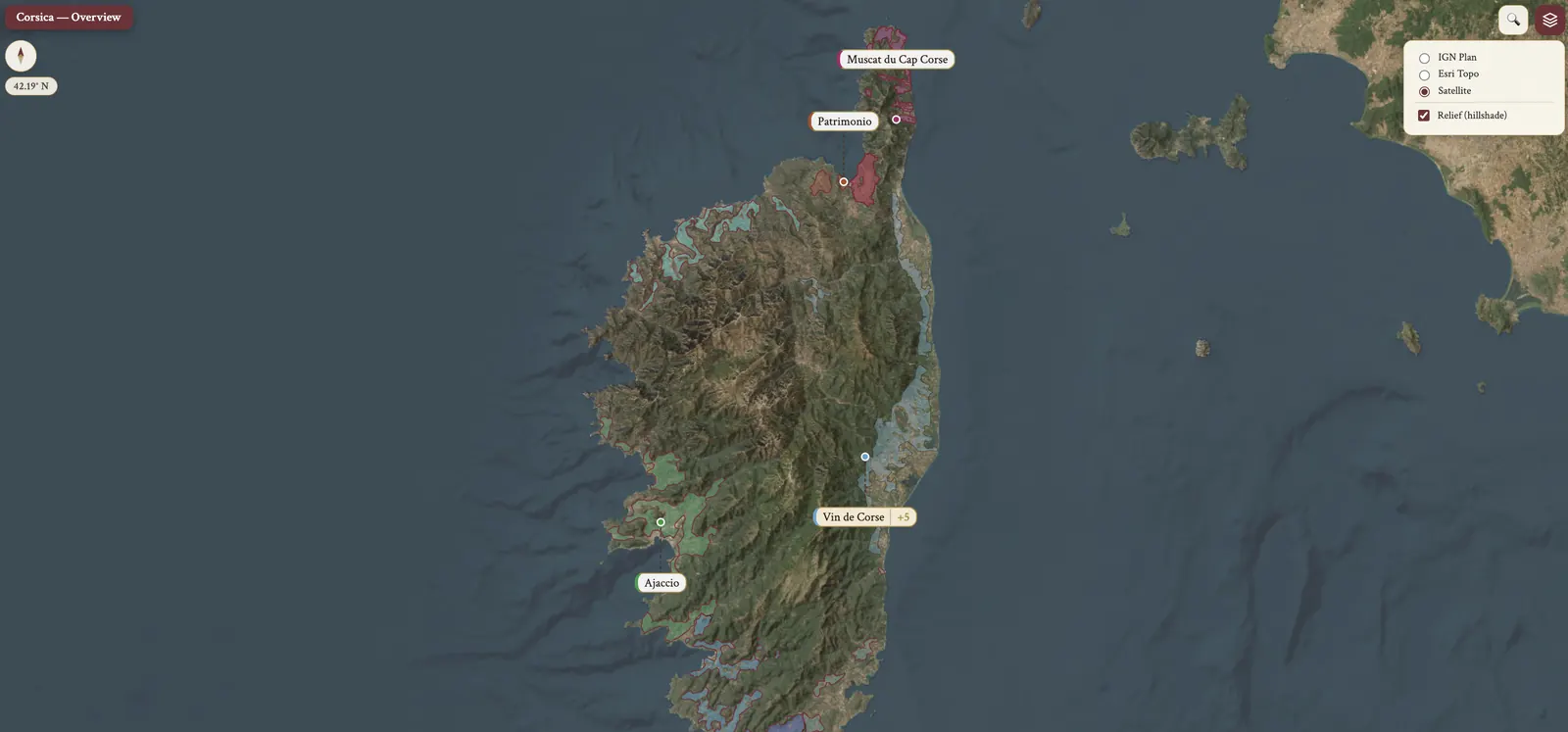
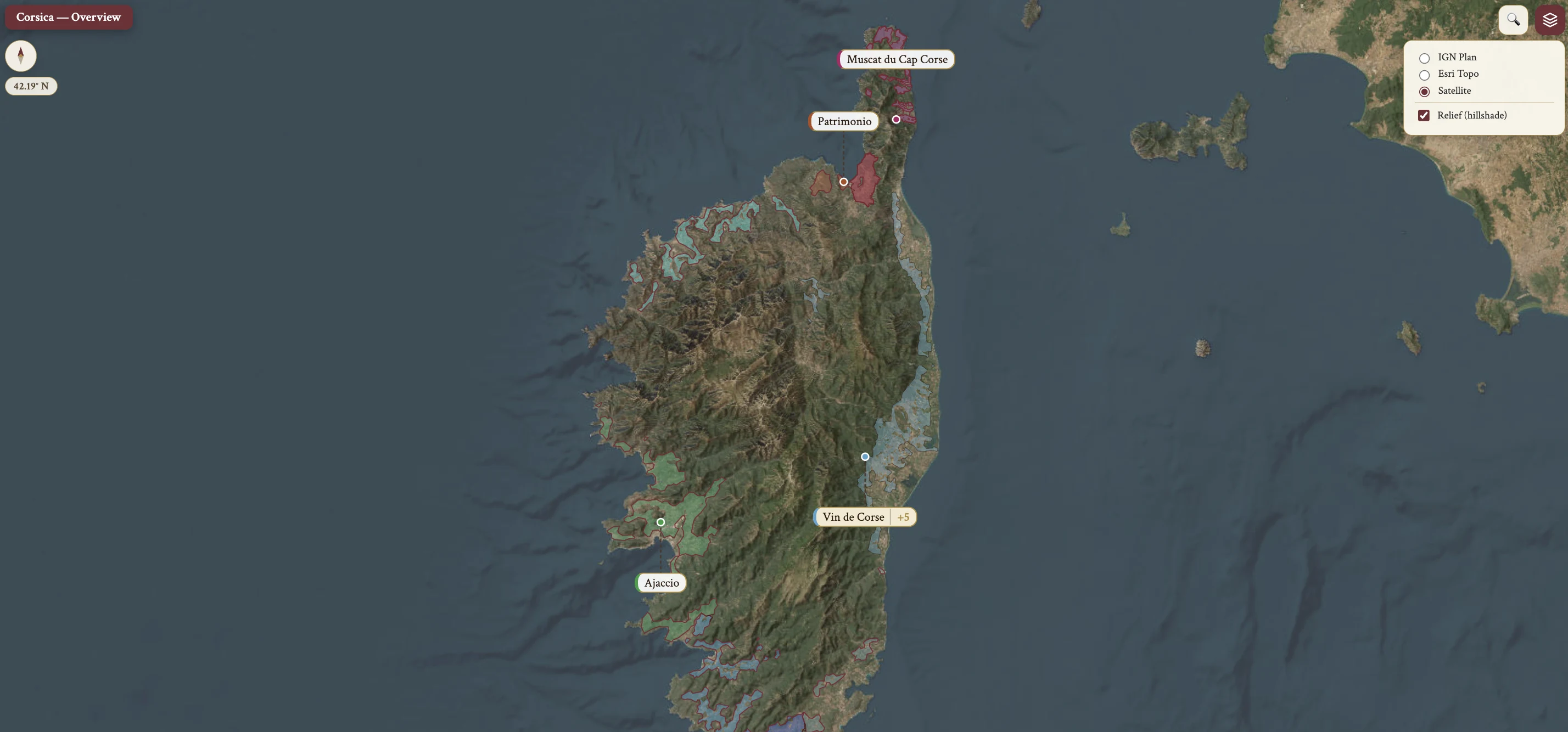
The Corsica maps from Your Own Wine Encyclopedia — every name tag opens a study card. Below, the chapter's own geography, climate and geology notes.
From the encyclopedia
Overview
Corsica lies 160 km south-east of mainland France, 11 km north of Sardinia and 80 km west of Italy, and it carries Italian winemaking traditions and grapes. The Genoese ceded the island to France in 1768. Napoleon was born in Ajaccio on August 15, 1769, and Napoleonic laws still entitle the island to sell duty-free wines and tobacco. The English diarist James Boswell wrote in 1769 of the excellence and diversity of Corsican wines.
The total vineyard stands at 5,780 ha (2020), with a red emphasis of about 75% against about 25% white, and 21% of vineyards are farmed organically. Most wine is released under the Île de Beauté IGP: in 2013 AOC wines accounted for about 30% of total production, IGP de l’Île de Beauté about 64% and table wine about 6%. Corsica is also entitled to use the Méditerranée IGP.
Grape Varieties
Nielluccio is the most planted red grape, a Sangiovese clone cultivated on the island for over 1,000 years, and it is dominant in Patrimonio, where the rouge takes a min. 90%. Sciaccarello, known as Mammolo on the Italian mainland, is the 2nd most planted red; it has been cultivated since the 1800s and is dominant in Ajaccio at a min. 40%. On granite soils it is richer and more full-bodied.
Vermentino is the principal white grape across all AOPs, and in Corsica it is known as Malvoisie de Corse. Aleatico is used for Rappu, the sweet red wine of Coteaux du Cap Corse.
Geology & Topography
The island’s geology divides it in two. The geological division sets the west and south as granitic and the north-east as schistose with some limestone. The central massif is a national park; 20% of the island lies above 1,000 m, and Monte Cinto reaches 2,706 m, holding ice and snow even in summer. The vineyards ring the coastline at an average of 300 m elevation.
Four main soil types follow from that. Granite on the west side, around Ajaccio, is where Sciaccarello thrives, and it gives richer, full-bodied wines. Schist in the north and Cap Corse suits Vermentino well, and its desiccating winds allow sweet Muscat. Chalk and clay in Patrimonio carry Nielluccio, giving full-bodied, fruit-forward reds that are herb-scented. Marly sand and alluvial soils on the east coast give light-bodied, fresh, fruit-driven wines.
Climate
The climate is Mediterranean with oceanic and alpine influences. Sunshine runs 2,470–2,885 hours/year, and the sea absorbs daytime heat and radiates it back at night, which leaves minimal diurnal variation except at altitude. Median rainfall is 737 mm, and there is little rain Aug–Sept, which gives dry, rot-free harvests and little vintage variation.
Irrigation is prohibited in all AOC regions except by special request. In Patrimonio and Muscat du Cap Corse it is fully prohibited.
The Winds
Most wind comes from the west, with Cap Corse, Bonifacio and Calvi often experiencing winds over 150 km/h. The Mistral arrives from Provence. The Libeccio, or Libecciu, comes from Gibraltar and is the most frequent wind; it brings rain, particularly to western areas.
The Tramontana comes from the Alps, dry and cold. The Gregale comes from the Apennines, damper, and brings rain, an important moisture supply. The Sirocco, or Siroccu, comes from the Sahara, hot and dry, with a drying effect on vegetation, and it leaves a dusting of sand.
Viticulture
Training was traditionally gobelet; single Guyot and cordon are now more common, for mechanical harvest. The threats are Esca and Flavescence dorée, with occasional cicada attacks.
Climate change is not a major challenge here: sea breezes and cool mountain air mitigate the heat, and there is interest in higher elevation planting.
On the map
- Cap Corse — Patrimonio · Muscat du Cap Corse
- Ajaccio
- Southern Corsica — Sartène · Figari · Porto-Vecchio