Germany — Wine Region Guide
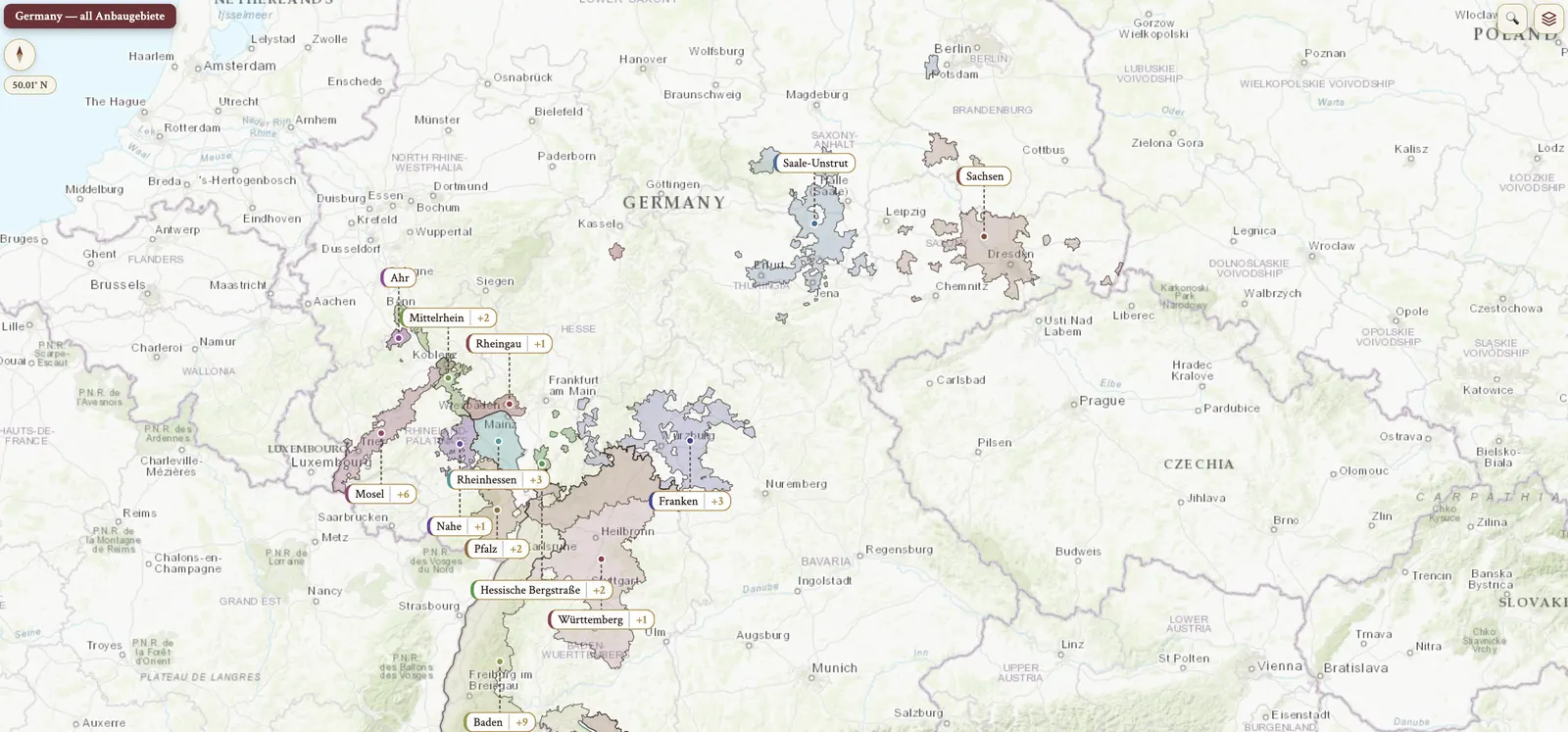
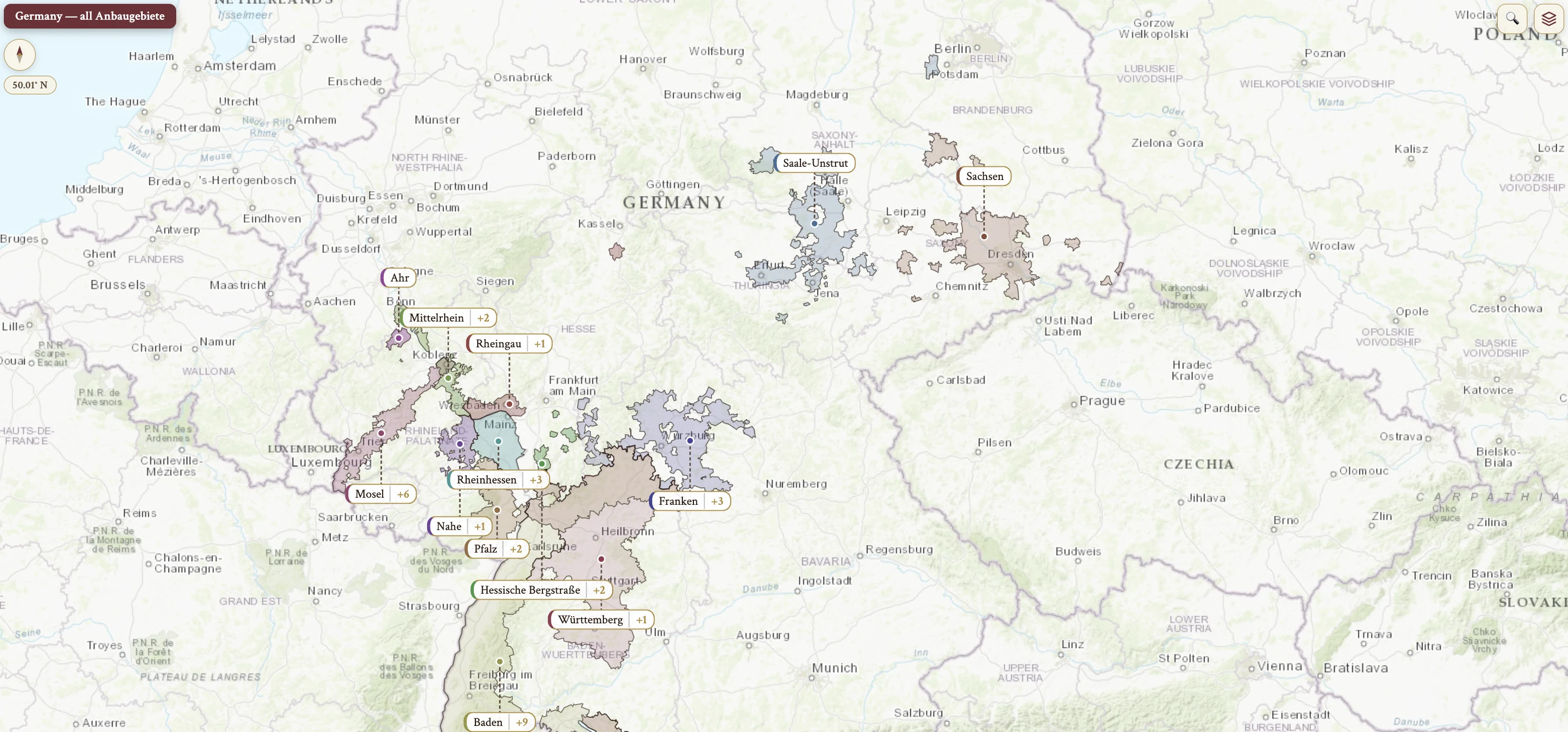
The Germany maps from Your Own Wine Encyclopedia — every name tag opens a study card. Below, the chapter's own geography, climate and geology notes.
From the encyclopedia
Germany — Latitude, Grapes and Geographic Structure
By latitude, Germany is one of the world’s northernmost major wine-producing countries, straddling 49–50°N, with Baden dipping lower. Its signature grapes are Riesling, the world’s most celebrated expressions, and increasingly Spätburgunder (Pinot Noir). The entire stylistic spectrum is produced: bone-dry trocken to noble sweet Trockenbeerenauslese and Eiswein, plus a significant sparkling Sekt category. Internationally, however, the country’s reputation rests above all on Riesling.
The geographic structure rests on 13 Anbaugebiete, the quality wine regions. Originally 11 were designated in the 1971 wine law; after reunification in 1990, 2 were added, Saale-Unstrut and Sachsen. The top 5 by production account for 88% of the total: Rheinhessen, Pfalz, Baden, Württemberg and Mosel. The 3 smallest by acreage are Hessische Bergstrasse, Sachsen, Mittelrhein. Mostly they lie in south or south-western Germany, while Saale-Unstrut and Sachsen lie in the east, the reunification additions. Within the Anbaugebiete sit 40 Bereiche, the districts; the Bereich is the unit required for a Prädikatswein designation.
History — Romans, Cistercians and the Rheingau Discoveries
Romans planted vines along the Mosel and Rhine in the ancient era. Augusta Treverorum (Trier) was founded 16 BC, one of the oldest wine towns in Germany, with 1st c. BC Roman amphora finds at Mosel sites. Medieval and monastic foundations followed: Benedictines and especially Cistercians drove vineyard development. Kloster Eberbach (Rheingau) dates from 1136 — a model wine estate that identified terroir and codified single-vineyard practice centuries before Burgundy formalized it.
The 18th c. discoveries belong to the Rheingau. In 1712 the first “Cabinet” cellar came at Kloster Eberbach, the origin of Kabinett. In 1775 Spätlese was discovered at Schloss Johannisberg, through a delayed messenger, a botrytis-affected late harvest; the first Auslese followed at Schloss Johannisberg in 1787. The first documented Eiswein, 1794, came from Franken.
The 19th c. was the golden era. Pre-phylloxera German Rieslings from the Mosel and Rheingau commanded prices equal to or above 1st-growth Bordeaux on London and New York lists, and Hochheim gave English “hock” for Rhine wine.
History — the Modern Wine Law
The VDP was founded in 1910, originally the VDNV, to promote Naturweine — no enrichment. The 5th German Wine Law of 1971 is the foundation of the modern system. It established protected geographical labelling — Anbaugebiete / Bereiche / Grosslagen / Einzellagen — and the Prädikat classification, based on must weight, and replaced the previous diversity of regional rules. It raised the minimum Einzellage size to 5 ha, so many small parcels were absorbed or renamed. The concept of Naturwein was rejected, and the VDP renamed itself and set higher private standards.
From the late 20th c. into the 21st c. came the shift to dry. The domestic palate moved decisively to trocken / halbtrocken from the late 1980s, led by the Rheingau — Charta, 1984 — and the VDP. The bulk wine image of the Liebfraumilch boom of 1970s–80s was gradually replaced by a single-vineyard quality focus.
The 2021 Wine Law reform restructured the pyramid along Burgundian lines: Anbaugebiet, Region, Ortswein, Einzellage, Erste / Grosse Gewächs. Bereich and Grosslage were abolished from labels, replaced by Region, and a transitional period allows the old labelling until 2025.
The Anbaugebiete at a Glance
At a glance, the Anbaugebiete each have their own main varieties and signature. Mosel grows Riesling, Müller-Thurgau and Elbling, and stands for slate, steep slopes and off-dry Riesling. Rheinhessen, with Müller-Thurgau, Riesling and Dornfelder, is the largest region, home of Liebfraumilch and the Roter Hang. Pfalz — Riesling, Dornfelder, Spätburgunder — is warm, in rain-shadow: Mittelhaardt Riesling. Rheingau, planted to Riesling and Spätburgunder, holds the dry Riesling leadership and the “Schloss” estates. Nahe grows Riesling and Dornfelder, and stands for geological diversity and Dönnhoff.
Baden, with Spätburgunder, Müller-Thurgau and the Burgunder family, is the warmest region, marked by the Kaiserstuhl. Württemberg grows Trollinger, Lemberger and Riesling, for domestic light reds and the Neckar terraces. Franken grows Silvaner, Müller-Thurgau and Spätburgunder, and stands for the Bocksbeutel and Muschelkalk Silvaner. Ahr is Spätburgunder, a red specialist at high latitude on slate and greywacke. Mittelrhein is Riesling and the UNESCO terraces; Hessische Bergstrasse is Riesling, tiny, for local consumption. Saale-Unstrut, with Müller-Thurgau and Weissburgunder, is the northernmost in the east, and Sachsen, with Müller-Thurgau and Riesling, is the Elbe valley and Dresden.
Grape Varieties — Riesling
Riesling is the signature. It buds late and ripens late; the thick wood makes it resistant to spring frost, but it requires a long, dry autumn and good sun exposure to reach full ripeness. It is winter-hardy, and so ideally suited to cool-climate viticulture.
Its stylistic range is full: bone-dry (trocken), through off-dry (halbtrocken/feinherb), to lusciously sweet (Auslese, BA, Eiswein, TBA). It can accumulate very high natural sugar levels and is susceptible to noble rot (Edelfäule). It retains high acidity even when fully ripe, which leaves it well-balanced with residual sugar and gives pronounced ageing potential.
The aromatics move with ripeness through green fruit, stone fruit and tropical fruit. Young, the wine shows white flowers and honeysuckle. With bottle age come petrol (TDN = 1,1,6-trimethyl-1,2-dihydronaphthalene), toast, honey, lanolin and wax.
This is why it relates to German style: late ripening on cool sites with a long growing season gives slow flavour development, complexity and high quality — and the possibility of high must weights for sweet styles.
Grape Varieties — Müller-Thurgau and Silvaner
Müller-Thurgau, or Rivaner, is the German cross Riesling × Madeleine Royale, made in 1882 by Hermann Müller at Geisenheim. It ripens earlier, carries much lower acidity than Riesling, and is a high yielder on almost any site, giving simple floral and fruity wines for early drinking. It is the main grape of Liebfraumilch. It was the most planted variety in the 1970s–1980s; plantings have more than halved.
Silvaner — Sylvaner in Alsace — buds early and ripens early, with lower acidity and less aromatic character than Riesling. Plantings have nearly halved since 1980 but have stabilised. At low yields it produces high-quality dry wines with M–M(+) acidity and an earthy, wet-stone character. It is most famously grown in Franken, where the high continentality and short growing season suit its early-ripening habit.
Grape Varieties — Grauburgunder, Weissburgunder and Chardonnay
Grauburgunder is Pinot Gris; Ruländer names the traditionally richer or sweeter styles. Plantings are sizable in Baden, Rheinhessen and Pfalz. It likes heavier soils, and runs dry to sweet, stone to tropical fruit, with M acidity.
Weissburgunder, Pinot Blanc, is well balanced, with M(+) acidity and delicate citrus to stone fruit, and is increasingly vinified with lees contact and oak for premium expressions. Chardonnay has only been permitted in Germany since 1990. Plantings are low, but high-quality oak-aged examples come from the warmer zones — southern Pfalz, and the Kaiserstuhl in Baden.
Grape Varieties — Scheurebe, Bacchus, Kerner, Gutedel and Elbling
Scheurebe is a German cross of Bukettrebe × Riesling: full-bodied, intensely aromatic with cassis, grapefruit and blackcurrant leaf, and lower in acidity than Riesling. It is one of the few crosses with genuine quality potential. Bacchus is the German cross (Silvaner × Riesling) × Müller-Thurgau, with Sauvignon-like aromatics, early ripening and productive. Kerner makes high-quality Prädikat wine with Riesling-like acidity and floral character.
Gutedel is Chasselas, widely planted in Markgräflerland, Baden. Elbling is an ancient variety, the 2nd/3rd most planted in the Mosel after Riesling and Müller-Thurgau, grown primarily in the Upper Mosel (Obermosel) for Sekt base.
Grape Varieties — Spätburgunder and Dornfelder
Among the black varieties, Spätburgunder — Pinot Noir — is the most planted, at ~11.5% of total vineyard, and its rise in domestic and export markets has been rapid. It thrives in the warmer zones: Baden, especially the Kaiserstuhl, then Pfalz, Ahr, Rheingau (Assmannshausen) and Franken (Bürgstadt). There is increasing attention to oak-aged high-quality Spätburgunder.
Dornfelder is a German cross of Helfensteiner × Heroldrebe, made in 1955 at Weinsberg, and is the 2nd most planted black grape. It is deep-coloured and easy-drinking, sometimes with some RS; at lower yields, with oak, it gives more tannic, structured wines with ageing potential. It is most successful in Rheinhessen and Pfalz.
Grape Varieties — Portugieser, the Württemberg Reds and the German Crosses
Portugieser, or Blauer Portugieser, gives light, simple, fruity reds for early drinking. Schwarzriesling is Pinot Meunier, with the synonym Müllerrebe, and sits mainly in Württemberg. Trollinger, which is Schiava or Vernatsch, is the classic grape of Württemberg: light, pale, fruity reds for domestic consumption. Lemberger is Blaufränkisch, and in Württemberg it produces fuller-bodied, higher-quality reds with ageing potential, often oaked. Domina is a cross of Blauer Portugieser × Pinot Noir.
The German crosses, the Neuzüchtungen, were bred by various German wine institutes — Geisenheim, Weinsberg — to cope with Germany’s cool climate. Many new crossings came in the mid-20th century, aiming for high yield with high must weight. Most lack Riesling’s acidity or aromatic intensity, and are widely used in inexpensive blends such as Liebfraumilch. The quality standouts are Scheurebe, Kerner and Dornfelder.
Grape Varieties — Comparisons to Remember
These comparisons are worth remembering. Mosel Riesling against Alsace Riesling: Mosel is paler, lower in alcohol, often with RS, higher in acidity, floral with green fruit, on blue/grey slate; Alsace is fuller bodied, usually dry and increasingly off-dry, higher in alcohol, on granite/schist/limestone, with exotic fruit.
Mosel Riesling against Clare or Eden Valley Riesling: Mosel is often off-dry, more floral, with green and stone fruit, and lower in alcohol; Australia is dry, high in acid, with lime and mineral, and higher in alcohol. Rheingau dry Riesling against Mosel dry Riesling: Rheingau is fuller, with riper fruit and more oak-friendly, on the Taunus shelter and the wider Rhine; Mosel is leaner, more tense, more mineral and lower in alcohol.
Ahr Spätburgunder against Burgundy: Ahr has slate and greywacke, brighter red fruit, higher acid and modest tannin, while Burgundy’s limestone/marl gives broader texture. Franken Silvaner against Alsace Sylvaner: Franken is high-quality, wet-stone, full-bodied dry, on Muschelkalk/Keuper; Alsace is lighter, more floral and historically entry-level.
Climate — Cool Continental at the Northern Limit
The climate is cool continental, situated at the northernmost limit for ripening grapes. Site selection is essential: most vineyards sit along rivers or on south-facing slopes to capture maximum sun. Vintage variation has historically been considerable, though reduced by climate change and advanced vineyard management.
Winters are very cold — cold enough for Eiswein. Summers are warm and wet, which is not naturally suited to organic viticulture. Autumns are long and dry, extending the ripening period and so develops sugar and flavour, while morning mists promote botrytis, the fuel for high-quality Prädikat wines. Frost is a major hazard, in spring and in winter. Annual rainfall is 500–800 mm, much of it falling in summer, which brings fungal disease, dilution, heavy storms and hail.
Climate — Regional Variation across the Anbaugebiete
Regional variation runs like this. Baden is the warmest, driest and sunniest region, lying further south and bordering Switzerland. Pfalz and Rheinhessen benefit from the rain-shadow effects of the Haardt and Hunsrück mountains. Mosel is tempered almost entirely by its steep slopes and the thermal mass of the river; without these, grapes would not ripen at this latitude. Franken has the most continental climate of the Anbaugebiete — harsh winters, a short growing season and spring frost risk.
Topography & Geography — the Rivers
Rivers are the decisive factor in German viticulture. Their role: moderate temperature through thermal mass, radiate heat at night, reflect sunlight onto the slopes, extend the growing season, help mitigate frost.
The 6 most important rivers impacting German wine are the Rhine, the Neckar (Württemberg), the Main (Franken), the Nahe, the Ahr and the Mosel. The key tributaries are the Saar and the Ruwer, both Mosel tributaries. The Rhine rises at the Tomasee (Graubünden, Switzerland, 2,345 m a.s.l.), and its mouth at the North Sea via the Netherlands delta, ~1,230 km in total.
Topography & Geography — Slopes, Terracing and Altitude
The best vineyards are on steep, south-facing slopes, sometimes up to 70° gradient — among the steepest in Europe. Bremmer Calmont in the Lower Mosel reaches ~69° and is considered one of Europe’s steepest vineyards. Terracing is common, and erosion is a constant cost.
Mountain ranges shelter vineyards from cold winds and rain: Taunus shelters Rheingau; Haardt, the continuation of the Vosges, shelters Pfalz; Hunsrück shelters Nahe and the Mosel’s hinterland. In altitude, many vineyards sit below 200 m a.s.l., reflecting the high latitude constraint.
Soil — Slate and Greywacke
Germany has an exceptionally diverse geology, crucial for ripening in the coolest sites, and Riesling in particular is famous for telegraphing soil differences.
Blue/grey Devonian slate lies in the Mosel (Middle), the Ruwer and parts of the Saar; it retains and radiates heat, and gives racy, mineral, green-fruit Rieslings. Red slate — Rotliegendes — is found at Ürzig (Würzgarten), at Erden (Treppchen, Prälat) and in parts of the Roter Hang in Rheinhessen; it is iron-rich, giving spicy, opulent fruit and a warmer mid-palate. Dark slate with greywacke, a dark sandstone, is the Ahr: heat-retaining, giving structured Pinot Noir.
Soil — Limestone, Keuper, Sandstone, Loess, Volcanic and Gneiss
Calcareous limestone, Muschelkalk, runs through Franken (Maindreieck), parts of Baden (Tuniberg, Breisgau) and pockets of Rheinhessen and Pfalz; it is favoured by the Burgunder family (PN, PB, PG) and Chardonnay. Keuper — marl and gypsum-marl — is Franken (Steigerwald), grand-cru Silvaner terroir, as at Julius-Echter-Berg, Iphofen. Buntsandstein, red sandstone, lies in Franken (Mainviereck, e.g., Centgrafenberg) and parts of Pfalz, and gives warm, expressive Spätburgunder.
Loess and loess-loam cover Kaiserstuhl, Tuniberg, Markgräflerland and parts of Rheinhessen: warm, water-retentive, generous in fruit. Volcanic basalt and tuff appear at Kaiserstuhl, an extinct volcano, and in Pfalz at the Forster Basalt-Pechstein, giving mineral, smoky, structured wines. Gneiss is found in the Ortenau, Baden.
Viticulture — Site, Canopy and Training Systems
Summer pruning, green harvesting and careful harvest-date selection are all standard tools for balancing alcohol, acidity and ripeness. Canopy management maximises sunlight and air flow, which reduces fungal disease and aids ripening. Improved clonal selection has raised quality and reliability across cool sites.
Among training systems, the traditional one on the Mosel slopes is Einzelpfahlerziehung: vines staked individually, canes tied at the top of a single pole. It is hugely labour-intensive, and the skill is gradually being lost. Pendelbogen is arched-cane or loop training, which replaces the straight cane with an arched cane; it improves sap flow, increases viable buds and therefore yield, and is widely used today. Single or double Guyot with VSP is standard on flatter sites and on many premium slopes today.
Viticulture — Organic and Biodynamic, and Mechanisation on Steep Slopes
Only ~9% of German vineyard is certified organic — the cool, wet climate makes disease pressure high. In the Mosel, helicopter spraying is still used on the steepest slopes, which can affect neighbouring properties. The notable biodynamic pioneer is Clemens Busch in Pünderich (Mosel), who farms a contiguous block of the Marienburg and colour-codes the labels by slate colour, blue/grey/red.
Conventional mechanisation is difficult to impossible. Winches and small caterpillar tractors specialised for steep slopes are used instead. High labour costs mean often only Riesling commands a price sustainable on these sites. Even on flatter sites German labour is expensive relative to global norms, so mechanisation is now widespread for large-scale, bulk production.
Viticulture — Key Training and Vineyard Terms
The key training and vineyard terms are these. Einzelpfahlerziehung is the single-post or staked training used on steep Mosel slopes. Pendelbogen — pendulum bow — is arched replacement-cane training, a variant of Guyot Double, standard across Germany, Switzerland and Alsace, also known as European Loop or Arc-Cane. Doppelbogen is bilateral pendelbogen, and Halbbogen is a single arched cane.
Hazards
Frost, in spring and winter, is a hazard the rivers mitigate; slope planting helps. Heavy storms, hail and erosion are hazards too, and fungal disease comes from the wet summers. Wild boar, deer and birds are a hazard for late-harvested grapes, especially Eiswein, where covering the vines in plastic sheeting is common to protect the fruit until freezing.
Harvesting
Hand harvest on the steep slopes adds cost but is indispensable for top quality. Machine harvest is used on flatter sites for large-scale inexpensive wines. Selective hand harvesting, for Auslese, BA and TBA, means individual bunch or berry selection. Eiswein is harvested at or below −7 °C, usually December–February, occasionally November.
Winemaking — the Two Worlds and the New Wave
German winemaking is polarised into two worlds. Bulk wine is large volume, with heavy reliance on sweet, simple, branded wines from fertile valley floors. The high-quality sector is small but globally admired — estates and ambitious co-ops. Significant R&D comes from research institutes (Geisenheim, Weinsberg), and winemakers increasingly gain experience abroad.
A new wave of producers embraces experimentation — lees contact and oak, particularly on Grauburgunder and Weissburgunder, sometimes on Riesling — and lower intervention: natural fermentation, reduced filtration and fining.
Winemaking — Enrichment, De-acidification and Fermentation Vessels
Enrichment, or chaptalisation, was relatively common historically, owing to the cool temperatures. Today it is used mainly for high-volume, inexpensive wines, and it is not permitted for Prädikatswein. In EU Zone A it is allowed up to 3% abv, except Baden — Zone B, up to 2%. De-acidification is likewise used mainly for high-volume, inexpensive wines, while acidification is permitted only in the hottest years.
Traditional large old oak casks allowed slight oxygenation. The Fuder (Mosel) is 1,000 L, cylindrical; the Stück (Rhine) is 1,200 L, oval, with the Halbstück at 600 L and the Doppelstück at 2,400 L. These were often made from German oak, especially Pfälzer, or from Central European oak for the large vessels, with French oak for barriques.
Stainless steel is the most common choice today for inexpensive, mid- and even premium Riesling, and Silvaner: easy temperature control, easy cleaning, no oxygen ingress, and preservation of primary aromas. New oak barriques are used on a proportion of Grauburgunder, Weissburgunder, Chardonnay and Pinot Noir, and rarely on Riesling, where new oak masks primary fruit.
Winemaking — Malolactic Fermentation, Süssreserve and the Sweet Wines
Malolactic fermentation is not the norm for Riesling, since it masks primary flavour. It is usually prevented by naturally low pH or by design, though some producers allow it partially in extremely acidic or lean vintages.
Süssreserve, the sweet reserve, is unfermented or partially fermented grape must added back to dry wine to adjust sweetness; it is common at large commercial wineries. It must come from the same region and same quality level, and frequently from the same must as the wine itself. It is added just prior to bottling, and contains little or no alcohol, so it slightly reduces the final abv. The alternative, for quality-conscious producers, is to stop fermentation with SO₂, racking, or sterile filtration. RCGM sweetening — rectified concentrated grape must — is only permitted at Deutscher Wein level.
For BA, Eiswein and TBA the very high must weights slow fermentation to a crawl. It stops naturally at high sugar levels, leaving high RS and low alcohol (5.5–8%).
Winemaking — the Drier Style Trend
Since the late 1980s the domestic market has shifted strongly to drier wines. Trocken or halbtrocken now dominate the vast majority of German production, and even in the Mosel more wines are being fermented dry. Top producers remain committed to high-quality wines with some degree of sweetness, still widely regarded as among the finest in the world and with devoted fans. Improved viticulture and a warming climate mean Riesling can ripen fully now, so sweetness is no longer needed to mask under-ripe bitterness or high acidity.
Winemaking — Red Wines, Rosé and Weissherbst
Inexpensive reds are often made by thermovinification for quick colour and flavour extraction, fermented off the skins: fruity, low in tannin, usually no oak. High-quality Spätburgunder gets cold maceration, whole-bunch fermentation, oak (often barriques) and extended maturation.
Rosé is small in volume overall, mostly fruity and easy-drinking, cool-fermented in stainless steel and released soon after bottling, though some higher-quality oaked versions exist.
Weissherbst is by definition a rosé-style wine from a single red grape variety, and must qualify as Qualitätswein (QbA) or Prädikatswein. Its composition is ≥95% lightly pressed must, with up to 5% red wine of the same variety added for colour. The allowed regions are Ahr, Baden, Franken, Rheingau, Rheinhessen, Pfalz and Württemberg, with particular popularity in Baden and Württemberg. In labelling, the variety must appear together with “Weißherbst” on the label: Spätburgunder Weißherbst.
Winemaking — Key Terms
The key winemaking terms follow. Spontangärung is spontaneous, native-yeast fermentation. Anreicherung is must enrichment, the German for chaptalization, and is NOT permitted for Prädikatswein. Süssreserve is unfermented must added to dry wine before bottling for sweetness, up to 15% vol, and is permitted for Prädikat in Germany — though not in Austria for Prädikat. RCGM sweetening is only for Deutscher Wein.
On the map
- Rhine & Mosel (west)
- Baden · Württemberg
- Saale-Unstrut · Sachsen (east)
- Ahr
- Mittelrhein
- Mosel
- Rheingau
- Nahe
- Rheinhessen
- Pfalz
- Hessische Bergstraße
- Franken
- Württemberg
- Baden
- Saale-Unstrut
- Sachsen