Barolo DOCG
Barolo DOCG, commune by commune and cru by cru, with the MGA map alongside.
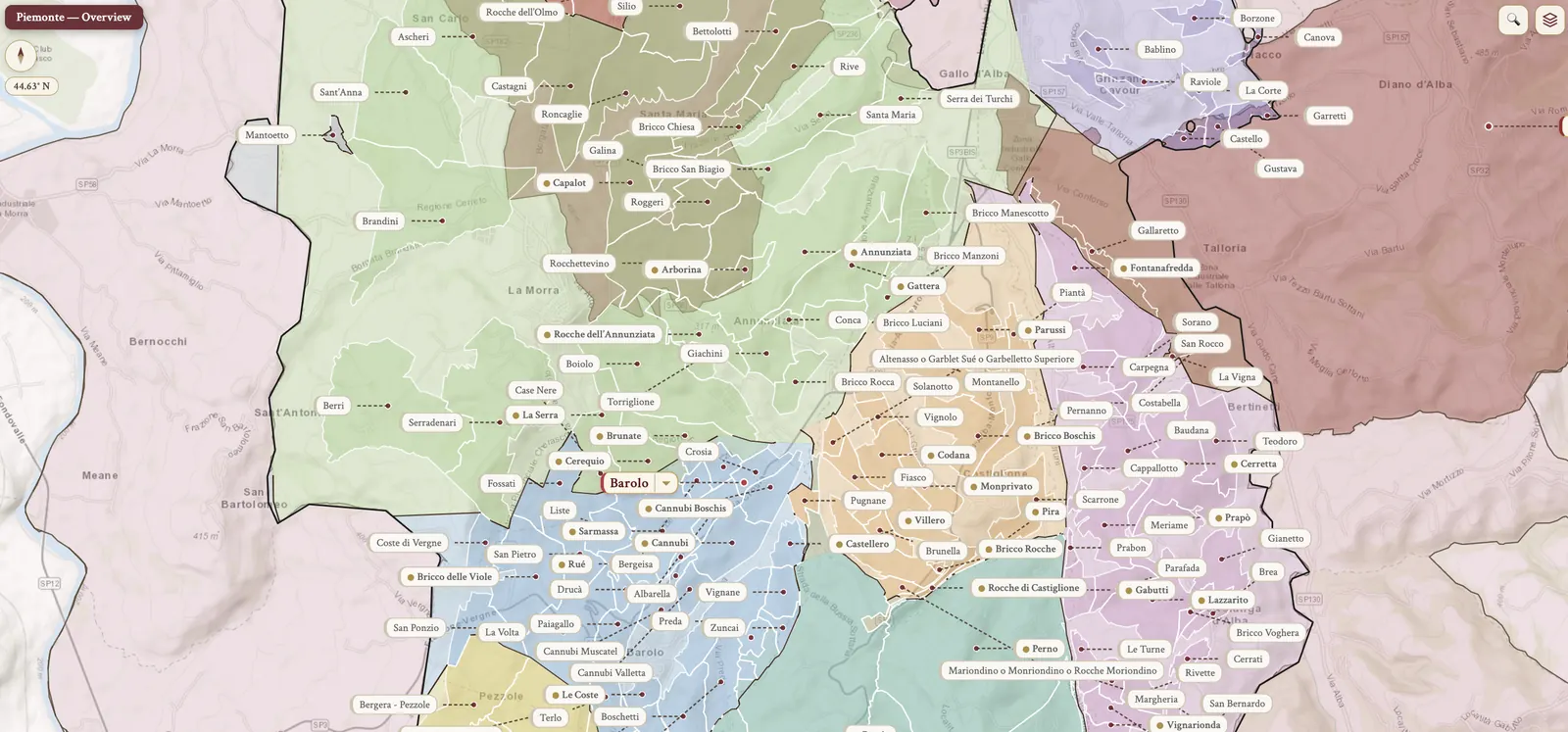
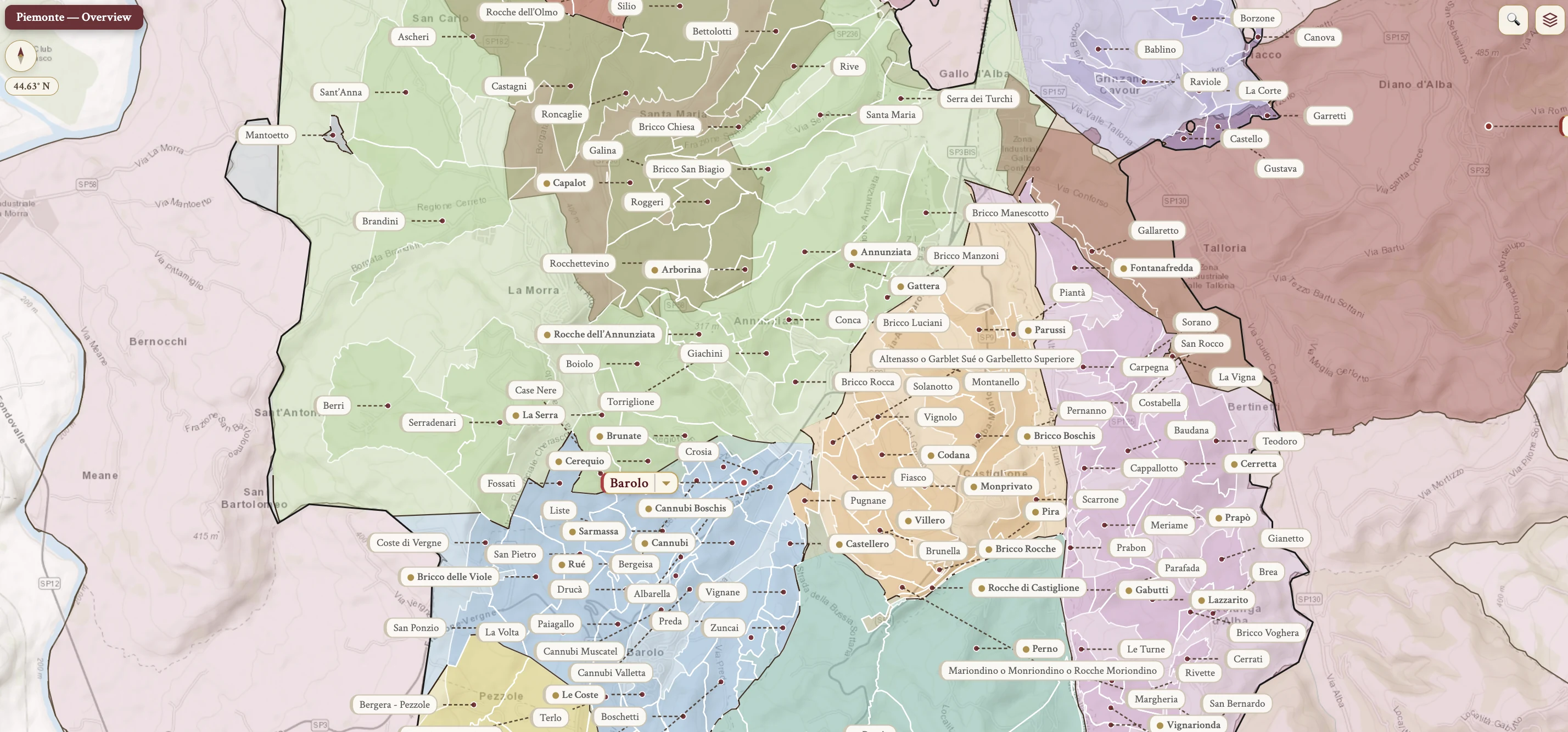
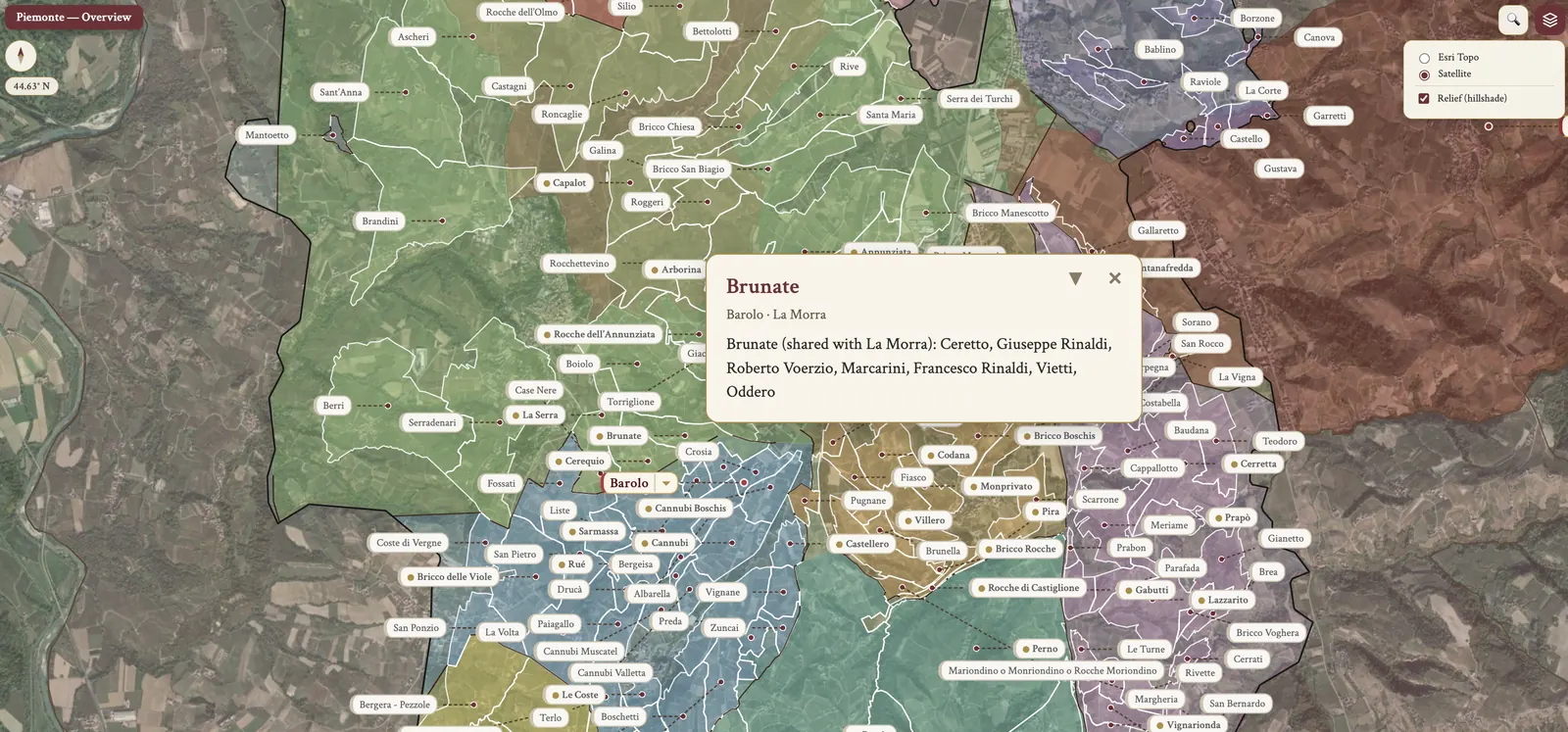
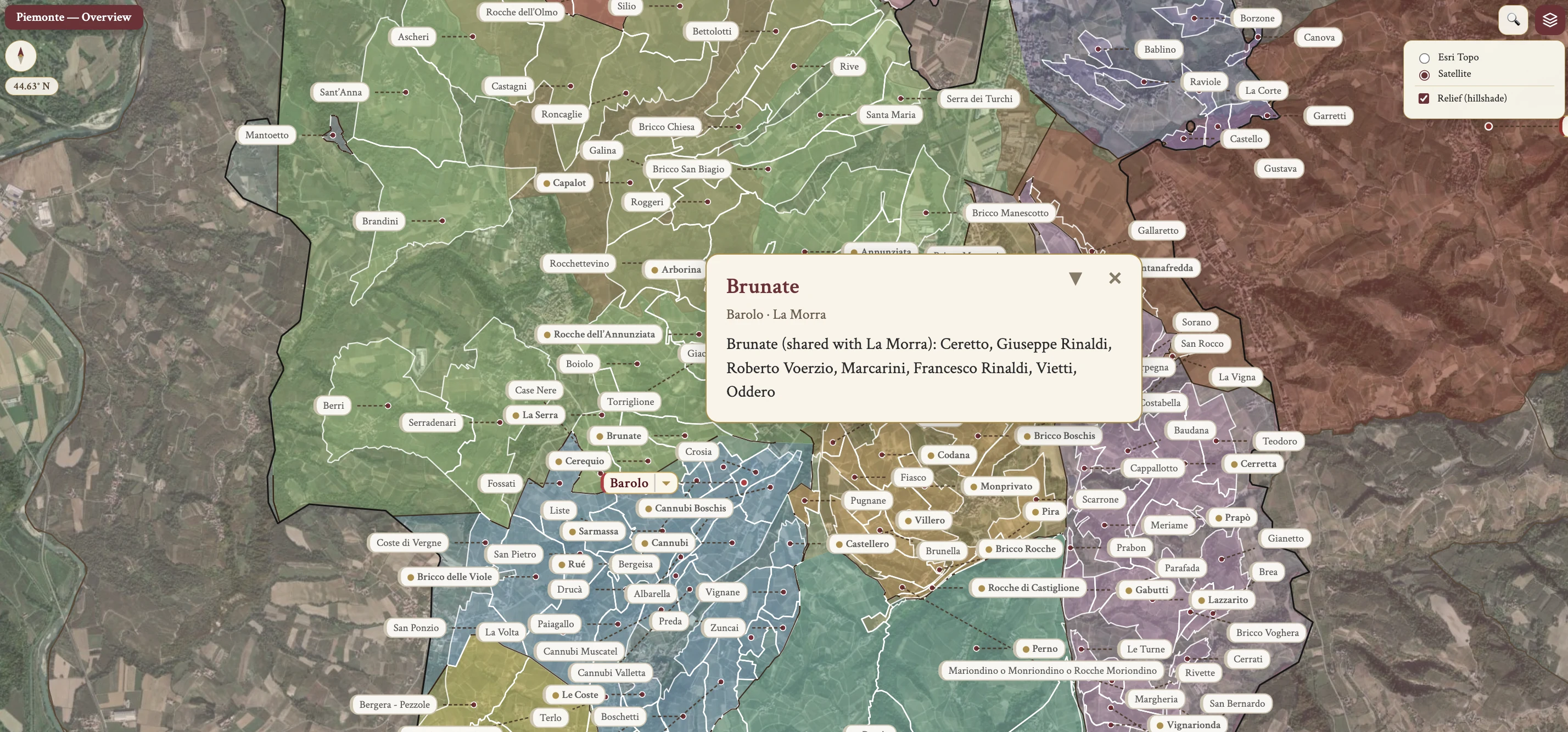
Barolo lies south west of the city of Alba and is 100% Nebbiolo. It was DOC in 1966 and elevated to DOCG in 1980. Its 11 communes are Barolo, Castiglione Falletto and Serralunga d'Alba, entirely included, together with Monforte d'Alba, La Morra, Diano d'Alba, Novello, Verduno, Grinzane Cavour, Cherasco and Roddi, partially included. The 5 main communes — La Morra, Barolo, Serralunga d'Alba, Monforte d'Alba and Castiglione Falletto — represent almost 90% of the DOCG, which holds 181 MGAs.
Commune of Barolo
Cannubi
Cannubi is a low-lying slope just outside the town with southeastern exposure and full access to morning sun, which gives power but less aromatic personality; it is known to be very plush and warm. Its producers are Paolo Scavino, Ceretto, Michele Chiarlo, Elio Altare, E. Pira, Marchesi di Barolo, Borgogno and Francesco Rinaldi.
Cannubi Boschis
Cannubi Boschis, historically known as Monghisolfo, is worked by Luciano Sandrone and Francesco Rinaldi.
Sarmassa
Sarmassa is worked by Marchesi di Barolo, Cabutto Tenuta La Volta and G. Scarzello.
Bricco delle Viole
Bricco delle Viole is worked by Vajra, Marengo and Giovanni Viberti.
Le Coste
Le Coste is worked by Giacomo Grimaldi and Giuseppe Rinaldi.
Castellero & Rué
Castellero and Rué are Bartolo Mascarello blend components.
Brunate
Brunate, shared with La Morra, is worked by Ceretto, Giuseppe Rinaldi, Roberto Voerzio, Marcarini, Francesco Rinaldi, Vietti and Oddero.
Cerequio
Cerequio, shared with La Morra, is worked by Michele Chiarlo, Roberto Voerzio, Batasiolo, Boroli, Vietti and Damilano.
Ravera
Ravera, shared with Novello, is worked by Vietti and Elvio Cogno.
Commune of La Morra
Rocche dell'Annunziata
Rocche dell'Annunziata is worked by Renato Ratti, Paolo Scavino, Roberto Voerzio and Trediberri.
Arborina
Arborina is worked by Elio Altare, Bovio and Mauro Veglio.
Capalot
Capalot is worked by Roberto Voerzio.
La Serra
La Serra is worked by Roberto Voerzio.
Annunziata
Annunziata is worked by Silvio Grasso.
Gattera
Gattera is worked by F. Revello and by Cordero di Montezemolo, whose Monfalletto estate is located here.
Marcenasco, Gancia & Giachini
Marcenasco, Gancia and Giachini are further crus of the commune.
Commune of Castiglione Falletto
Monprivato
Monprivato is a 7 ha southwest-facing site held by Giuseppe Mascarello, its sole owner since 1991.
Villero
Villero is worked by Brovia, Giuseppe Mascarello, Vietti, Oddero and Cordero di Montezemolo, and by Bruno Giacosa, whose last vintage here was '96.
Rocche di Castiglione
Rocche di Castiglione is worked by Vietti, Paolo Scavino, Brovia, Oddero and Terre del Barolo.
Bricco Boschis
Bricco Boschis is worked by Cavallotto.
Bricco Rocche
Bricco Rocche is worked by Brovia, Ceretto and Livia Fontana.
Parussi
Parussi is worked by Bovio and Massolino.
Pira
Pira is worked by Roagna.
Codana
Codana is worked by Giuseppe Mascarello, Francesco Rinaldi and Vietti.
Vignolo & Bricco Fiasco
Vignolo and Bricco Fiasco are further crus of the commune.
Commune of Serralunga d'Alba
Vigna Rionda
Vigna Rionda is worked by Massolino, Oddero, Luigi Pira and Giovanni Rosso.
Fontanafredda
Fontanafredda is worked by Fontanafredda.
Lazzarito
Lazzarito is worked by Fontanafredda, Vietti and Ettore Germano.
Falletto
Falletto is a Bruno Giacosa monopole.
Francia
Francia — Cascina Francia — is the monopole vineyard of Giacomo Conterno in Serralunga d'Alba, source of Monfortino. It runs to 16 ha at 400m altitude on calcareous soils, west-facing. Conterno purchased the Cascina Francia vineyard in 1974, and the first vintage exclusively from this vineyard was 1978.
Cerretta
Cerretta is worked by Elio Altare, by Giacomo Conterno, who purchased here in 2008 with a first vintage of 2010, and by Azelia, Luigi Baudana and Ettore Germano.
Ornato
Ornato is worked by Pio Cesare.
Prapo
Prapo is worked by Ceretto, Ettore Germano and Mauro Sebaste.
Gabutti
Gabutti is worked by Capellano and Ceretto.
Serra
Serra is worked by Bruno Giacosa and Pio Cesare.
Boscareto, Parafada & Arione
Boscareto, Parafada and Arione are further crus of the commune.
Commune of Monforte d'Alba
Bussia
Bussia is worked by Aldo Conterno, Prunotto, Parusso, Conterno Fantino, Oddero, Giuseppe Rinaldi as of the 2019 vintage, Ceretto, Giacomo Fenocchio, Silvano Bolmida and Monti. Bussia Soprana, of Aldo Conterno, is sub-divided into the vineyards Cicala, Colonnello and Romirasco, and Barolo Granbussia is a blend of about 70% Romirasco, 15% Cicala and 15% Colonnello.
Ginestra
Ginestra is worked by Clerico — Domenico Clerico — Elio Grasso and Conterno Fantino.
Perno
Perno is worked by Giuseppe Mascarello and Rocche dei Manzoni.
Santo Stefano di Perno
Santo Stefano di Perno is worked by Giuseppe Mascarello and Rocche dei Manzoni.
Mosconi
Mosconi is worked by Rocche dei Manzoni and Clerico.
Gramolere
Gramolere is a further cru of the commune.
Other communes
Bricco Ambrogio
Bricco Ambrogio, in Roddi, is worked by Paolo Scavino.
Ravera (Barolo/Novello)
Ravera, shared between Barolo and Novello, is worked by Vietti and Elvio Cogno.
The vineyard
Vineyard elevation runs 170-540m, and northern exposures are prohibited; the south and south-west facing slope sits at 200-300m. Good sunlight interception with a cooling influence allows the grapes to ripen fully over a long growing season, giving pronounced aromatic intensity and high acidity.
Regulations
Maximum yield is 56 hl/ha and minimum alcohol 13%, from 12.5% potential at harvest. Barolo requires 38 months aging from 1st Nov of the year of harvest, including 18 months in wood; Barolo Riserva requires 62 months from Nov 1 of the harvest year, again including 18 months in wood.
Soils — three geological ages
All Barolo soils are high in pH, across three geological ages. The Serravallian, also called Helvetian, is the oldest at 13-11 million years ago; it lies south and east, in Serralunga d'Alba and Monforte d'Alba and nearly all of Castiglione Falletto. It is less fertile — yellow-grey compacted sand and clay, sandstone layered with marls and sandy marls — and provides more structure in the wine, tannic in youth and to be cellared for 10-15 yrs. The Tortonian, 11-7 million years ago, lies north and west, in La Morra and Barolo: blue-grey marl called Sant'Agata Fossili, greyish-blue marl soils, with a higher proportion of calcareous marl, giving lighter, more aromatic wine drinkable after a few years in bottle. The Messinian, 7.2-5.3 million years ago, is the youngest and is marked by evaporite deposits and gypsum and anhydrite formations.
The Lequio Formation
The Lequio Formation is the oldest geological portion, the substrate of Serralunga d'Alba and partly of Monforte d'Alba. Its Upper Langa deposits date back about 30 million years and alternate between layers of light, compact marl and cemented sands, giving rise to the famous Langa Stone, the Pietra di Langa.
The official MGA on the Consorzio map
The official Barolo MGA on the Consorzio map number 170 across 11 communes — Barolo (33): Albarella, Bergeisa, Boschetti, Bricco San Giovanni, Bricco delle Viole, Cannubi, Cannubi Boschis, Cannubi Muscatel, Cannubi San Lorenzo, Cannubi Valletta, Castellero, Coste di Rose, Coste di Vergne, Crosia, Drucà, Fossati, La Volta, Le Coste, Liste, Monrobiolo di Bussia, Paiagallo, Preda, Rivassi, Rué, San Lorenzo, San Pietro, San Ponzio, Sarmassa, Terlo, Vignane, Zoccolaio, Zonchetta, Zuncai; Castiglione Falletto (20): Altenasso o Garblet Sué o Garbelletto Superiore, Bricco Boschis, Bricco Rocche, Brunella, Codana, Fiasco, Mariondino o Monriondino o Rocche Moriondino, Monprivato, Montanello, Parussi, Pernanno, Piantà, Pira, Pugnane, Rocche di Castiglione, Scarrone, Solanotto, Valentino, Vignolo, Villero; Cherasco (1): Mantoetto; Diano d'Alba (2): Gallaretto, La Vigna; Grinzane Cavour (8): Bablino, Borzone, Canova, Castello, Garretti, Gustava, La Corte, Raviole; La Morra (38): Annunziata, Arborina, Ascheri, Berri, Bettolotti, Boiolo, Brandini, Bricco Chiesa, Bricco Cogni, Bricco Luciani, Bricco Manescotto, Bricco Manzoni, Bricco Rocca, Bricco San Biagio, Brunate, Capalot, Case Nere, Castagni, Cerequio, Ciocchini, Conca, Galina, Gattera, Giachini, La Serra, Rive, Rocche dell’Annunziata, Rocchettevino, Roere di Santa Maria, Roggeri, Roncaglie, San Giacomo, Santa Maria, Sant’Anna, Serra dei Turchi, Serradenari, Silio, Torriglione; Monforte d'Alba (10): Bricco San Pietro, Bussia, Castelletto, Ginestra, Gramolere, Le Coste di Monforte, Mosconi, Perno, Ravera di Monforte, San Giovanni; Novello (7): Bergera - Pezzole, Cerviano - Merli, Ciocchini - Loschetto, Corini - Pallaretta, Panerole, Ravera, Sottocastello di Novello; Roddi (1): Bricco Ambrogio; Serralunga d'Alba (39): Arione, Badarina, Baudana, Boscareto, Brea, Bricco Voghera, Briccolina, Broglio, Cappallotto, Carpegna, Cerrati, Cerretta, Collaretto, Colombaro, Costabella, Damiano, Falletto, Fontanafredda, Francia, Gabutti, Gianetto, Lazzarito, Le Turne, Lirano, Manocino, Marenca, Margheria, Meriame, Ornato, Parafada, Prabon, Prapò, Rivette, San Bernardo, San Rocco, Serra, Sorano, Teodoro, Vignarionda; Verduno (11): Boscatto, Breri, Campasso, Massara, Monvigliero, Neirane, Pisapola, Riva Rocca, Rocche dell’Olmo, Rodasca, San Lorenzo di Verduno.