Rioja & Navarra — Wine Region Guide
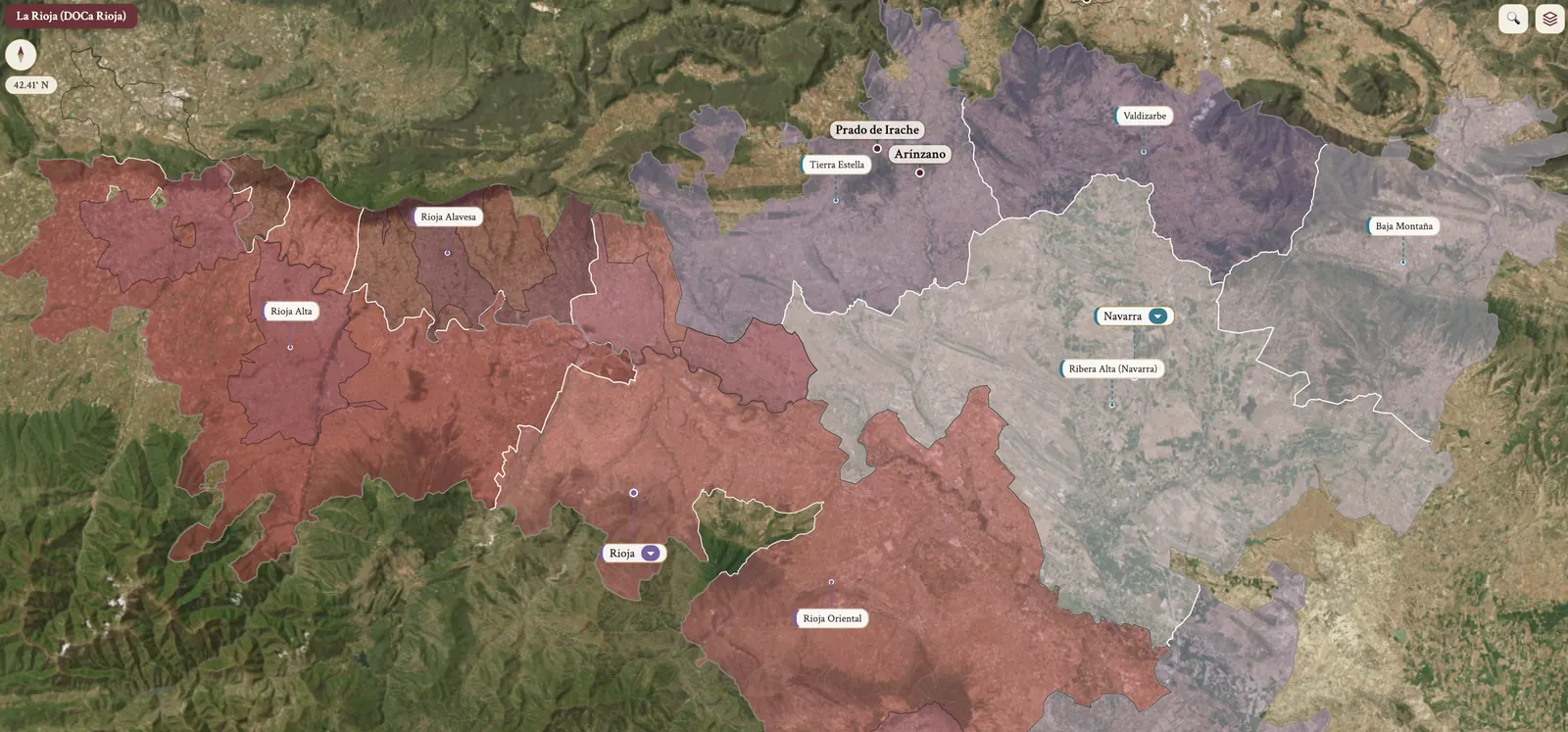
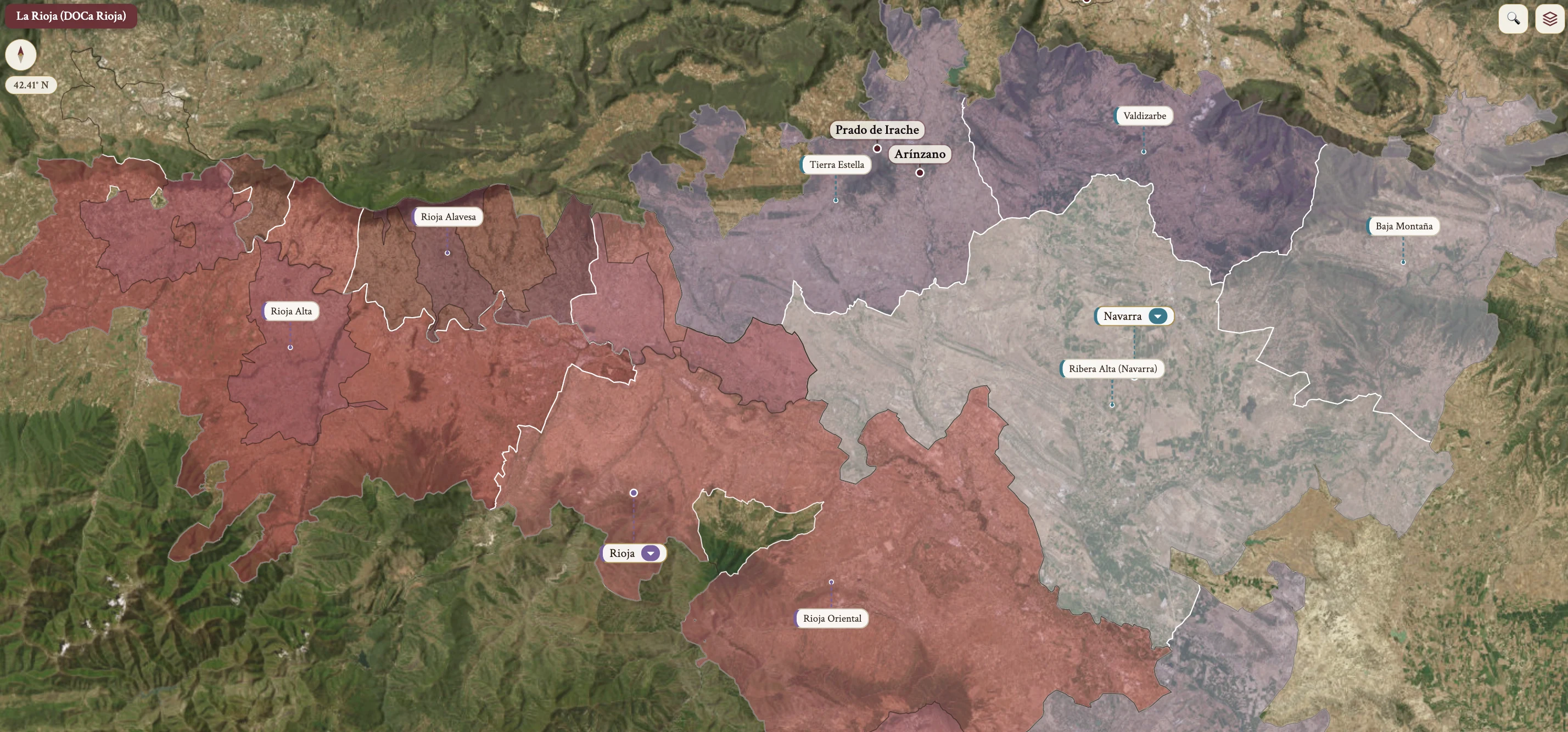
The Rioja & Navarra maps from Your Own Wine Encyclopedia — every name tag opens a study card. Below, the chapter's own geography, climate and geology notes.
From the encyclopedia
Overview
La Rioja is Spain's second-smallest autonomous community. Its capital, Logroño, holds about 50% of the region's 315,000 inhabitants and is a major stop on the Camino de Santiago. The wine region is located within 3 autonomous regions: La Rioja itself, with 69% of the vines; Pais Vasco, the Álava province, with 20%; and Navarra with 11%.
DOCa Rioja stretches ~62 mi/100 km north-west to south-east along the Ebro, and is ~25 mi/40 km wide. The area under vine is 162,697 ac / 65,841 ha. Production is about 90% tinto, 5% blanco, 5% rosado and <1% espumoso.
History
The Real Sociedad Económica de Cosecheros de Rioja was created in 1787 to protect La Rioja's reputation. In the mid-19th century two pioneers, Marqués de Murrieta and Marqués de Riscal, brought Bordeaux winemaking techniques to Rioja: barrique aging in barricas, and estate bottling in bodegas. Phylloxera arrived in Rioja in 1899.
In 1926 Rioja pioneered the first bottle seal guaranteeing wine origin in Spain, and in the 1930s Spain's Consejos Reguladores regulatory system was established for Rioja, Jerez and Málaga. In 1991 Rioja was elevated to DOCa status, the first DOCa in Spain and one of only 2 DOCa, alongside Priorat DOQ.
The Rioja Trustseal is a modern security system modeled on European banknote technology: a metallic strip with the DOCa logo embedded in a color-coded label, the first of its kind in the wine world.
Soils
Three primary soil types are found across the region: calcareous clay, ferrous clay and alluvium.
Calcareous, or chalky, clay accounts for about 30%. It lies on steep terraces running from the Sierra de Cantabria down to the banks of the Ebro. It is poor and hard to irrigate and cultivate, and it is dominant in all of Rioja Alavesa and in the parts of Rioja Alta nearest the river.
Ferrous clay accounts for about 25%, on the low mountains on the right bank of the Ebro and on the lower hillsides in Rioja Alta and Rioja Oriental. It is compact clay with slow root penetration, moderately sloped and difficult to irrigate.
Alluvial soil accounts for about 45%, along the Ebro and its tributaries in Rioja Alta and Rioja Oriental. Roots reach ~3.3 ft/1 m before hitting limestone hardpan. It is susceptible to drought and to waterlogging, and the flat terrain is highly mechanized.
Black Grape Varieties — Tempranillo
Black grape varieties accounted for 91% of plantings in 2020. Tempranillo alone is 88% of black grape plantings and >75% of the total area under vine. Recent studies show it originated in the upper Ebro River Valley.
As recently as the early 1970s Tempranillo occupied only 30% of vineyard land, while Garnacha Tinta was at ~40%; growth has been rapid since then as its potential was recognized. It reliably produces larger yields, and with the legalization of irrigation drought resistance became less important, so many Garnacha were replanted with Tempranillo.
It is early ripening and able to ripen even in cooler, high-altitude sites with cool clay soils, which makes it well suited to Rioja Alta and Rioja Alavesa. As a varietal it produces lower-alcohol wine, so it is commonly blended with Garnacha Tinta, Mazuelo and Graciano to boost alcohol.
Tempranillo is the dominant component in most red Rioja, with raspberry and black plum fruit and M to M(+) tannins and acidity. Some single varietal Tempranillo is also made.
Black Grape Varieties — Garnacha, Graciano, Mazuelo and the rest
Garnacha is ~8% of black grape plantings. It is well suited to warm, dry conditions, Rioja Oriental among them, and growers have begun to replant it, as it is better suited to warm conditions than early-ripening Tempranillo. It gives ripe strawberry fruit, lower tannins and fuller body, and it is the predominant variety for Rioja rosado, with moderate pigment and luscious red fruit.
Graciano is late ripening and drought resistant, gives only small yields, and is susceptible to fungal diseases. It has H acidity and tannin with fresh black fruit, and is occasionally bottled as a single varietal; it is just over 2% of black grape plantings. Mazuelo, which is Cariñena or Carignan, also has H acidity, is just over 2%, and is very occasionally seen as a single varietal.
Maturana Tinta, which is Trousseau (see Jura), was permitted in Rioja in 2009, and plantings are tiny but increasing. It has deep purple color and H acidity, with fresh cranberry and blackberry. Cabernet Sauvignon is also permitted, with very small plantings.
White Grape Varieties
Viura, which is Macabeo, is 68% of white plantings and 6% of total Rioja plantings. It is best suited to warm, dry sites, buds late and ripens late, and is susceptible to botrytis. It is a neutral grape with a range of styles: high yields with stainless steel give simple whites, while low yield with oak gives concentrated, complex wines with long aging potential.
Tempranillo Blanco is 13% of white plantings, the 2nd most planted white grape. It is a white mutation of Tempranillo, first discovered in 1988 and permitted in 2004, and its plantings have risen quickly. It has H acidity with lemon, grapefruit and pineapple.
Malvasía and Garnacha Blanca are blending components that bring a diversity of flavors, generally in oak-matured mid to premium wines. Verdejo and Sauvignon Blanc are made as single varietals or in blends with Viura, giving more flavor intensity and acidity, typically in inexpensive unoaked styles.
Authorized White Grapes & Varietal Labeling
In 2007 the Consejo Regulador authorized additional white grapes, including Chardonnay, Sauvignon Blanc and Verdejo. Varietal white wines have been permitted since 2017: a single-varietal wine may be made from any of the 9 authorized white grapes.
The traditional grapes are Viura, Malvasía de Rioja, Garnacha Blanca, Tempranillo Blanco, Maturana Blanca and Turruntés de Rioja. The grapes added in 2007 are Chardonnay, Sauvignon Blanc and Verdejo.
Location & Climate
Rioja is located in northern Spain, mainly across La Rioja, Álava in the Basque country, and Navarra. Its borders are País Vasco and Navarra to the north and east, Aragón to the south-east, and Castilla y León to the south and west. It runs ~100 km long in a north-west to south-east direction, along the Río Ebro, and is ~40 km wide.
The climate is predominantly continental: hot dry summers with ample sun, mild autumns, and cold winters with spring frost risk. Avg temps are 54–90°F / 12–32°C and annual rainfall is 12–24 in / 300–600 mm, with mountainous areas receiving more.
Rioja Alavesa and Rioja Alta, in the north-west, take some maritime influence from the Bay of Biscay, which makes them cooler and more humid. Rioja Oriental, in the south-east, takes some Mediterranean influence and is the warmest, most arid zone. Vintage variation is marked: the region may receive more or less Atlantic influence, cooler and wetter, or Mediterranean influence, warmer and drier, and it is difficult to generalize because the region is large and varied.
Under climate change, high-altitude vineyards have become more viable, where previously grapes struggled to ripen. Low-altitude vineyards in Rioja Oriental are the most at risk, being already warm and suffering from drought.
Topography — the Mountain Ranges
To the north stand the Montes Obarenes and the Sierra de Toloño, both part of the larger Sierra de Cantabria, itself part of the Pyrenean-Cantabrian range. These mountain ranges protect the vineyards from cold, rainy northern coastal winds. The Sierra de Cantabria also separates Rioja Alavesa from the rest of Álava province.
To the south lies the Sierra de la Demanda, the western end of the Sistema Ibérico. It separates La Rioja from the Meseta's severe climate. Its highest peak is Monte San Lorenzo, at 7,451 ft / 2,271 m, and many Ebro tributaries originate here. South-central is the Sierra de Cameros.
Topography — the Ebro and the Seven Valleys
The Ebro is Spain's longest river. It originates in Cantabria and enters La Rioja through a narrow gorge between the Montes Obarenes and the Sierra de Toloño, then flows ~75 mi/120 km through Rioja en route to the Mediterranean. On the way it passes Haro and Logroño in Rioja Alta, and Calahorra and Alfaro in Rioja Oriental.
Seven tributaries from the Sistema Ibérico form the Zone of Seven Valleys: the Oja, Najerilla, Iregua, Leza, Jubera, Cidacos and Alhama.
The Cierzo
The Cierzo is a powerful north-west wind that blows through the Ebro Valley. It originates from an anticyclone over the Bay of Biscay and reaches speeds up to 62 mph / 100 km/h. It is most dominant in Rioja Oriental, and blows mainly in autumn and winter.
Its benefits are direct: it chases humidity and moderates temperatures, which gives more gradual ripening and less disease pressure.
Viticulture
Vines are trellised with VSP, the most common system, which allows mechanization. There are also considerable plantings of old bush vines, some of them over 100 years old.
Vara y pulgar, meaning "stick and thumb", is a unique pruning method used in Rioja, and also extensively in Andalucía. The vine is a single trunk with two arms, and production alternates yearly between them. One arm is cut back to a pulgar, a spur of 1–2 buds, while the opposite arm is left with a vara, a cane of 7–8 buds, for fruit production. Each year the roles swap: one side grows and the other rests, which optimizes yields.
Winemaking for Red Wines
A variety of styles is reached through blending, drawing on different varieties, vineyard areas and winemaking techniques.
The aging regulations allow only 225 L barriques, and they apply to still white, rosado and red Rioja alike; the maximum for all Spain is 330 L. No oak chips or staves are allowed. American oak barrels are still the primary choice, some winemakers are experimenting with French oak, and today >50% of red wines undergo a barrel regimen.
If the grapes are destemmed, the wine must be a min 95% red grapes; if whole bunches are used, the min drops to 85%. Carbonic maceration is employed for younger wines intended for immediate consumption.
Vinos de autor appeared in the 1990s: premium wine without an aging category, from low yields and selected parcels, very ripe, concentrated and structured, and aged in new French oak. It was a step away from the former style of long aging in American oak with secondary and tertiary notes.
Current Winemaking
There are two stylistic camps, modern and traditional, and the majority falls between them. The common trend is to highlight the characteristics of the grapes: earlier harvest dates, gentle extraction, older and larger oak vessels, concrete and amphorae, and shorter maceration. There is the option to label within an aging category or not. French oak is more common, some use only American, and some blend both.
Blending across the DOCa is a feature of the region, which has many small growers, few wineries and many co-ops. Garnacha is best in Rioja Oriental, while Tempranillo is of higher quality from Rioja Alta and Alavesa.
Blending for Tempranillo
Garnacha Tinta, Mazuelo (Cariñena) and Graciano are the three common blending grapes. Graciano brings concentrated black fruit aromas, acidity and tannins, which give aging potential; it is a distinct variety and is NOT identical to Monastrell, despite the occasional synonym confusion. Mazuelo brings high acidity, tannin and color, which also give aging potential.
The classic blend is 70–80% Tempranillo, 10–15% Garnacha, 5–10% Mazuelo, and a small % of Graciano.
Winemaking for White Wines
Inexpensive white Rioja is a simple unoaked style: protective winemaking, cool temps in stainless steel, bottled soon, made from high-yield Viura, with M acidity.
Mid to premium whites are an oaked style. The classic oxidative version uses skin contact, MLC, lees stirring and long barrel maturation, which give complexity, texture and fuller body. The modern style, which changed in the last 5–10 years, is more balanced and fresher: Viura at lower yields with Malvasía and Garnacha Blanca, M(+) body and M(+) acidity, and subtle citrus with smoky, nutty complexity.
Winemaking for Rosé
Rosé is a small volume here, but it includes some of the highest quality and most expensive rosé in Spain. It is made from Tempranillo or Garnacha, pale to deep in color, mostly in stainless steel and bottled soon. The traditional style, as at López de Heredia, is matured in oak.
Cosecheros
Cosecheros are small-scale grape growers producing young red wine by semi-carbonic maceration, a whole berry and whole bunch fermentation with wild yeast. They are especially associated with Rioja Alavesa, and their wines are fresh, grapey, low-acidity reds.
There are ~700 cosecheros in Rioja, and only ~150 bottle their own production. There has been a resurgence in places such as Labastida, where growers are reclaiming their heritage by crafting unique village-terroir wines.
Assemblage Requirements
Blanco must be 100% authorized white grapes. Rosado must be a min 25% combined authorized red grapes. Tinto must be a min 95% authorized red grapes if destemmed, and a min 85% authorized red grapes if whole clusters or whole berries are used.
On the map
- Navarra