Toscana — Wine Region Guide
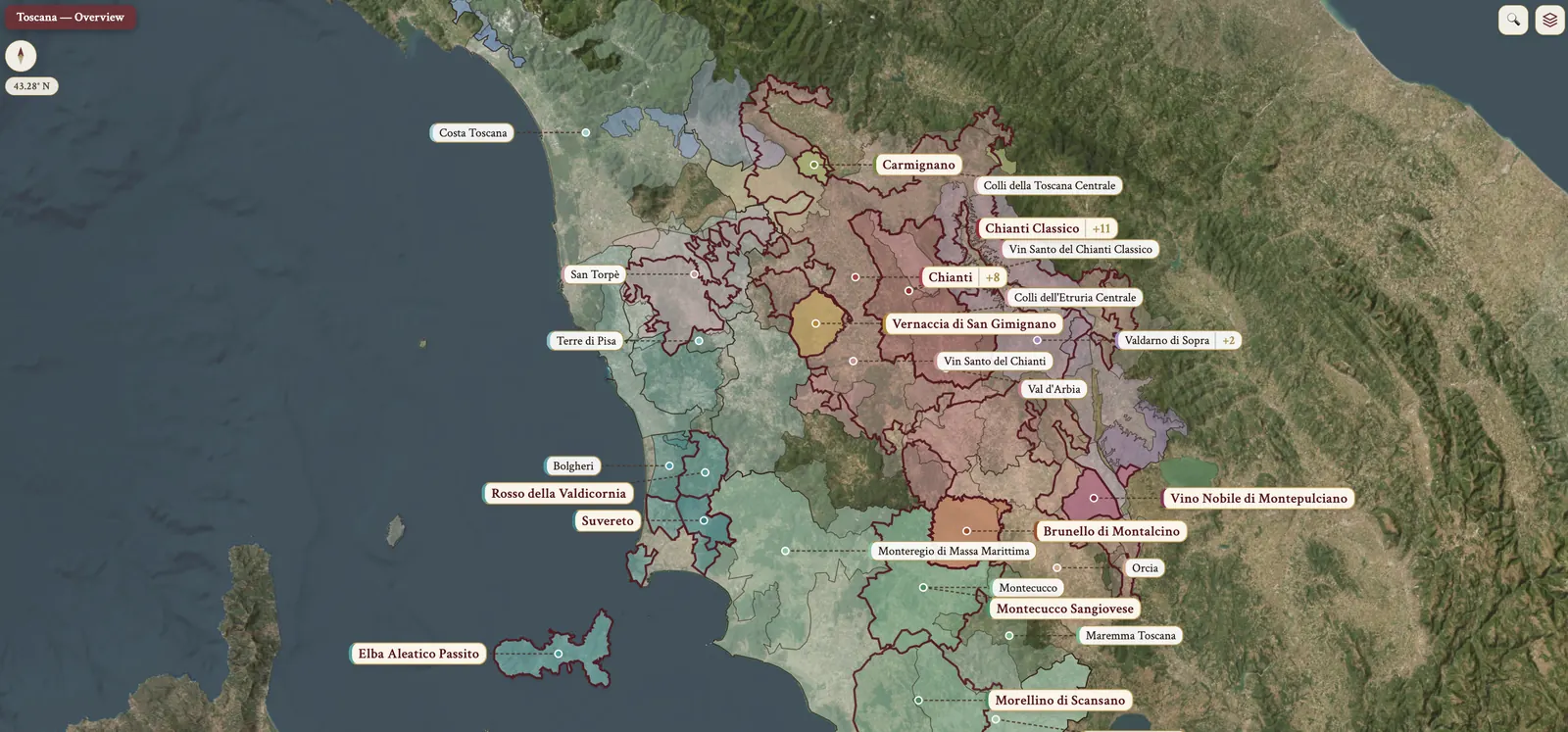
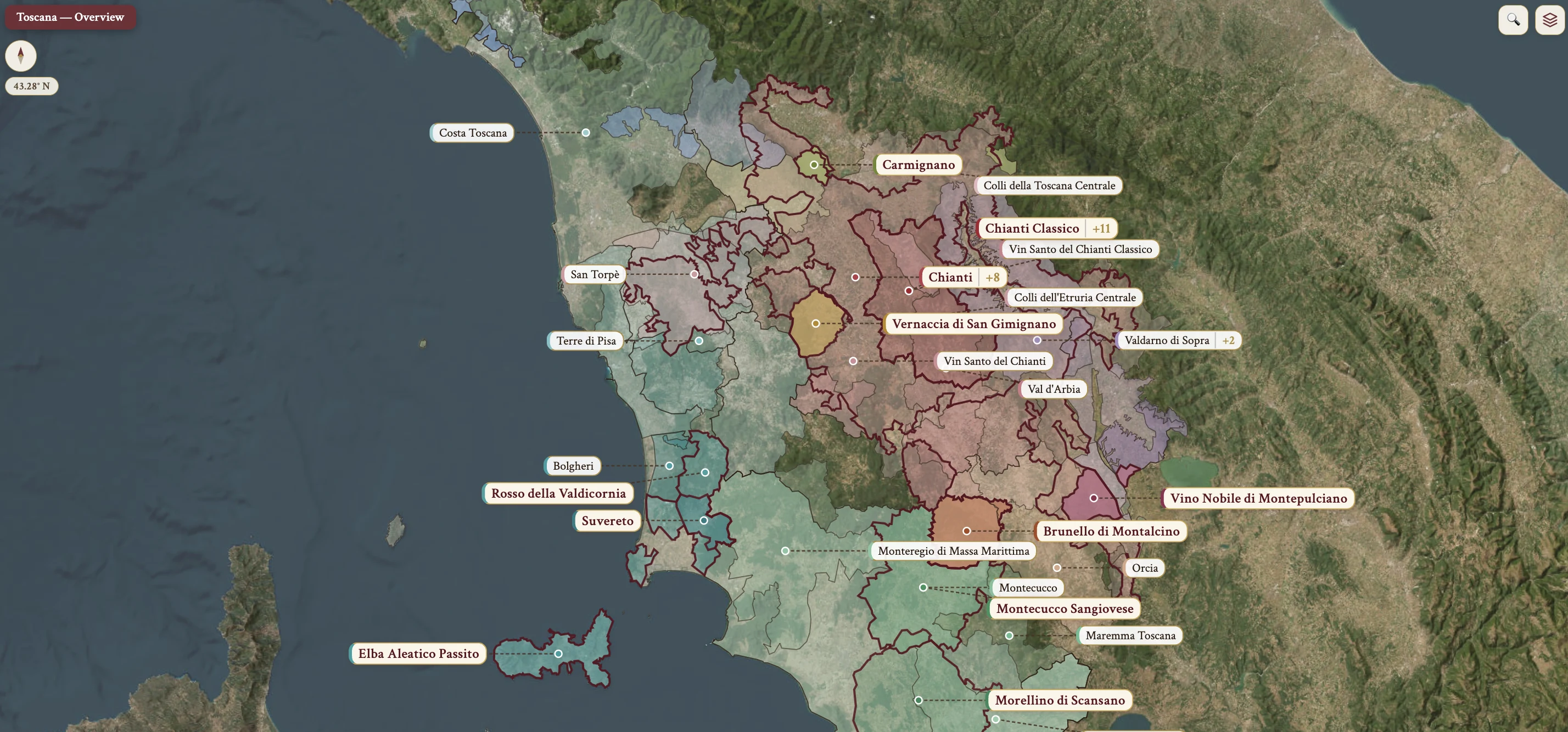
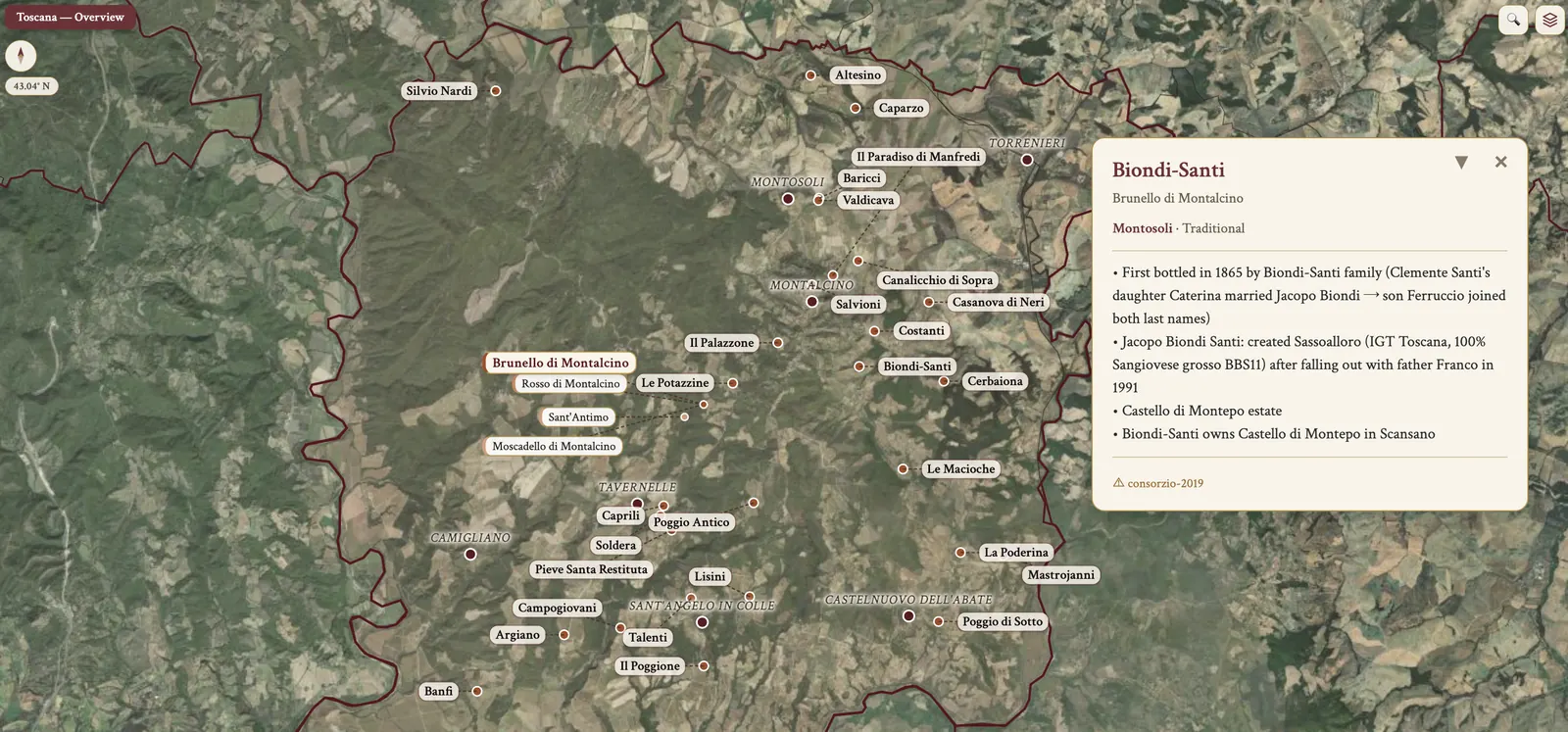
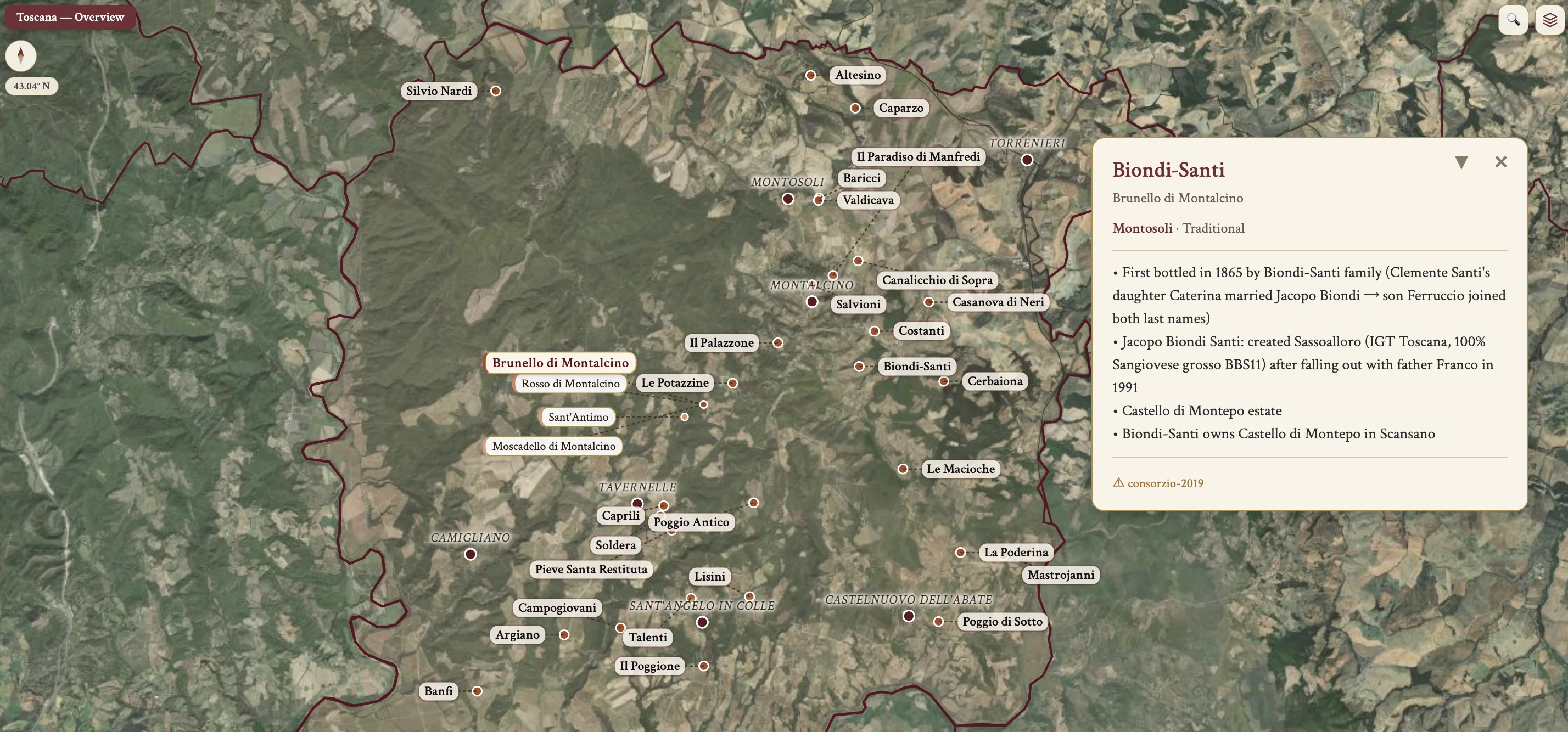
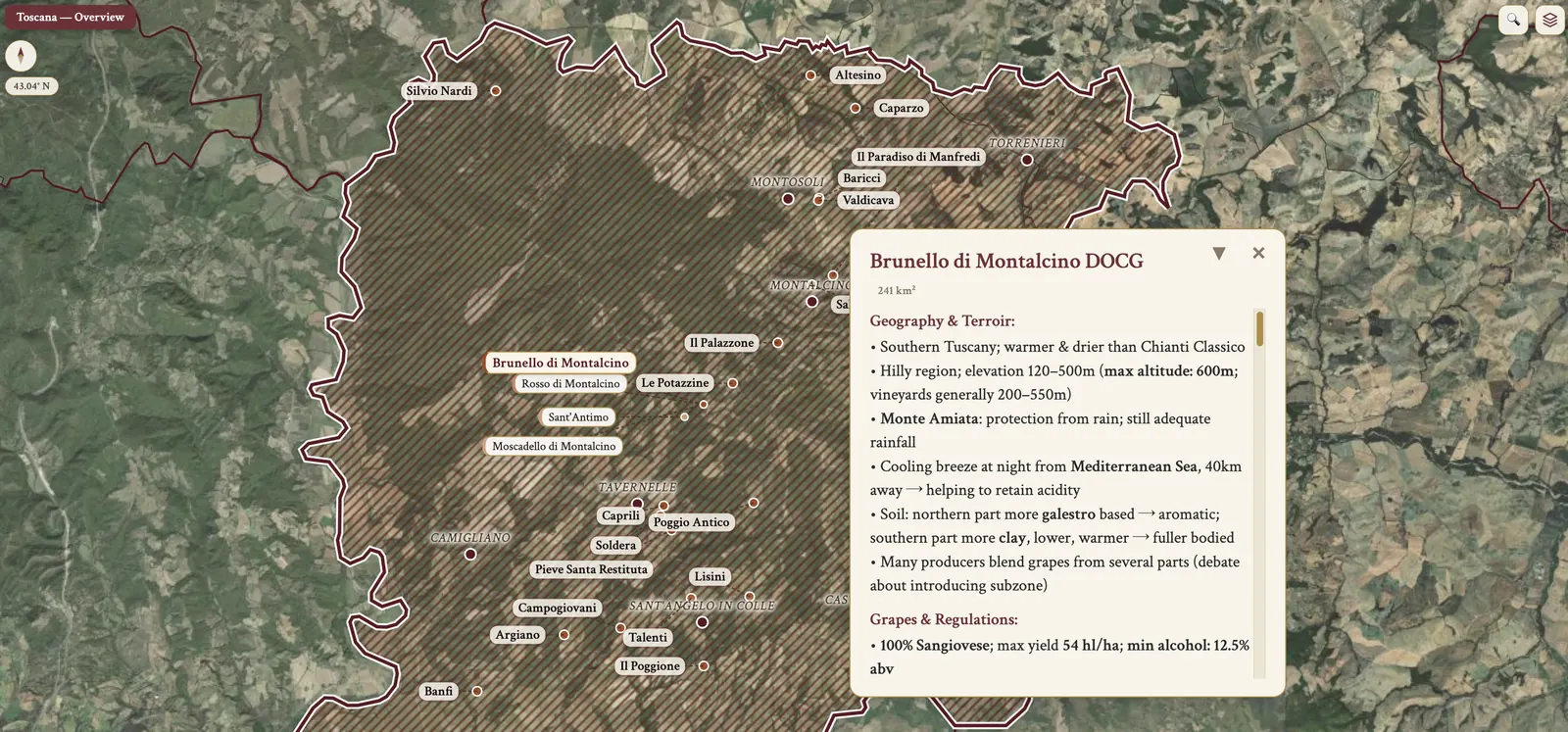
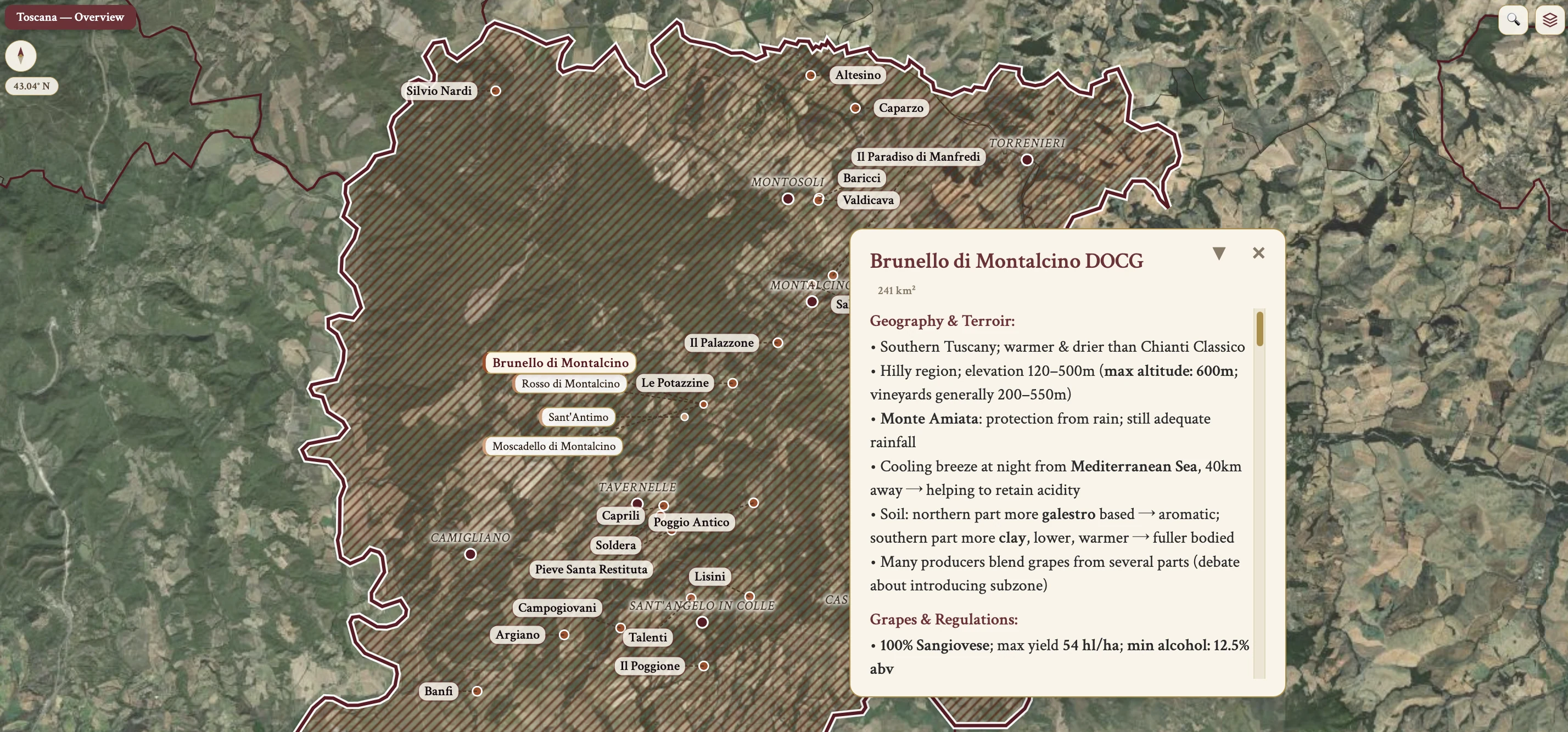
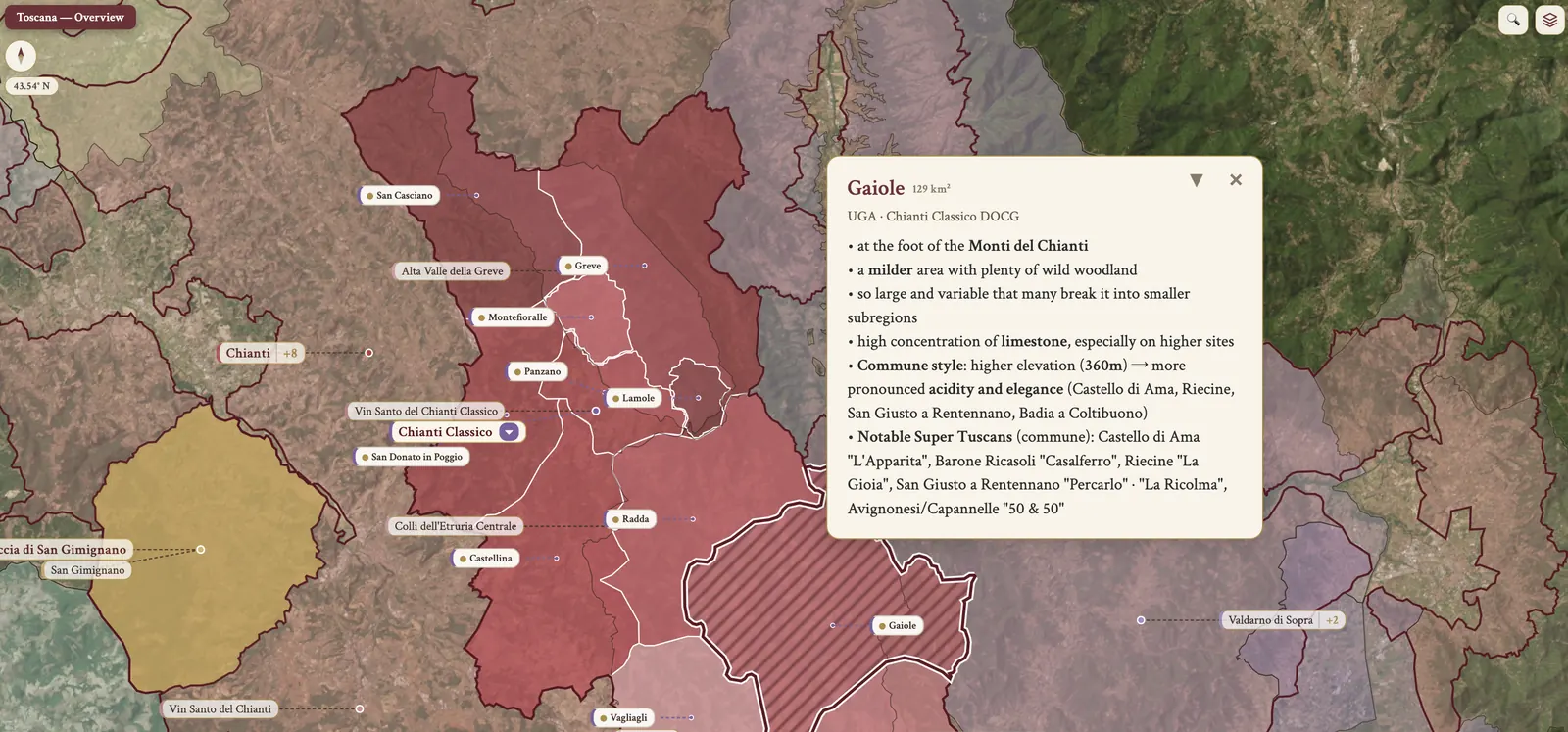
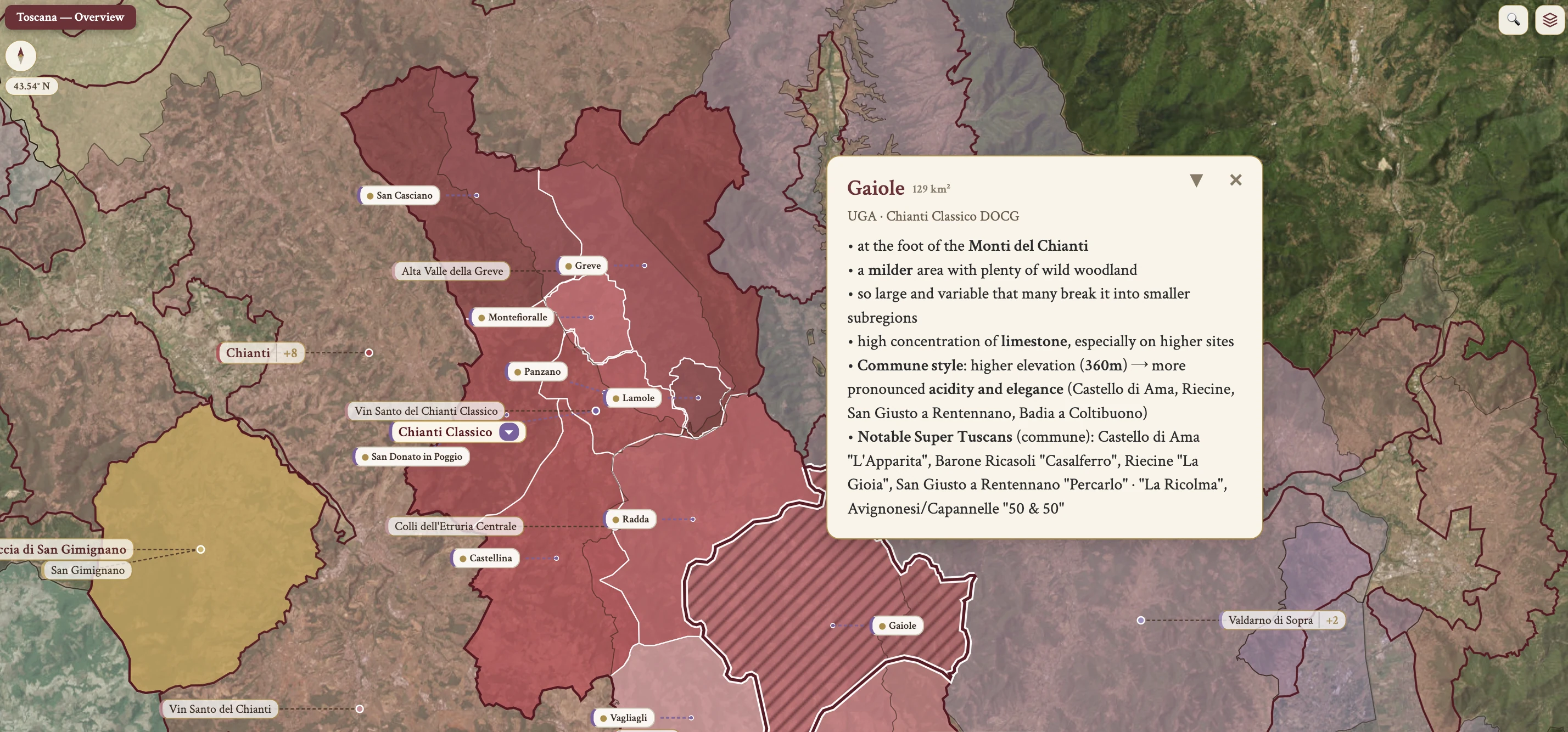
The Toscana maps from Your Own Wine Encyclopedia — every name tag opens a study card. Below, the chapter's own geography, climate and geology notes.
From the encyclopedia
Overview
Toscana occupies the northwestern part of central Italy and is the largest of the central Italian regions. It has 373 miles / 600 km of coastline, facing the Ligurian Sea to the north and the Tyrrhenian Sea to the west.
The Northern Apennines form the northeastern border. The Arcipelago Toscano, the Tuscan Archipelago, is a group of 7 islands, of which Isola d'Elba, Elba, is the largest.
Production Profile
Toscana has about 143,000 ac / 58,000 ha under vine, roughly 6% of Italy's total, and makes about 2.7 million hl. Almost 90% of that is red wine, and red grapes are >80% of plantings.
By origin category, DOC/G accounts for about 65% and IGT for about 30% — almost entirely Toscana IGT — with the balance wine without origin. 2 of Italy's first DOCGs are here: Brunello di Montalcino and Vino Nobile di Montepulciano.
Local Terms & Symbols
Estate names in Toscana follow a small set of local terms: podere, a farm; poggio, a knoll; castello, a castle; and fattoria, again a farm.
Two symbols belong to the region as firmly as the terms do. The fiasco is the squat, straw-covered Chianti bottle that epitomized cheap Italian wine in the 1960s-80s. The Gallo Nero, the Black Rooster, is the symbol of Chianti Classico DOCG.
Climate
The climate is warm Mediterranean. Rainfall is adequate, and the growing season has some rain. Higher altitude in the inland is a cooling influence, while the inland pattern is cold winter and hot summer.
The coast, the islands and the southern Maremma have the highest average annual temperature, about ~59°F / 15°C, with summer heat mitigated by sea breezes. Inland the climate is more continental — freezing in winter, and easily >95°F / 35°C in summer.
Rain is not spread evenly. It is wettest along the Apennines and driest in central-southern Toscana, because Corsica blocks humid air from the west and south-west. Drought is a problem especially in Maremma and southern Toscana.
Topography
Toscana is 67% hills, 25% mountains, 8% plains. The great majority of vineyards sit on hills at 150–550m (500–1,800 ft). The plains are small and alluvial, lying along the coast or in inland river valleys.
The Maremma is a large historic-geographic area shared between Toscana and Lazio, a coastal territory running from south of Livorno to the province of Viterbo. It is divided into Alta Maremma, the northern Tuscan part; Maremma Grossetana, the southern Tuscan part, often simply called Maremma; and Maremma Laziale. Formerly marshland and malarial, it was drained in the first half of the 20th century.
Soil
A complex geologic history has left the soils diverse, and they may change considerably even within the same appellation. They are mainly clay, limestone and sandstone, and the crumbly nature of these materials gives the gentle rolling hills of central Toscana. Principally the ground is limestone and clay.
Galestro is a crumbly rock with clay and marl, and it gives aromatic wines with aging potential. It is found particularly in Chianti Classico, Rùfina and Montalcino. In closer description it is a crumbly clayey, schist-like rock with sharp edges and a tendency to flake, which is to say schistous.
Alberese is a calcareous soil with clay, a fine-grained calcareous marl. It lies in central and southern Toscana, particularly in Chianti Classico. There is also some sand and sandstone.
Rivers
The Arno is the largest and longest river; it flows westward across Toscana and empties into the Ligurian Sea. There are 6 rivers in all: Serchio, Arno, Cecina, Sieve, Ombrone and Fiora.
The Orcia river lies between Brunello and Montecucco, and the Ombrone and Orcia rivers run through the southern part of the region. Three rivers surround Brunello: Asso to the east, Orcia to the south and Ombrone to the west.
Hazards
The hazards are spring frost, hail, rain at harvest and summer drought. In many DOC(G)s irrigation is allowed.
A heat wave, meaning prolonged high temperature, brings cessation of photosynthesis and so incomplete ripening of skin and seed. Wild boar are met with fencing, and esca with soft pruning.
Grape Varieties — Sangiovese
The identity of Sangiovese begins with its name: Sanguis Jovis, Latin for Jupiter's blood. Its DNA cross is Ciliegiolo × Calabrese Montenuovo, which suggests a southern Italian origin, not a Tuscan one.
It carries many synonyms — Brunello in Montalcino, Prugnolo Gentile in Montepulciano, Morellino in Scansano, Sangiovese Grosso, and Sangioveto in Chianti Classico — all genetically identical, DNA proven. It is the most planted variety in Italy, at 10%, and in Tuscany, where it is >60% of Toscana's plantings.
Sangiovese — Viticulture and Wine Profile
Sangiovese is early budding and late ripening, which exposes it to spring frost at one end of the season and autumn rain at the other. It is difficult to grow successfully, being vigorous and high yielding. Vigorous growth calls for careful canopy management to avoid shading; being productive, it calls for pruning, cluster thinning and green harvesting to reduce yield. Its thin skin leaves it susceptible to botrytis.
It is best on a sunny south or south-east facing slope, which aids ripening, and it tends to be grown at 200–550m altitude, where the longer growing season allows full ripeness. Growers are now looking to higher sites or less sunny aspects owing to global warming. It is best on limestone and shale, which drain excellently, and reasonably successful in clay.
The wine is M ruby in color, with red fruit and a herbal note, M to F in body, with H tannins and H acidity. It runs from acceptable to outstanding in quality, and from inexpensive to super-premium in price.
Trebbiano Toscano and Canaiolo Nero
Trebbiano Toscano, the same variety as Ugni Blanc, is late budding, vigorous and high yielding, and good disease resistant, though it is prone to downy mildew and eutypa dieback. It ripens well in warm condition with retaining acidity. The aroma is neutral, M(-) in intensity, showing lemon and herbal notes, and the high acidity makes it suitable for Vin Santo. It is declining in popularity, for lack of fruitiness and with increased demand for red wine.
Canaiolo Nero adds red fruit and some floral note to a blend, with only light tannins; it adds aromas and softens tannins, refining perfume and mouthfeel. It was historically the principal red grape of Toscana until the 18th century, then gradually lost ground to Sangiovese. Its decline accelerated after phylloxera, as it proved difficult to graft. Now it is merely a blending option.
Ciliegiolo, Colorino and Aleatico
Ciliegiolo means small cherry, which is the cherry aroma typical of this grape. It is a parent of Sangiovese, with Calabrese Montenuovo, and as a blending partner it softens Sangiovese with its lower acidity. It has adapted well to the warmer Maremma, where it gives varietal wines.
Colorino, in full Colorino del Valdarno, means little colored one, a reference to its deep color skin. It is added to Sangiovese for color, deepening the color of Chianti and VNM.
Aleatico is believed native to Toscana and is related to Moscato Bianco, Muscat Blanc à Petits Grains. Its character is aromatic, and grown on Isola d'Elba it gives fragrant sweet red wines.
White Varieties — Additional Notes
Two additional notes belong to the white side. Malvasia Bianca Lunga, also called Malvasia del Chianti, has been grown in Chianti for centuries; its main role today is Vin Santo, to which it provides body, texture and perfume.
Vernaccia di San Gimignano takes its name from the Latin vernaculus, meaning indigenous or native. It is unrelated to the other Italian Vernaccias, Vernaccia di Oristano among them.
International Varieties
International varieties have been present since at least the 19th century, and have increased significantly over the last 30 years, boosted by Super Tuscan success. Merlot is the 2nd most widely planted grape in Toscana, after Sangiovese, and Cabernet Sauvignon the 3rd most planted. Syrah, Cabernet Franc, Petit Verdot and Pinot Nero are also grown. International red varieties account for about 20% of total plantings.
Viticulture
The most common training systems are Archetto, a Guyot variation, Cordone Speronato — cordon spur — and Guyot itself. Average vine density is 5,000–7,000 vines/ha.
Clonal research centres on the Chianti Classico 2000 project, run from the late 1980s by the Consorzio with the Universities of Pisa and Firenze. It produced high-quality clones of Sangiovese — deeper color, smaller berries, disease resistant, thicker skin, more open bunch, less vigorous — and also researched Colorino, Canaiolo and Malvasia Nera.
Winemaking — Sangiovese
Maceration time for Sangiovese has been reduced — 30+ days was the older figure — in the absence of white grape. For early drinking it runs 7-10 days; for aging, 15-25 days.
Fermentation is in temperature controlled stainless steel tank, introduced in the 1990s by investment. Concrete fermentation tank is used by some producers and is making a comeback.
Traditionally the wine went into large, neutral cask for extended time, 3-4 yrs, to soften tannins. In the later 20th century a proportion of new oak barriques came into widespread use, adding oak spice. At the beginning of the 21st century the move was to older barriques, 500L tonneaux and traditional large neutral oak cask, with the focus on sour red cherry fruit, NOT on added oak spice. A short period in stainless steel tank serves inexpensive wine.
Governo all'uso Toscano is the traditional winemaking process of adding dried grape must to fermenting wine.
Blending and Consultants
Many Tuscan DOC(G)s allow Sangiovese to be blended with local grape, Canaiolo among them, and with international grape — CS, CF, Merlot, Syrah. Some producers think small proportions of IG blending, especially CS and Merlot, can be too dominant in the taste of the final wine.
Two consultants have been the most influential. Giacomo Tachis was responsible for Sassicaia, Tignanello and Solaia with the Antinori family; he is the father of Super Tuscan and the pioneer of CS in Toscana. Giulio Gambelli was il maestro assaggiatore, the master taster, with consultancies at Soldera in Brunello, Poggio di Sotto in Brunello and Montevertine in CC.
Vin Santo
Vin Santo is an amber colored, sweet wine made by the appassimento method. The grapes are Trebbiano Toscano, Malvasia Bianca Lunga and Grechetto. A rare red version comes from Sangiovese and is called Occhio di Pernice, partridge eye.
If the wine is fortified it must be labeled liquoroso. Cantucci, the traditional Tuscan almond cookie, is classically dunked into Vin Santo.
Vin Santo — Production Process
The production process starts with grapes dried on racks in lofts, raisinated usually until December 1. The pressed must is placed into caratelli, the traditional barrels: most common size 50 litres, made of chestnut, oak, acacia, juniper or cherry, filled to 4/5 of total volume and not topped up. Slow fermentation and aging in caratelli then run 3–8 years; chestnut wood is traditional, giving rapid oxidation, though many now use oak.
The vinsantaie, or vinsantaia, are non-temperature controlled storage rooms and lofts, and their seasonal temperature fluctuations give oxidative aging: amber color and complexity of dried fruit and nuts, with some VA.
The madre is the thick deposit of wine-soaked lees left in the caratello. New pressed juice is added to the madre from the previous fermentation, and over years it accumulates a complex blend of older Vin Santo and lees, which influences quality and character. The traditional method uses madre with caratelli sealed with wax; the modern method uses ambient or cultured yeast with small oak barrels, and tends to be less distinctive and complex.
Vin Santo — Wine Profile and Trentino Comparison
The wine is sweet with balancing high acidity and M to M(+) alcohol. It sits at premium or super premium price, is made in small batch production, and takes years of aging before sale. A few produce significant volumes, Avignonesi among them.
Trentino's Vino Santo is a different wine. It uses Nosiola, is always sweet, and is usually sweeter and lower in alcohol; Toscana's Vin Santo can be dry to sweet.
On the map
- Chianti (Firenze–Siena)
- Chianti Classico
- San Gimignano
- Montalcino (Brunello)
- Montepulciano
- Orcia
- Carmignano & Montalbano
- Bolgheri
- Costa Toscana (Livorno–Pisa)
- Elba
- Maremma (Grosseto)
- Cortona & Valdarno (Arezzo)
- Lucca & Apuane (Lunigiana)