Victoria — Wine Region Guide
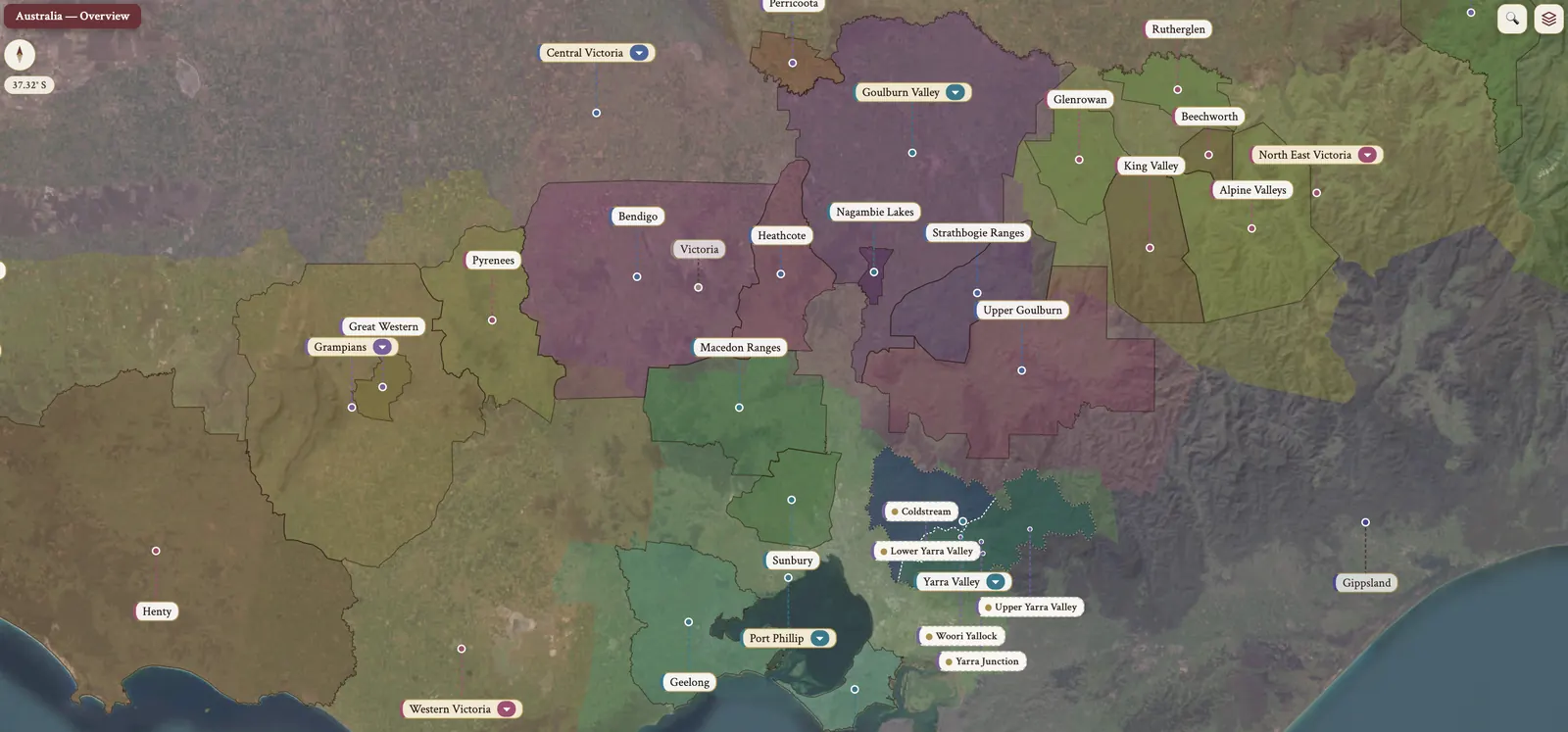
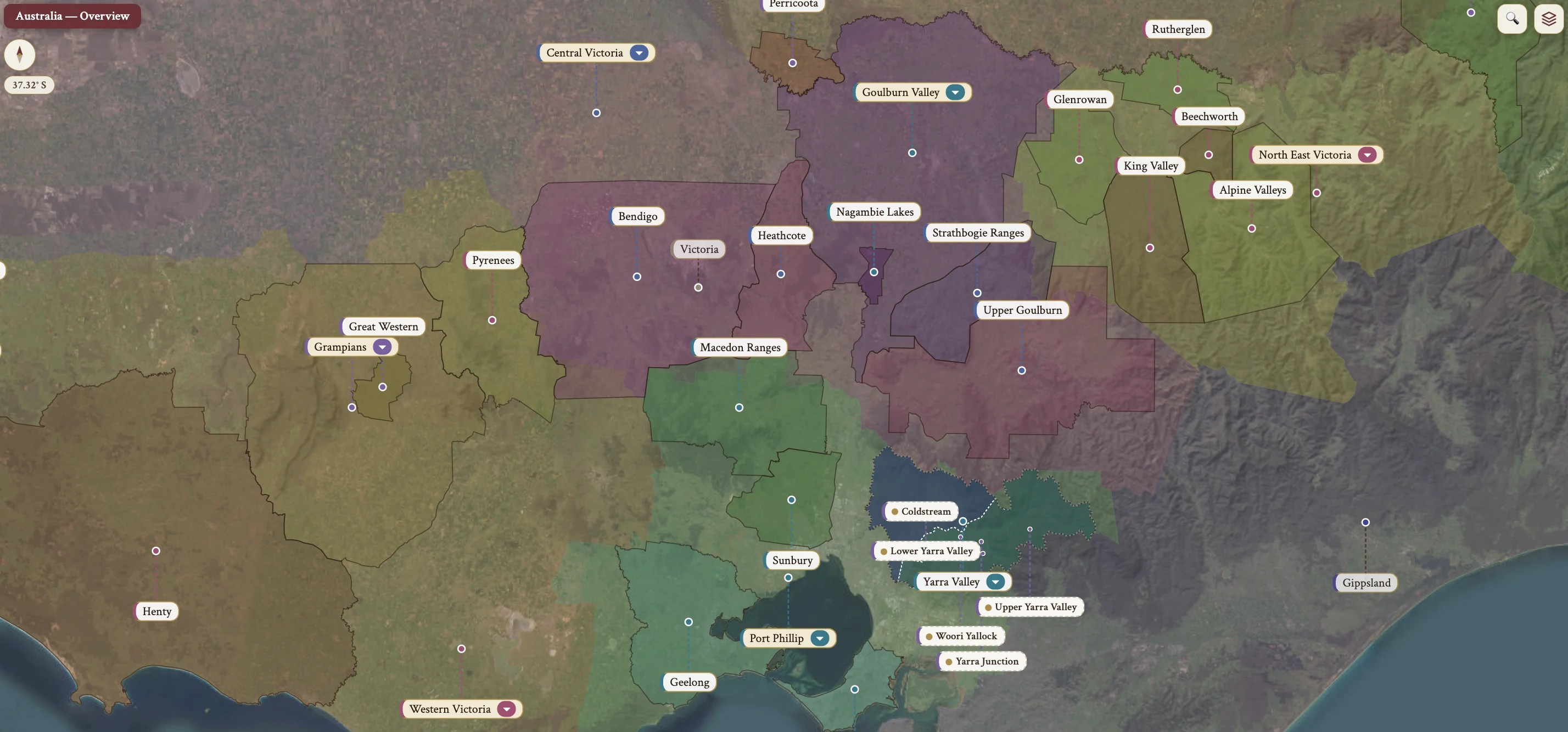
The Victoria maps from Your Own Wine Encyclopedia — every name tag opens a study card. Below, the chapter's own geography, climate and geology notes.
From the encyclopedia
Overview
Victoria is located to the east of South Australia and is 3rd in production among Australian states. Its production and vineyard land are smaller than NSW's, and it focuses more on quality than quantity, the exception being the Murray-Darling Basin. Average wine prices tend to be higher due to the many smaller producers.
Victoria has the most wineries of any state, about 775+ as of 2013, and 21 distinct GI regions. Vineyards are everywhere, from the Murray River banks at the NSW border to the cool coastal Port Phillip zone and Henty. It is the Australian GI which has the most diversity of soils and climates.
The state is divided into 6 smaller zones: Port Phillip, Western Victoria, Central Victoria, North Eastern Victoria, North West Victoria and Gippsland.
Zones and GIs
Victoria's GIs sit inside 6 Zones. Only officially registered GI sub-regions are listed here, and the Zone is shown on the first row of each group.
The Port Phillip Zone holds Yarra Valley, Mornington Peninsula, Geelong, Sunbury and Macedon Ranges, none of them with a registered sub-region. Central Victoria holds Heathcote, Bendigo, Goulburn Valley — whose sub-region is Nagambie Lakes — Strathbogie Ranges and Upper Goulburn.
North East Victoria covers Rutherglen, Glenrowan, Alpine Valleys, Beechworth and King Valley, none of which carries a registered sub-region. North West Victoria has two regions, Murray Darling and Swan Hill, both shared w/ NSW and both without a registered sub-region. Western Victoria holds Grampians, whose sub-region is Great Western, together with Pyrenees and Henty. Gippsland has no GI regions and is a zone only, with 3 unofficial subzones: East, West and South.
History — first plantings and phylloxera
Vines were first planted in the Yarra Valley in 1838 by the Ryrie brothers at Yering Station. The 1851 gold rush at Ballarat and Bendigo grew the population sevenfold, and Geelong became Australia's largest wine region by the 1860s. At the 1873 Vienna Exhibition the French judges withdrew when wines they had praised were revealed as Victorian.
In 1877 phylloxera arrived in a Geelong vineyard, and the Victorian government's "death by extinction" response uprooted every vine, ending Geelong's wine industry. Phylloxera also struck Heathcote in 1891 and Bendigo in 1893, and in 1899 it reached Rutherglen, then the Southern Hemisphere's largest wine region.
The Yarra Valley was spared phylloxera, but its vineyards were grubbed up for pastureland in the 1930s. Phylloxera finally arrived in Yarra in December 2006, and the Maroondah Phylloxera Infested Zone (PIZ) was officially gazetted on March 1, 2007. Viticulture recovery began in the early 1960s, with Wantirna Estate in the Yarra in 1963 and Idyll Vineyard in Geelong in 1966.
Major Bushfires — Black Saturday (2009)
Black Saturday — one of Victoria's major bushfires — struck on Feb 7, 2009, when extreme heat and drought produced violent firestorms throughout Victoria. It caused 173 deaths and was Australia's worst natural disaster to that date.
In the Yarra Valley about 5% of vineyards were damaged or destroyed, with losses also in Bendigo, Beechworth, Heathcote and Gippsland. De Bortoli became a leader in the subsequent research into identifying and managing smoke taint — volatile phenols — in the wake of this event.
Black Summer (2019–2020)
Black Summer, in 2019–2020, was the most catastrophic event in the history of the Australian wine industry by sheer scale. The damage fell into two categories: direct fire loss, meaning vines burning, and smoke taint, meaning grapes made unusable by smoke exposure.
Adelaide Hills in SA was "ground zero" for vineyard destruction, with approximately 1,100 ha of vines destroyed, about 1/3 of the entire region's production area; Henschke lost around 95% of its Lenswood vineyard crop, including some of the region's oldest Pinot Noir vines. In the Hunter Valley in NSW few vineyards were reached by flames, but the largest economic blow came from smoke taint, with an estimated 80% of the 2020 vintage discarded; Tyrrell's alone walked away from 80% of its crop to maintain quality standards.
On Kangaroo Island in SA the fires wiped out more than half the island's land mass, and Islander Estate was almost entirely destroyed. The high-altitude Canberra District and Tumbarumba in NSW were blanketed in thick smoke for weeks, and many wineries such as Shaw Wines produced zero wine for the 2020 vintage. In North-East Victoria, Beechworth, King Valley and parts of Gippsland were severely impacted, and producers such as Vignerons Schmölzer & Brown lost their entire Beechworth crop. The Yarra Valley, Gippsland and Alpine Valleys saw many top producers scrap their entire red wine production.
January 2026 Bushfires
The January 2026 bushfires are the most recent major event, concentrated in specific Victorian and South Australian corridors rather than the broad Black Summer footprint.
The Strathbogie Ranges in Vic were the epicenter, and the region's 2026 vintage was virtually wiped out. Fowles Wine reported a 100% harvest loss after 300 acres of vineyards and the family residence were destroyed, and Elgo Estate's Upton Hill vineyard was reported "wiped out" with virtually no fruit.
In Bendigo and Macedon Ranges in Vic the Harcourt Cooperative Cool Stores, also referred to as the Ravenswood South blaze, burned, destroying about 500,000 bottles of wine belonging to roughly 20 local wineries, including irreplaceable museum stocks. Affected producers include Joshua Cooper, Blackjack Wines, Killiecrankie and Sutton Grange.
On the Southern Fleurieu Peninsula in SA, the mid-January 2026 Tooperang bushfire near Mount Compass damaged two vineyards on Nangkita Road, both confirmed, one grower losing 25 acres of vines and with it the total loss of the 2026 vintage.
Phylloxera — quarantine and replanting
Phylloxera remains a threat, with recent outbreaks, notably in the Yarra Valley, which is now classified as a phylloxera-infested zone. The Mornington Peninsula is classified as 'at risk.'
Strict quarantine and biosecurity laws apply, and all new vineyards are planted on phylloxera-resistant rootstock. Replanting programs are in progress for older vineyards, an opportunity for producers to reconsider the varieties best suited to their vineyards.
On the map
- Yarra Valley
- Mornington Peninsula
- Rutherglen