Loiben
Loiben, Rossatz and Mautern, ried by ried, with the Rieden map alongside.
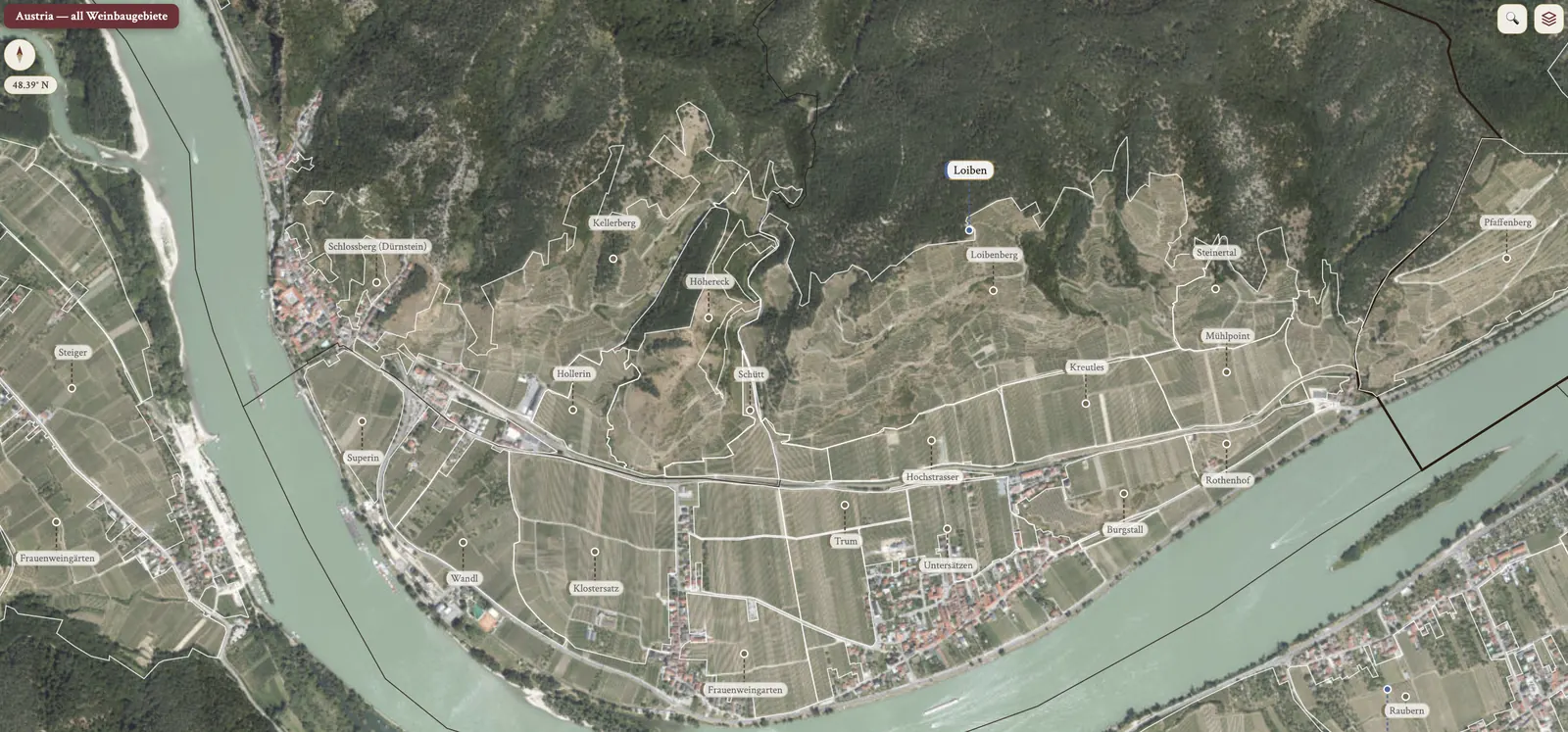
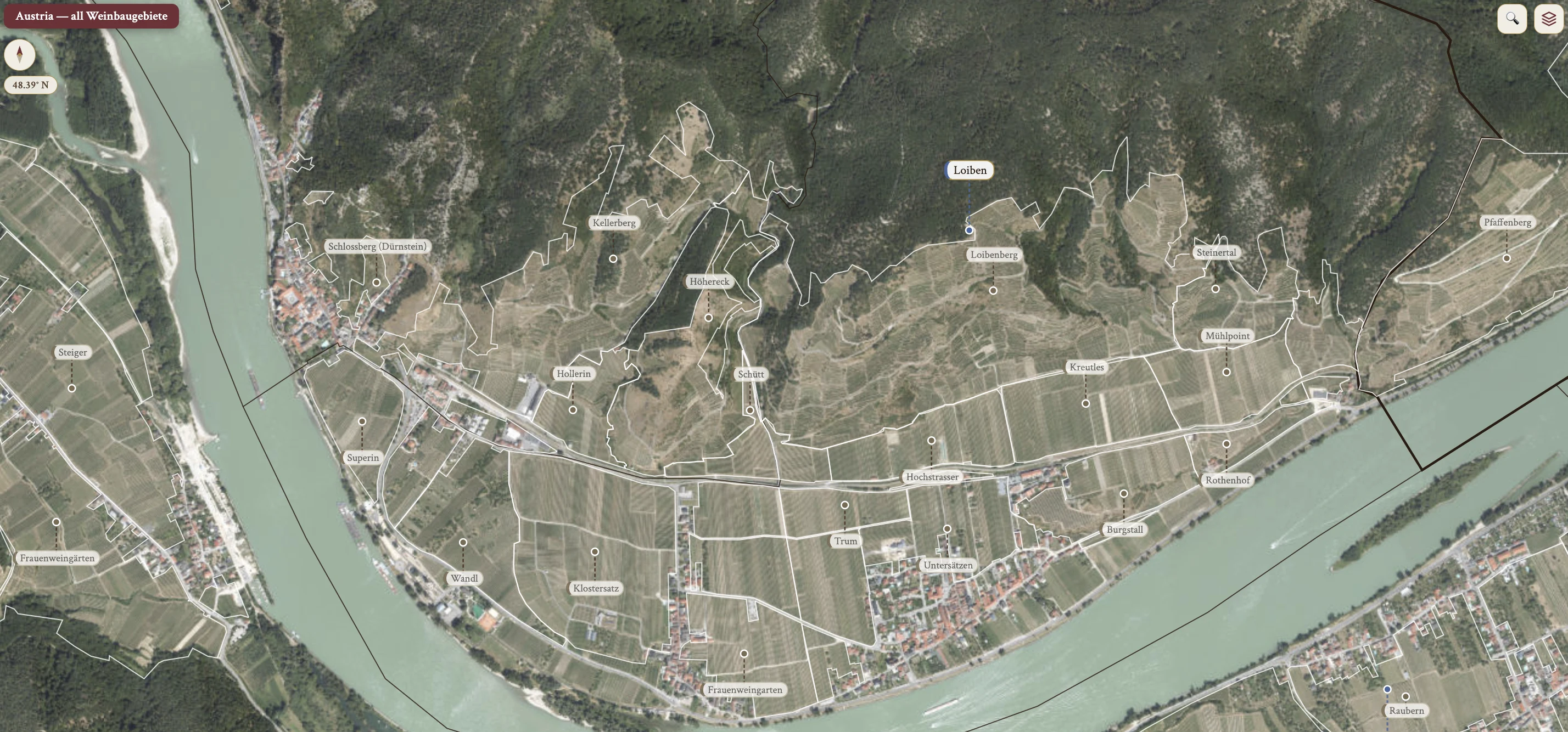
Loiben is defined by Loibenberg, a huge south-facing hill that gives some of the most powerful wines of the Wachau.
Shared between Dürnstein and Loiben
Schütt
Schütt is one of the first named vineyards, recorded in 1379, and is shared by Dürnstein and Loiben. As the Danube dips south then north, a sheltered swell defines the site. Its soils are deep loess at a lower elevation, though a small crevasse allows cool evening air in; it sits on a stream debris cone of deep gneiss weathering material. Its producers are Knoll, Paul Stierschneider of Urbanushof, and Tegernseerhof.
Oberloiben
Klostersatz
Klostersatz is worked by F.X. Pichler.
Oberhauser
Oberhauser is worked by Högl.
Unterloiben
Loibenberg
Loibenberg is a huge south-facing hill giving some of the most powerful wines of the Wachau. Its producers are Alzinger, Domäne Wachau, Knoll and F.X. Pichler, for GV and Riesling.
Mühlpoint
Mühlpoint is worked by Alzinger.
Steinertal
Steinertal is worked by Alzinger and F.X. Pichler; it is a cool site, taking cold air from the north via a side valley.
Kreutles
Kreutles is worked by Knoll.
Mautern — south bank, easternmost
Silberbichl
Silberbichl is worked by Weingut Jakob and Weingut Hutter; its parcel Vom Stein holds some of the oldest vines in the Wachau.
Im Weingebirge
Im Weingebirge is worked by Nikolaihof.
Rossatz, south of the river
Rossatz, on the south bank, typically gives weightier styles.
Mautern and the beginning of Austrian viticulture
Mautern is quite flat, on sandy and gravelly soils. It is thought to be where viticulture began for Austria, in the ried Im Weingebirge, documented back to 470 CE at Nikolaihof. Nikolaihof is Austria's oldest winery, owned by the Saahs family since 1894 and famous for its biodynamic practices.