Spitz & the Spitzer Graben
Spitz and the Spitzer Graben, ried by ried. Soil, aspect, style and growers for the western Wachau, with the Rieden map alongside.
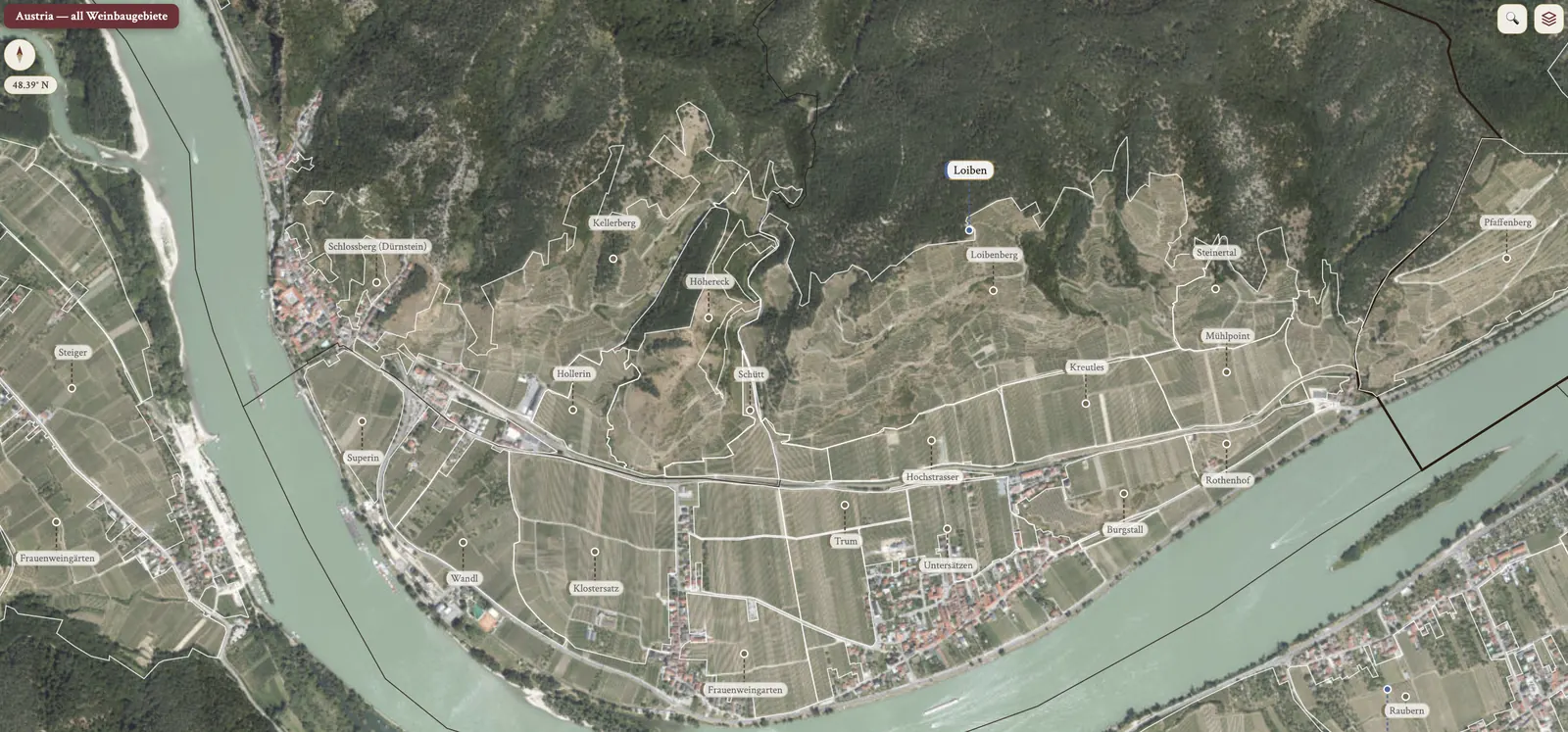
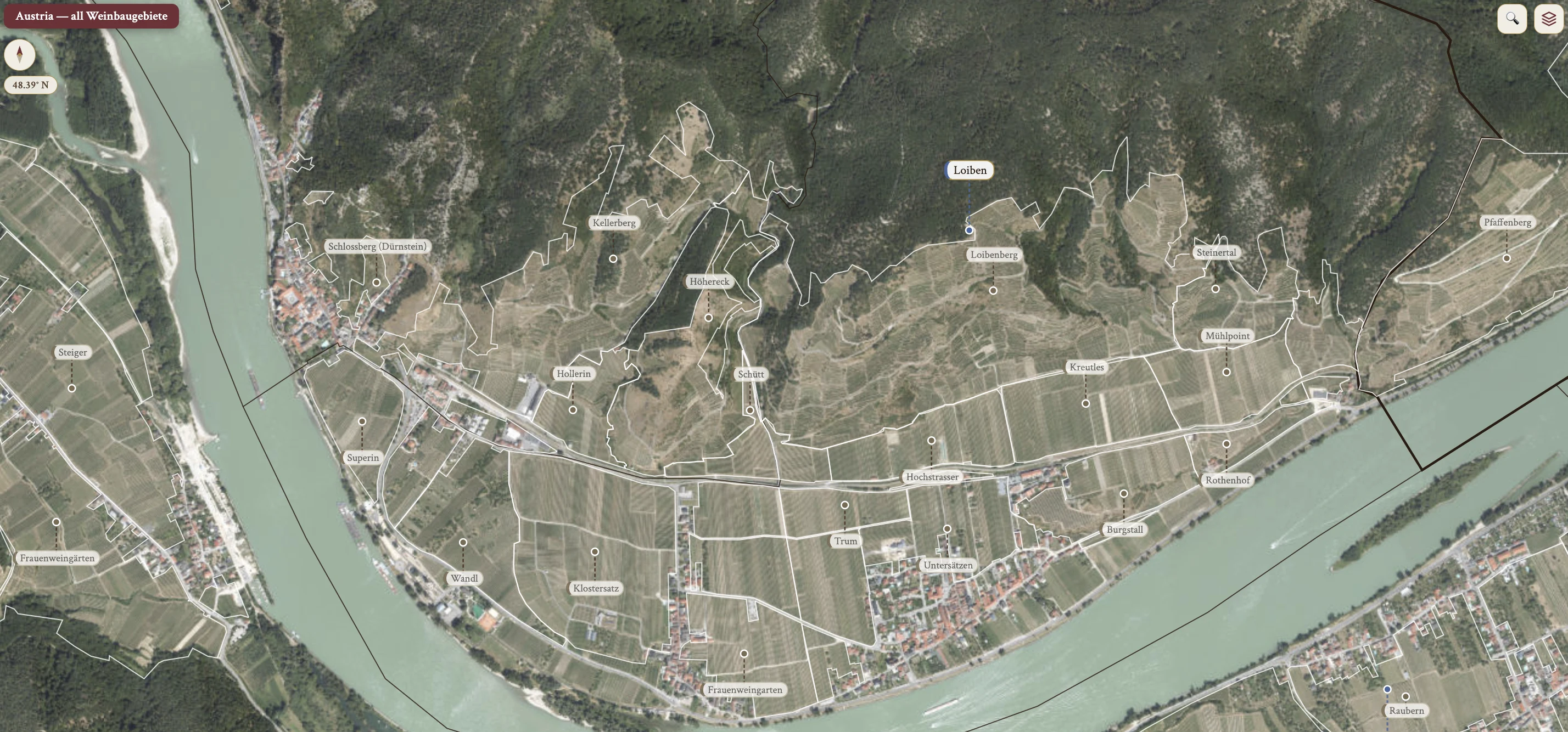
Spitz is the major wine village on the Danube at the mouth of the Spitzer Graben, a narrow side valley extending inland toward Mühldorf. The Graben is the coolest zone of the Wachau and holds some of the steepest terraces in the region. Administratively its hamlets belong to the municipality of Spitz, but in terroir terms they represent a distinct, cooler other Wachau.
Spitz
Tausendeimerberg
Tausendeimerberg, also written 1000-Eimerberg, is the vineyard of a thousand buckets — a historic hillside at the base of Spitz giving delicate, easy-drinking wines.
Singerriedel
Singerriedel is a dramatically steep, terraced ried behind the village, on sandier loam over gneiss and excellent for Riesling. Producers here are Hirtzberger and Domäne Wachau.
Hochrain
Hochrain is likewise a dramatically steep, terraced ried behind the village, on sandier loam over gneiss and excellent for Riesling. The producer here is Franz Hirtzberger.
Axpoint
Axpoint is worked by Hirtzberger, Lagler and Domäne Wachau.
Offenberg
Offenberg is worked by Donabaum.
Setzberg
Setzberg is worked by Domäne Wachau, Donabaum, Hirtzberger and Lagler.
Burgberg
Burgberg is worked by Lagler.
The Spitzer Graben
Vießling
Vießling is the heart of the Spitzer Graben, directly opposite Ried Bruck, and the reference point for many of the valley's top vineyards.
Kalkofen
Kalkofen is a set of south-west-facing terraces.
Bruck
Bruck is a set of south-west-facing terraces running up to about 480 m, with a peak at about 500 m.
Schön
Schön is a set of south-west-facing terraces.
Brandstatt
Brandstatt is the ried of Elsarn.
Why the Spitzer Graben is the coolest zone
Three things cool the valley. It is set back from the Danube, so it loses the river's moderating warmth and reflective water surface. Its slopes face east and west rather than south, which means less direct midday solar exposure and slower, more uneven ripening. And the narrow valley channels cold air down from the Waldviertel, giving lower night-time temperatures, delayed ripening and preserved acidity.
Harvest
The harvest here is the latest in the Wachau, sometimes extending into December in cooler years, and conditions approach the climatic limits of viticulture deeper into the valley.
Soils
The higher slopes are slate and schist — sparse and stony, naturally restricting yields. Below them lies Spitzer granodiorite gneiss, the western counterpart to the Gföhl gneiss of the east: sandy, of neutral-to-weakly-acidic pH, with no loess or carbonates.
Style
The fruit profile is more austere than the main Wachau, the wines built on tension, high acidity and a leaner frame. Riesling thrives in the highest, stoniest sites, giving focused, mineral wines that often need time in bottle, while Grüner Veltliner finds excellent conditions in slightly less extreme sites such as Ried Schön, ripening fully without losing clarity.
Up the valley
The valley leads past Gut am Steg, Zornberg, Vießling and Elsarn to Mühldorf at the upper end.
Key producers
Rudi Pichler and Franz Hirtzberger are based in Spitz with key holdings extending into the Graben. Veyder-Malberg is a purist whose GV Viessling underlines the late-ripening, high-acid character of the valley. Donabaum, Högl and Muthenthaler also work here, and Grabenwerkstatt of Trandorf is biodynamic.