Western Australia — Wine Region Guide
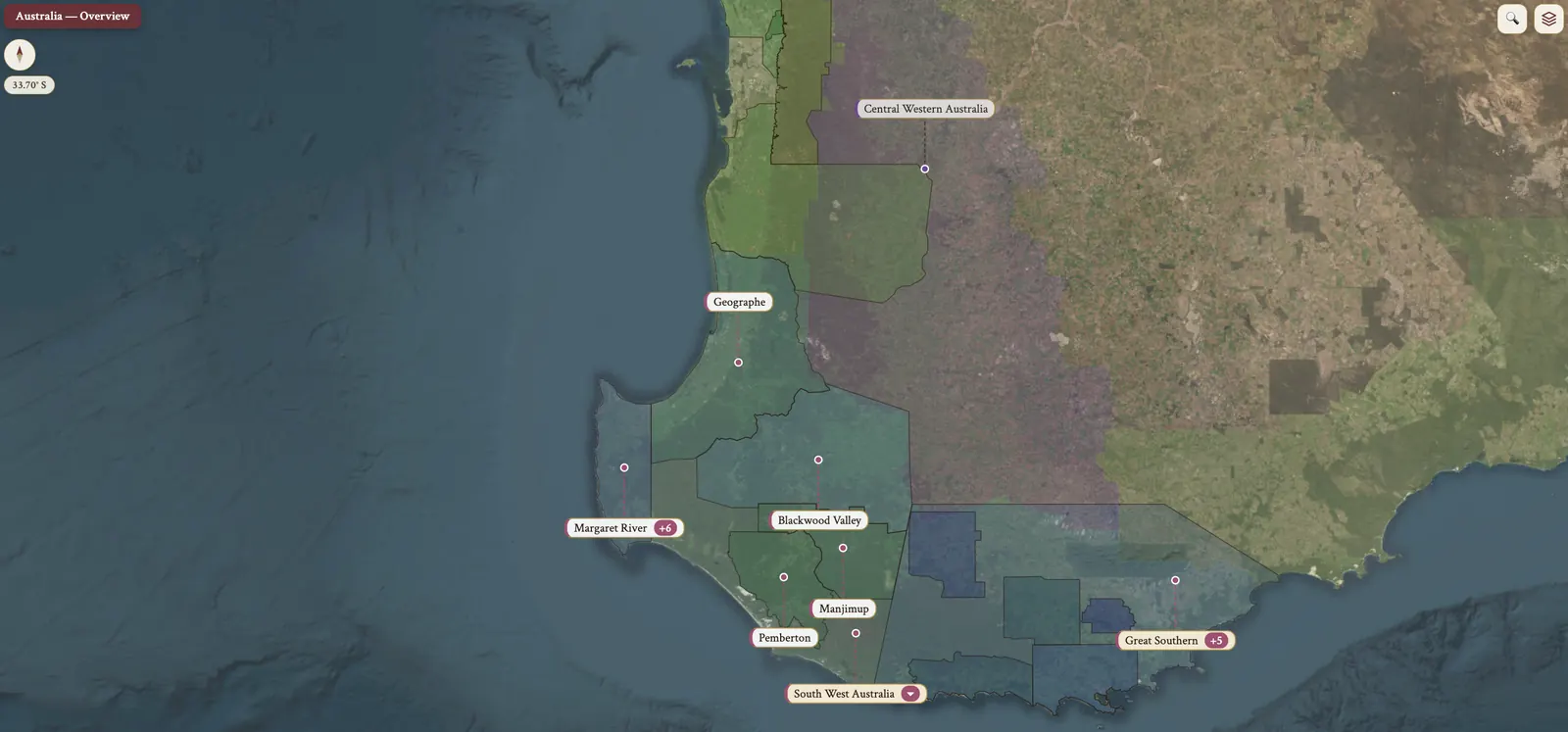
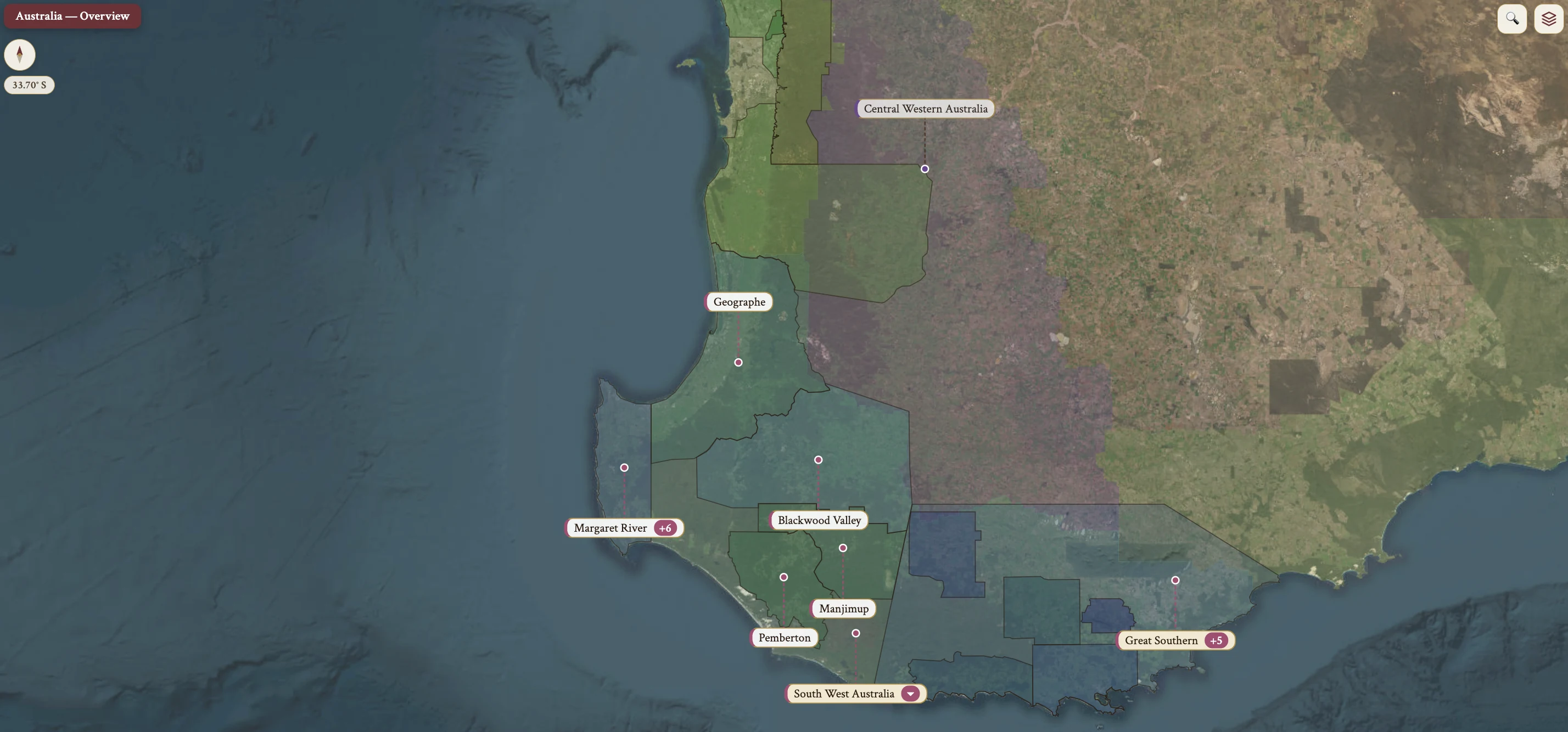
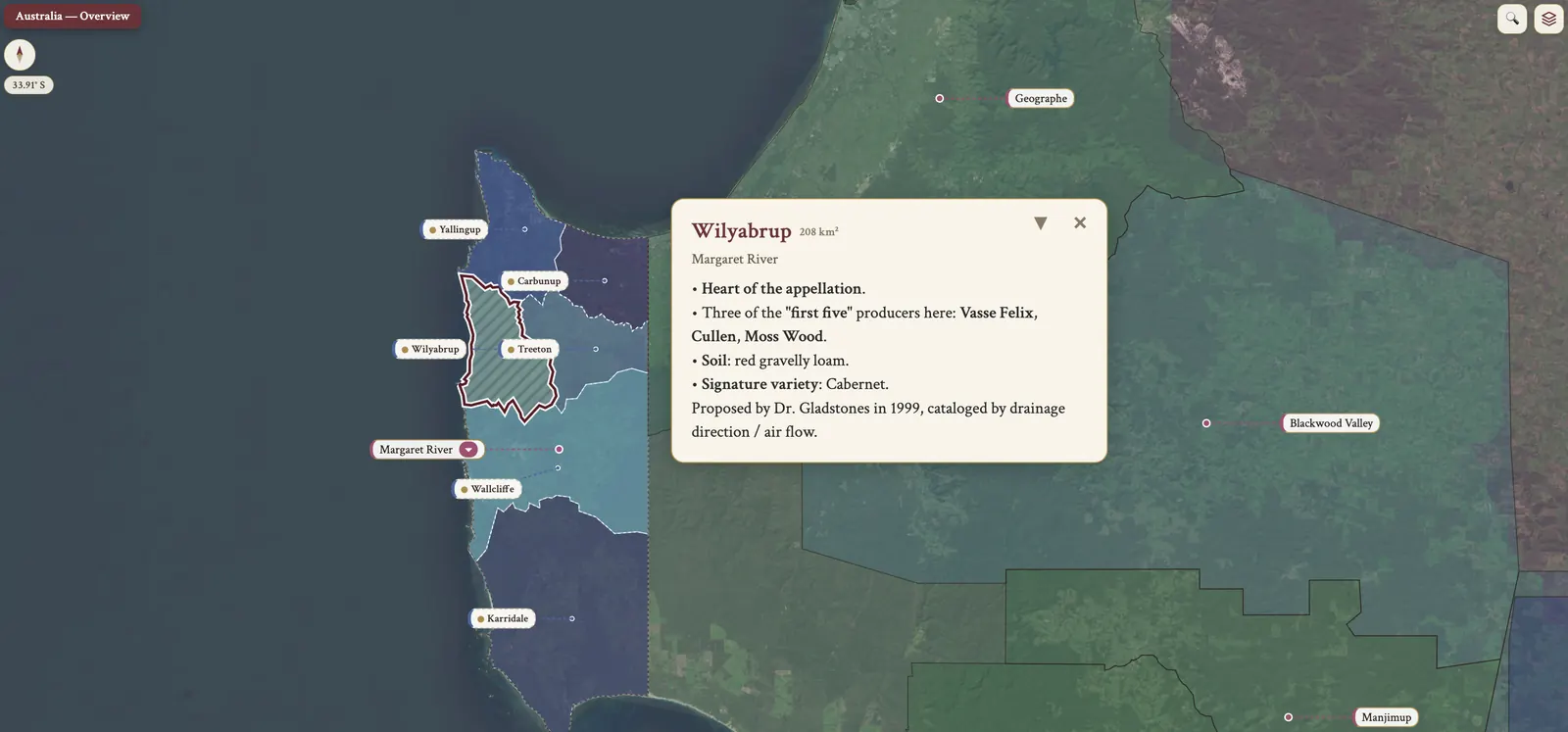
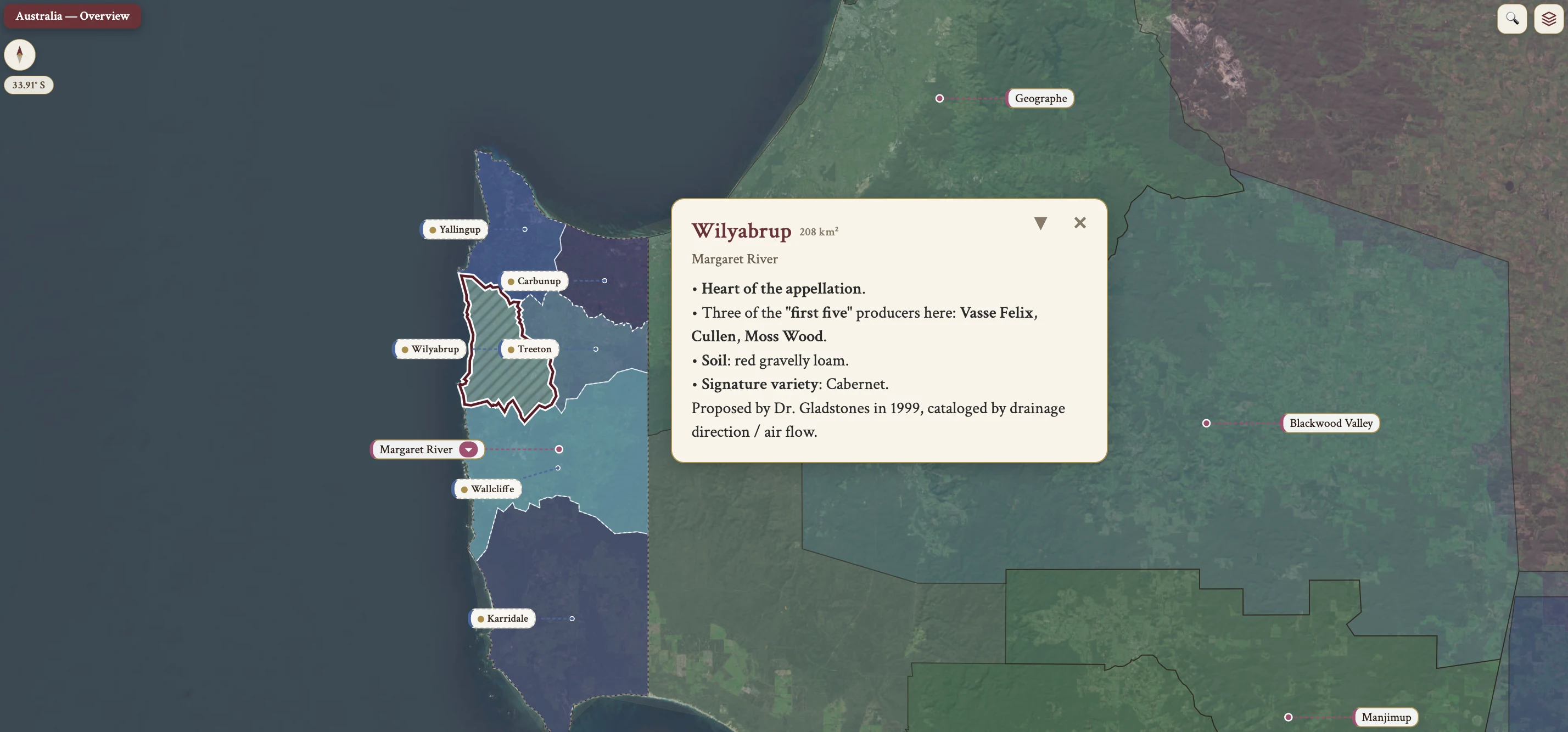
The Western Australia maps from Your Own Wine Encyclopedia — every name tag opens a study card. Below, the chapter's own geography, climate and geology notes.
From the encyclopedia
Overview
Western Australia is the largest state in Australia, and most of the state is too hot for viticulture. The Swan Valley, in the Greater Perth Zone, is the historical wine production center and lies at the same latitude as Hunter Valley; it is one of Australia's hottest wine regions, and it produced high yields of extremely ripe grapes for inexpensive or fortified wines. Since the 1990s production has increased in the cooler south-western corner, where temperatures are moderated by ocean and altitude.
Production is relatively small, 3% of Australia's total volume, but focused on premium wines. 85% of WA's vines are in the South West Australia zone, and WA accounts for about 7% of total Australian vineyard area but less than 2% of total harvest as of 2019.
Cooling sea-breeze winds are critical to WA viticulture. The Fremantle Doctor is the afternoon sea breeze off the Indian Ocean; it penetrates about 100 km inland, reaching as far as York. The Albany Doctor is the equivalent sea breeze along the southern coast and the key cooling influence for Great Southern. "Southern Forest" is the informal sub-zone covering Pemberton and Manjimup, both of which focus on Sauvignon Blanc in white and Pinot Noir in red.
Zones and GIs
Western Australia is divided into 5 Zones: Greater Perth, South West Australia, Central Western Australia, Eastern Plains, Inland and North of WA, and West Australian South East Coastal. Only officially registered GI sub-regions are listed here, and the Zone is shown on the first row of each group.
The Greater Perth Zone contains Swan District, whose sub-region is Swan Valley, together with Peel and Perth Hills, neither of which carries a registered sub-region. South West Australia is the larger zone. Margaret River has no registered sub-region; Great Southern carries the sub-regions Albany, Denmark, Mount Barker, Porongurup and Frankland River; and Geographe, Blackwood Valley, Pemberton and Manjimup each stand without one.
Three zones carry no GIs at all — Central Western Australia; Eastern Plains, Inland and North of WA, which is desert and tropics; and West Australian South East Coastal.
Wine History
Western Australia's wine history begins in 1829, when the botanist Thomas Waters planted WA's first vineyard in the Swan Valley after arriving with the first European settlers. Houghton was founded in the Swan Valley in 1836, and Sandalford in 1840.
In the 1980s more than half of WA's wine was produced in the Swan Valley; production has since shifted south to Margaret River, Great Southern and Geographe.
On the map
- Margaret River
- Great Southern