Piemonte — Wine Region Guide
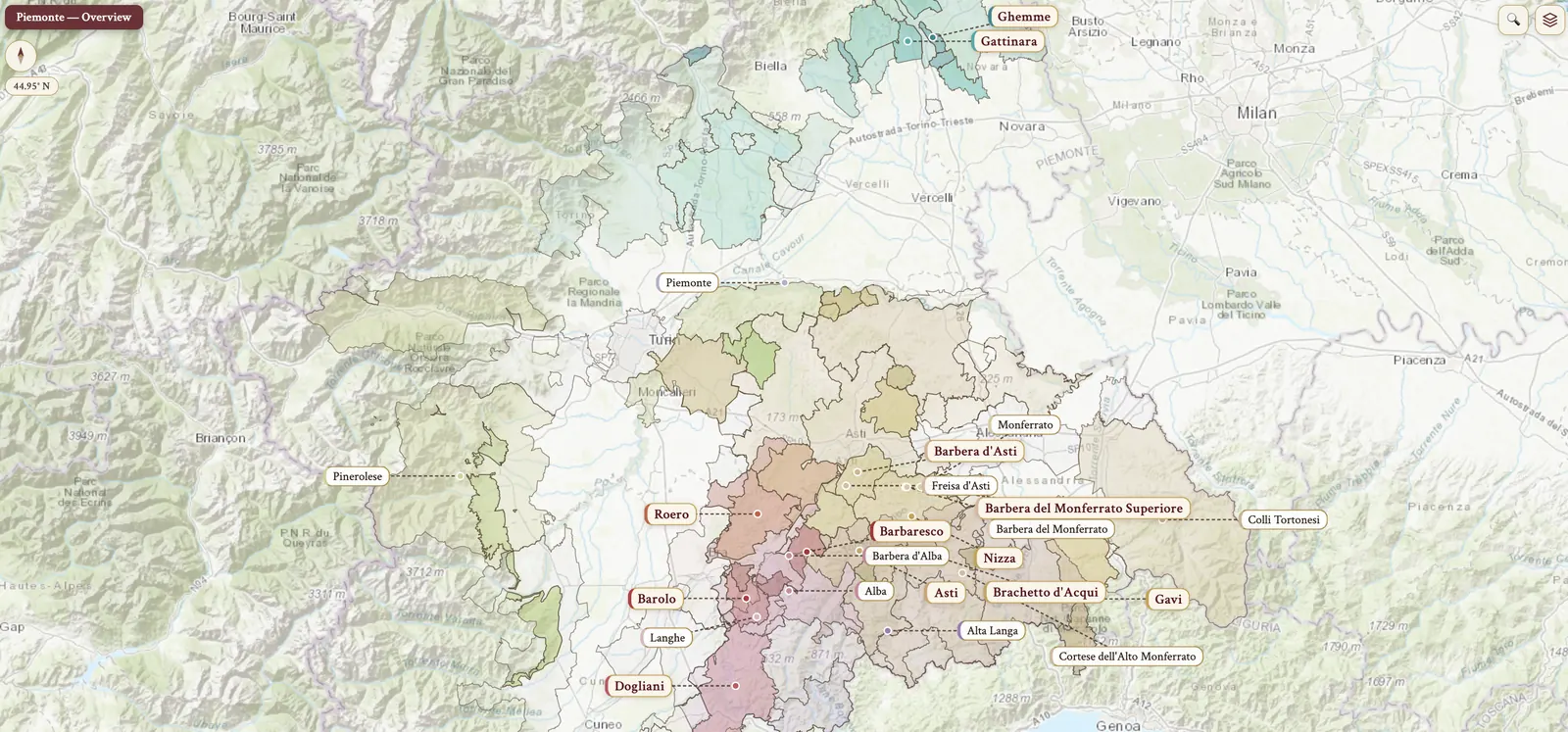
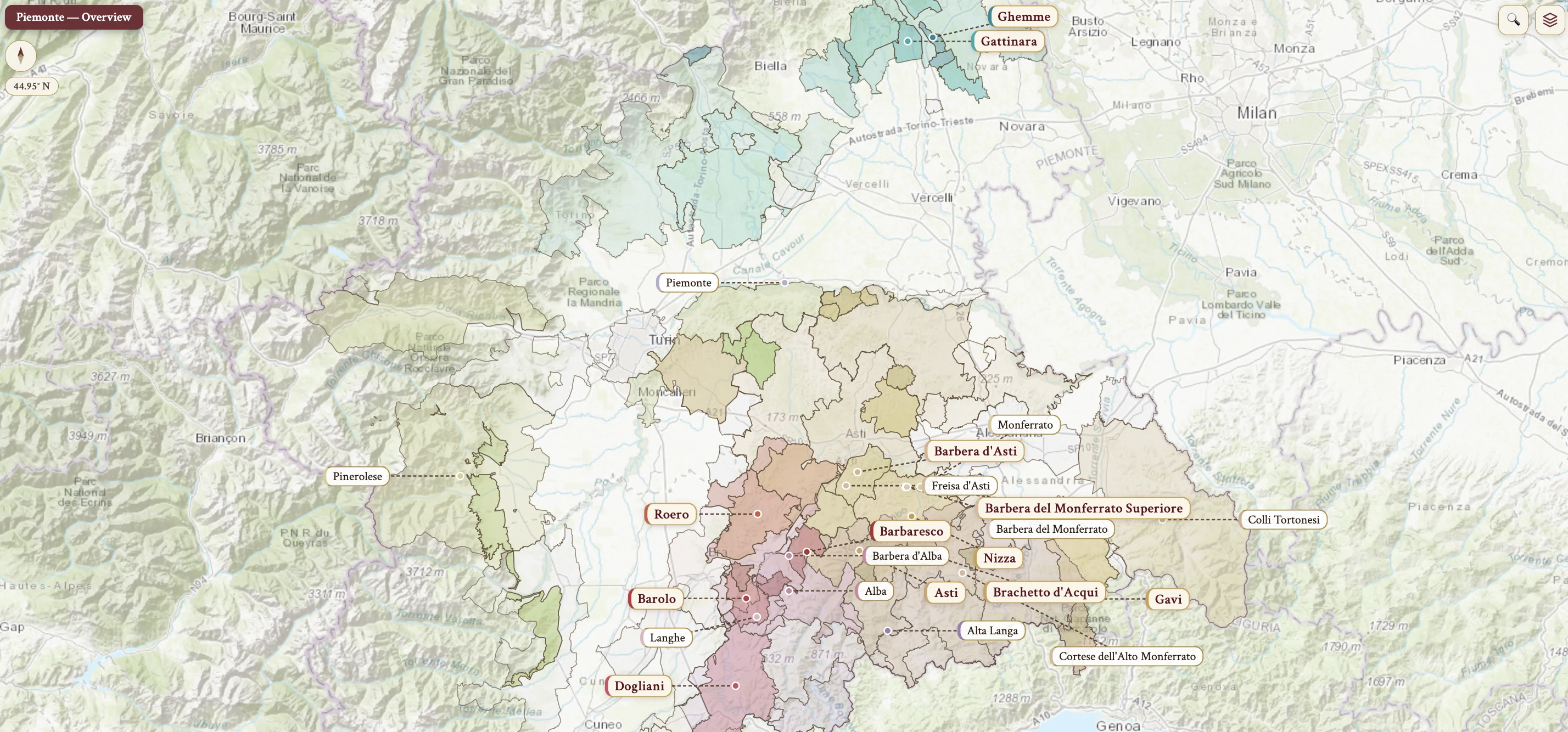
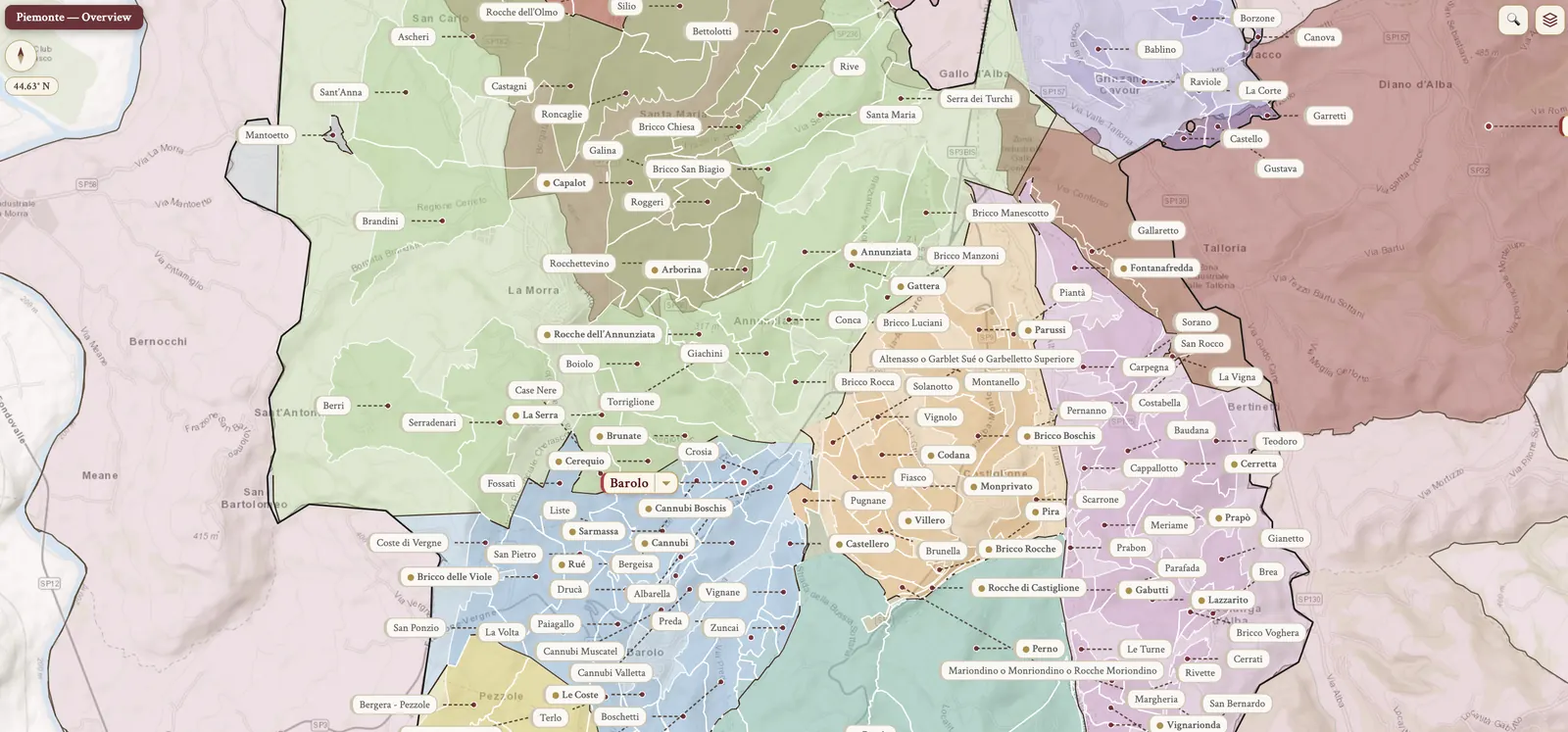
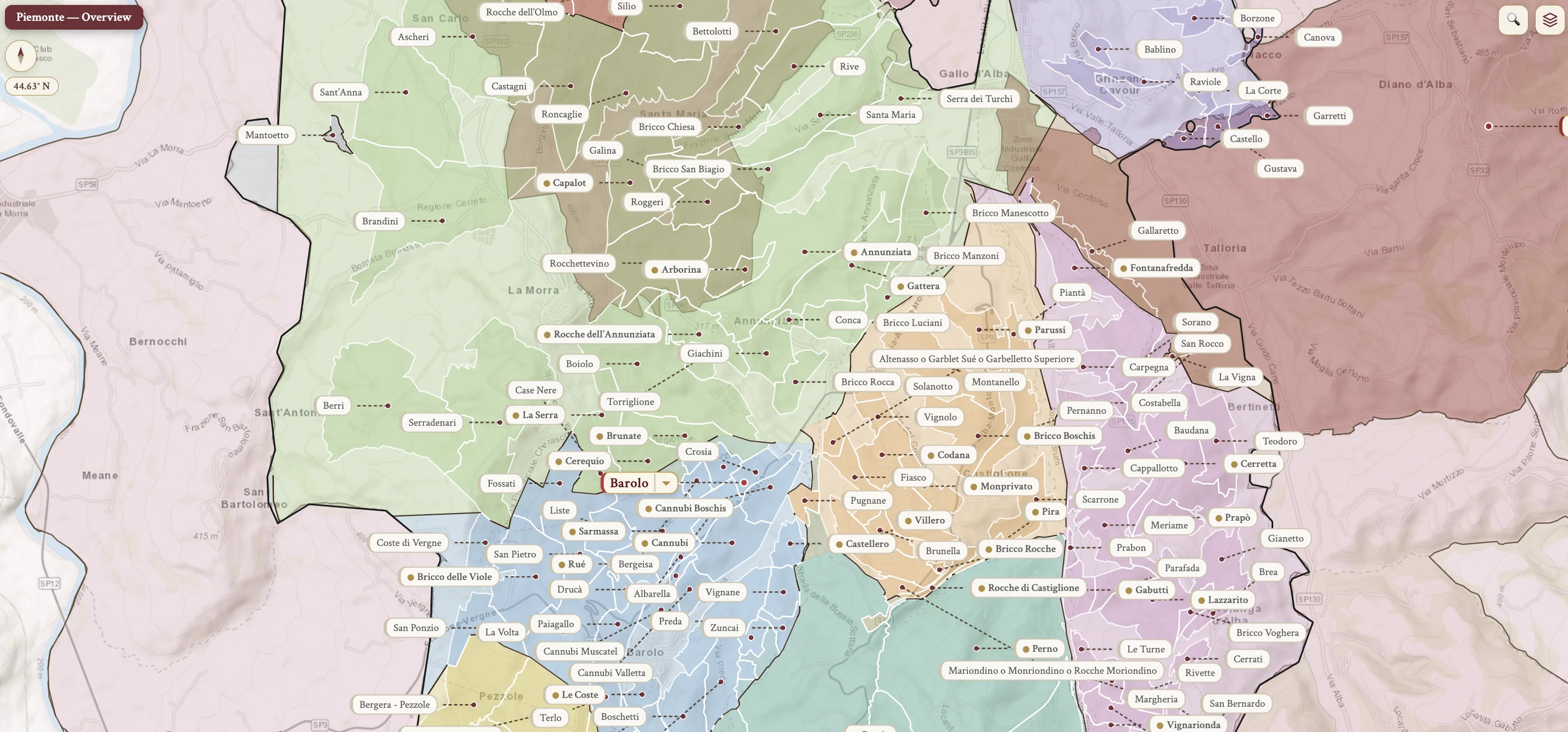
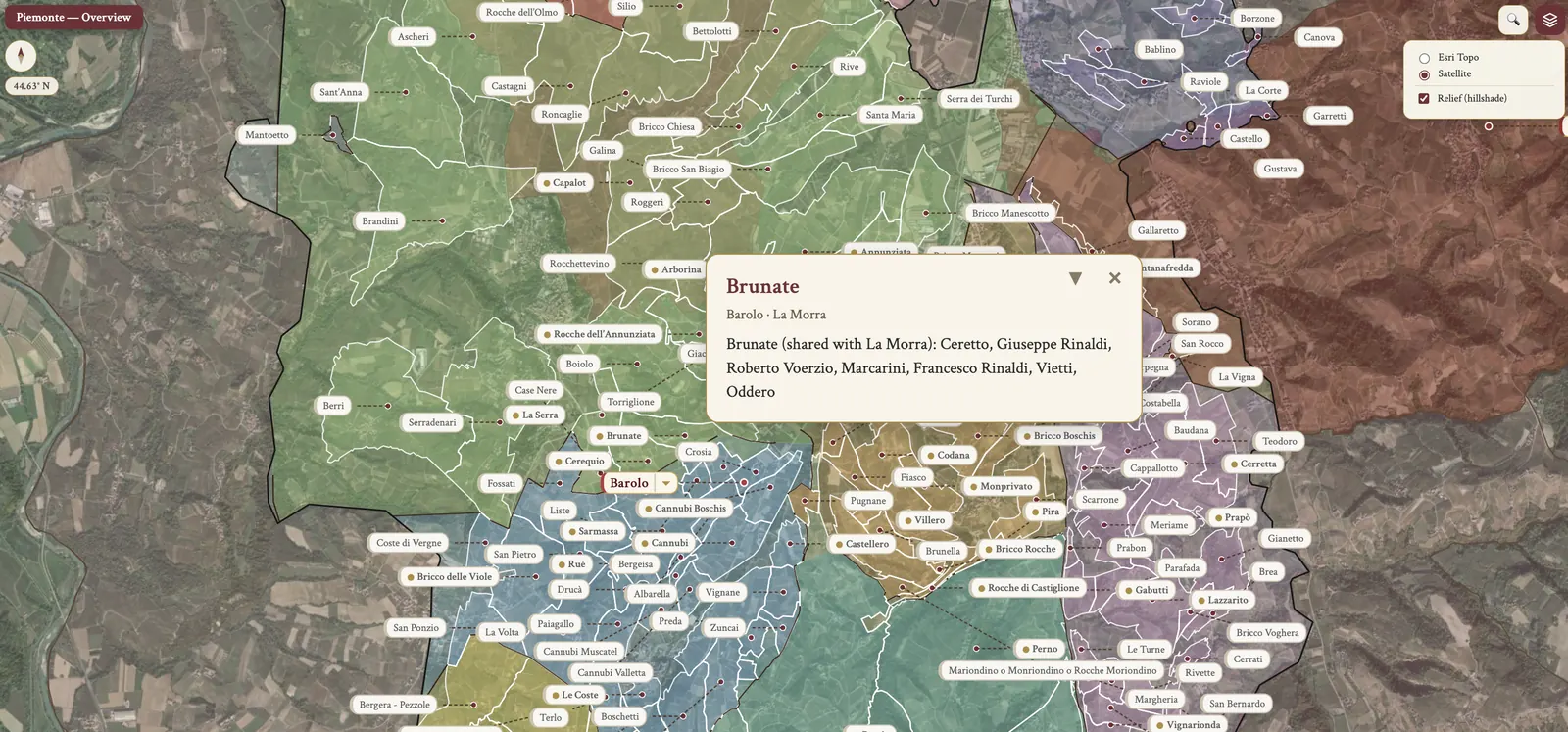
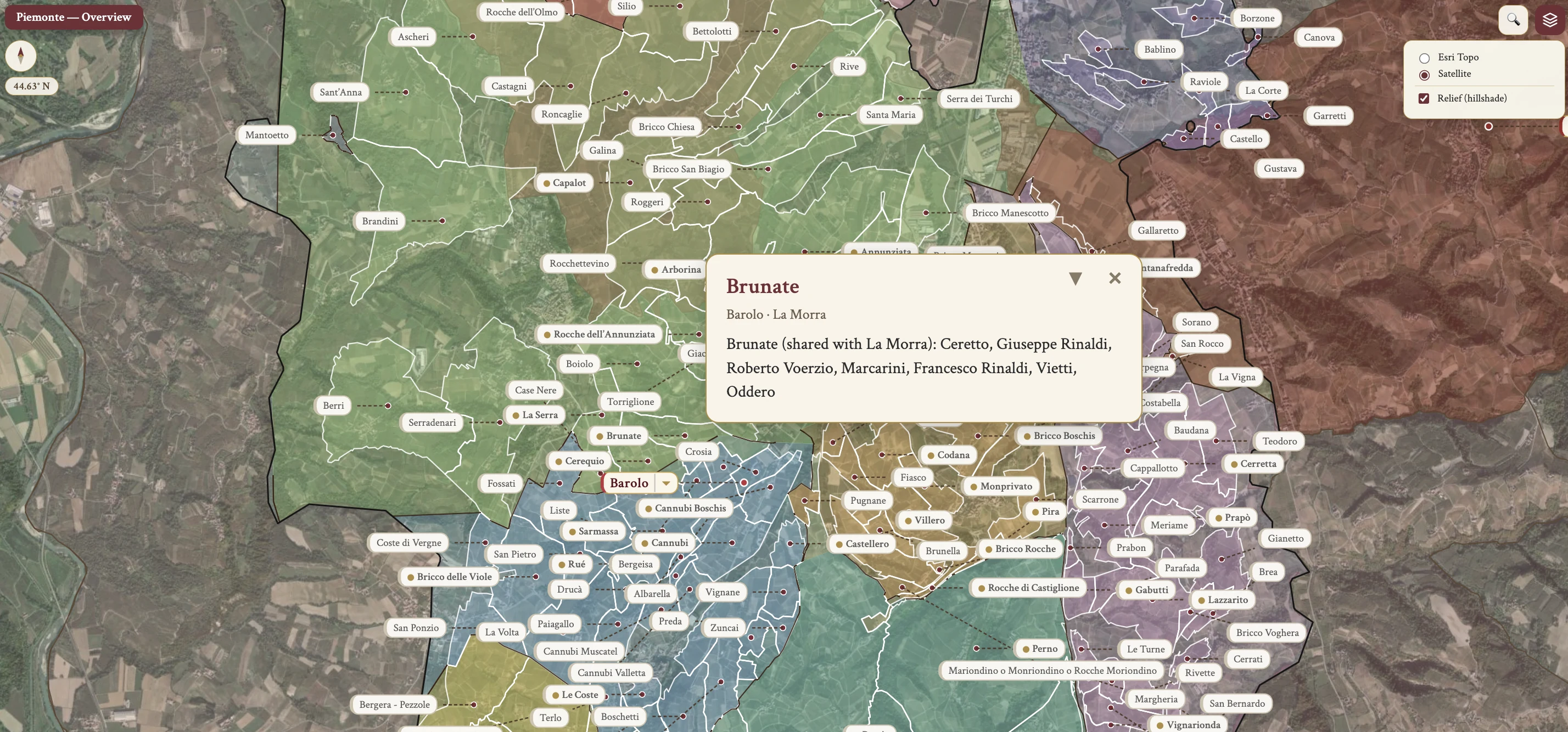
The Piemonte maps from Your Own Wine Encyclopedia — every name tag opens a study card. Below, the chapter's own geography, climate and geology notes.
From the encyclopedia
Overview
"Piedmont" literally translates to "at the foot of the mountain", and the region is completely landlocked. Its capital is Torino, a major industrial & financial center, and the hometown of Vermouth, introduced there by Antonio Benedetto Carpano in 1786.
There are 5 main provinces for winegrowing: Novara, Vercelli, Asti, Alessandria and Cuneo. Piemonte counts 19 DOCGs and ~42 DOCs, and there is NO IGP in Piemonte — a wine here is either the simple 'wine' category or a DOC/DOCGs wine.
The DOCGs are Alta Langa, Asti, Barbaresco, Barbera d'Asti, Barbera del Monferrato Superiore, Barolo, Brachetto d'Acqui, Dolcetto di Diano d'Alba, Dolcetto di Dogliani Superiore, Dolcetto di Ovada Superiore, Erbaluce di Caluso, Gattinara, Gavi, Ghemme, Nizza, Roero, Ruchè di Castagnole Monferrato, Terre Alfieri (2020) and Canelli (2023).
MGA and the Four Sub-regions
MGA stands for Menzioni Geografiche Aggiuntive. An MGA may be an entire village, e.g. La Morra, or a specified sub-zone, e.g. Bussia or Cannubi. Vigna means vineyard, and it can only appear as a labelling term if the name of the MGA is also stated. 4 DOCGs have MGA: Barolo, Barbaresco, Dolcetto di Diano d'Alba and Roero.
Piemonte has 4 sub-regions. Northern Piemonte is also called Alto Piemonte. Western Piemonte covers the Torino Hills. Alba lies in the Cuneo province, in the Langhe and Roero hills on the banks of the Tanaro. Monferrato takes in the Asti and Alessandria provinces, south of the Po River.
The Piedmontese Dialect
A handful of Piedmontese dialect terms carry real meaning in the vineyard. Sorì is a hilltop with southern exposure — the part of the slope where the snow melts first, south and steep. Bricco is the highest point or summit of a vineyard. Vigna is a single vineyard, and "Dolcetto" means "little sweet one".
Favorita is Vermentino in Piemonte. Spanna is the local name for Nebbiolo in Alto Piemonte, in Gattinara and Ghemme. Nas-cëtta, also written Nascetta, is the indigenous white grape of the Novello commune, and La Nebbia is the morning fog that Nebbiolo is named after.
A Cascina is a farmhouse and a Ciabot a small tool shed. Infernotti are underground cellars carved in marly-sandstone soils, in Monferrato.
Climate & Weather
Piemonte has a continental climate, with wide diurnal and seasonal temperature swings. The Alps and Apennines provide a rain shadow effect. Protection by the Alps is from cold northern wind and from excessive rainfall; protection by the Ligurian Apennines is from the Mediterranean weather system.
Average annual temp is 12°C (53°F) for most winegrowing districts, and 13°C in southern Piemonte near the Ligurian border, under the Ligurian Sea influence. Winter brings frequent snow, plain to peak, and fog is very common in autumn and winter. In summer the plain is hot & muggy, while the hills benefit from air circulation and higher altitude, which leaves day and night cooler.
Rainfall is low from June to September, which allows the grapes to ripen fully and reduces fungal disease. It increases in late September and October, a threat to late-ripening varieties such as Nebbiolo. Hail cannons are used in Langhe & Monferrato. Rainfall is lowest in Monferrato — Asti and Alessandria — and eastern Cuneo, Roero, at 500–650 mm/yr, and highest in the mountainous north and south, at 900–1,200 mm/yr.
Topography
Piemonte is cradled on three sides by the Alps and the Apennines. To the south are the Ligurian Apennines and the Maritime Alps, on the border with Liguria & France. To the west, the Alps, on the border with France. To the north, the Alps again, on the border with Valle d'Aosta & Switzerland. To the east lie Lombardia & Emilia-Romagna.
The region reads as 3 concentric topographical rings: an outer mountain rim, a middle hilly zone and an inner plain. Mountains are 43% of the territory, and they are highest in the western and northern portions, at Gran Paradiso and Monte Rosa.
Hills, Plain and Soils
Hills are 30% of the territory and home to the great majority of the winegrowing districts, at vineyard elevations of 150–400m (500–1,300 ft). Monferrato, the largest hill network, is in the Asti & Alessandria provinces. Langhe and Roero are in the Cuneo province. The Hills of Novara & Vercelli are in Alto Piemonte, and Colli Tortonesi in the Alessandria province.
The plain is 27% of the territory, the upper Po Valley or Pianura Padana. It is too flat and fertile for the vine, so its principal crop is rice. Italy is the largest rice producer in Europe and Piemonte the largest in Italy; Arborio rice, from the town of Arborio in the Vercelli province, is the highest quality for risotto.
There are 2 hill systems — the Monferrato hills, east of the Langhe, and the Langhe hills — on calcareous marl and sandstone soils with varying percentages of clay and sand.
Rivers and Lakes
There are 3 important rivers: the Po, the Tanaro and the Sesia. The Po rises in the Western Alps and flows eastward, centrally bisecting the region. The Tanaro is in the Cuneo province, with Barolo & Barbaresco located southeast of the river. The Sesia straddles Gattinara DOCG and Ghemme DOCG.
The Po tributaries from the Alps, flowing south, are the Ticino, Sesia, Dora Baltea and Dora Riparia; the tributaries from the Ligurian Apennines, flowing north, are the Tanaro and the Bormida. Of the lakes, Lake Maggiore is the largest lake in Piemonte, on the northeastern border with Lombardia.
Hazards
The hazards are thunderstorm, hail, fog, frost and rainfall at harvest. The historical hail defense was literal: producers once fired cannons into threatening skies to disperse hail clouds.
Grape Varieties — Overview
The most planted red grape is Barbera; the most planted white is Moscato Bianco, which is Muscat à Petits Grains. 4 grapes account for 70% of total planting: Barbera, Moscato Bianco, Dolcetto and Nebbiolo. 3 late ripening red grapes stand out — Nebbiolo, Dolcetto and Barbera.
Timorasso is the white grape variety of note, revived by Walter Massa. International grapes — CS, CH, Merlot, Syrah, SB — have been growing since the 1980s.
Nebbiolo
Among the red grapes Nebbiolo is early budding and very late ripening, and it is usually the first variety to go through budbreak in spring in Piedmont. Early budding leaves it open to spring frost, and very late ripening leaves it open to rain at harvest. It is best at south & southwest facing sites, which let it ripen fully, and best at calcareous marl. It is vigorous, so it takes regular canopy management, and because the first few buds are infertile it is pruned high. It is mainly grown in the Cuneo province, including the Langhe, but also in Alto Piemonte.
The wine is P ruby turning P garnet within 3-5yrs. The aroma is P, with violet, rose and red fruit. It has F body, H tannins, H acidity, and can be H alcohol.
Nebbiolo — Synonyms and Clones
The synonyms are Chiavennasca in Valtellina, Spanna in Alto Piemonte, Gattinara and Ghemme, and Picoutener in Valle d'Aosta, Arnad-Montjovet and Donnas.
Among the clones, Lampia is the most widely planted. Michet is a virused version of Lampia, with smaller berries, lower yields and concentrated fruit. Rosé is lighter-colored and less common, and Elvio Cogno produces Riserva Vigna Elena from this clone. On its genetic status, DNA profiling has shown it is not simply a clone of classic Nebbiolo, such as Lampia or Michet, but a unique and distinct cultivar sharing the same family. Bolla is a lesser quality, higher yielding clone.
Barbera
Barbera is early budding, which exposes it to spring frost, and late ripening, but before Nebbiolo. It is vigorous and productive. High yield gives acceptable to good QL; low yield, from pruning hard, gives highly concentrated wine. It is disease resistant, but susceptible to fan leaf virus.
It is the most grown variety in Piemonte as a whole, with 3 times as much vineyard area as Nebbiolo. It is found in Asti, Alba and Monferrato, and is best from Asti and its sub zone, Nizza DOCG. It carries H acidity and L tannins, and is mostly an early drinking style.
The color is M to D ruby, the intensity M, with red plum, cherry and black pepper; acidity is H, tannins M, alcohol M. Quality runs good to very good at inexpensive to mid price, with some very good to outstanding at premium price. There are 3 Barbera-based DOCGs: Barbera d'Asti, Barbera del Monferrato Superiore and Nizza.
Dolcetto
Dolcetto is early ripening and takes a cooler site. There has been a reduction in vineyard site — Nebbiolo carries a much higher price. It has low vigor, is susceptible to fungal disease and is fragile, its buds easily broken, and its ripening can be blocked by cold weather.
It is reductive in the winery, so it needs frequent pump over, or rack and return, to introduce oxygen and avoid off flavor. Its high tannins are met with a soft extraction method, a shorter maceration time of 5-10 days and a mid-range fermentation temp. It is aged in stainless steel or cement vats to retain the primary fruit. The wine has M(+) tannins and M(-) acidity, D ruby color, red cherry & floral notes, and runs good to very good at inexpensive to mid price, with some very good to outstanding at premium price.
It appears as Dolcetto d'Alba DOC, Dogliani DOCG and Ovada, which is Dolcetto di Ovada Superiore DOCG; Marcarini works in Alba and Marziano Abbona in Dogliani. There are 3 Dolcetto-based DOCGs. Dolcetto di Diano d'Alba may be released in both normale and superiore versions, as may Dogliani. Dolcetto di Ovada Superiore, or Ovada, is the only one that must be "Superiore" to qualify for DOCG status.
Freisa, Grignolino, Brachetto and Ruchè
Freisa is an indigenous black grape, highly aromatic, in Freisa d'Asti DOC and Langhe DOC. Grignolino is an indigenous black grape with many pips, in Grignolino d'Asti DOC and Grignolino del Monferrato Casalese DOC. Brachetto has Brachetto d'Acqui, or Acqui, DOCG.
Ruchè has Ruchè di Castagnole Monferrato DOCG, which took DOCG in 2010 as the 3rd Monferrato DOCG, and is 90% Ruchè, max 10% combined Barbera and Brachetto. Its name suggests either strong resistance to the viral disease roncet, which plagues other varieties of the region, or its arrival in Piedmont alongside French monks who dedicated a medieval monastery to Saint Rocco.
Croatina and Vespolina are lesser indigenous red grapes of Piedmont.
White Grapes — Cortese and Arneis
Cortese is high yielding, with light intensity aromas of lemon, apple, pear & white flowers. It has H acidity and M body, and its thin skin opens it to grey rot. It is fermented at mid temperature and aged in stainless steel tank to preserve primary fruit; for top quality wine, a few hours of pre-fermentation maceration give increased aromatic intensity. It is good with some very good, inexpensive to mid price, with some premium example. Castellari Bergaglio and La Scolca are the names to know.
Arneis is mostly grown in the Roero area. Its aroma is light in intensity but complex — white flowers, chamomile, white peach, lemon — and its acidity M(-). It is good with some very good QL, inexpensive to mid, some premium price. It must be picked as soon as the desired ripeness is reached, as the acidity drops very rapidly, and it oxidizes easily, so oxygen contact is kept to a minimum. Roero Arneis is its DOCG, with Bruno Giacosa, Vietti and Ceretto.
Erbaluce and Moscato Bianco
Erbaluce is native to Caluso and its environs in the Canavese district of northern Piemonte, and was first mentioned in official documents in the 17th century. Its thick skin and very high acidity have traditionally suited it to complex, distinctive passito; dry Erbaluce — refreshing, floral, with citrus & apple aromas — is increasingly gaining attention. Its appellation is Erbaluce di Caluso DOCG.
Moscato Bianco is used for Asti DOCG and Moscato d'Asti. Geraniol is the most important aromatic compound of the Moscato grape, the biogenetic precursor of monoterpenes; see the Asti DOCG section.
Viticulture — Nebbiolo
Nebbiolo has to be pruned high, as the first few buds are infertile, so it needs to be pruned with more buds. Single Guyot is m/c, which facilitates mechanical trimming of the canopy. Excessive sunlight exposure can be a problem, and regular canopy management — the variety is vigorous — avoids unripe fruit d/t shading.
Cluster thinning is time consuming but gives higher QL fruit. Clonal research went for deeper color and lost some aromatic intensity. Mass selection, as at Gaja, gives low vigor and so high concentration, an open bunch that reduces fungal dz, and small berries for deeper color.
Winemaking — Traditional and Modern Nebbiolo
In Nebbiolo winemaking for Barolo & Barbaresco DOCG the traditional shape is very long maceration on the skins, 3-4 months, with typical traditional maceration of 30-45 days, then 5-8 yrs of aging in large old wooden vessel to soften tannins. The traditionalists are Giacomo Conterno, Bartolo Mascarello, Giuseppe Rinaldi, Giacomo Borgogno and Luigi Einaudi, with extended macerations of 30-50 days and longer periods of aging in large neutral casks. The consumer needed to cellar the wine for years — sometimes decades — before it was approachable.
The modern shape belongs to Elio Altare and Angelo Gaja: deeper color, softer tannins, new oak flavors, and less need to be aged. It means shorter maceration, less than 15 days, smaller vessel and new oak. The modernists are Paolo Scavino, Luciano Sandrone, Elio Altare and Roberto Voerzio.
Winemaking — Current Practice
Current practice has moderated the extremes. Only ripe grape is picked, ripe skin & seed, and the fruit is macerated on skin 3-4 weeks for top wines. Large oak, French or Slavonian, is used, or a combination of large and smaller oak — barriques & up to 500L. Only a small proportion of new oak goes in. Overt new oak spice can mask delicate aromas of Nebbiolo.
Winemaking — Single-Vineyard Wines
The oldest known single vineyard label is a bottle of Cannubi from 1752. The 1961 pioneers were Prunotto, with Bussia Soprana by Beppe Colla, and Vietti, with Rocche di Castiglione by Alfredo Currado. Renato Ratti was a pioneer of the modern single-vineyard, or cru, movement, and released his single-vineyard Barolo in 1965; he created the first comprehensive map of the Barolo subzones, the Carta del Barolo, identifying 170 separate crus, laying the groundwork for the official MGA system. Giuseppe Mascarello made the first bottling of Monprivato as a single vineyard in 1970.
These wines carry a high reputation and are fashionable, e.g. Angelo Gaja and Bruno Giacosa. Most top producers, though, blend their wine from numbers of vineyards, for complexity and balance, e.g. Bartolo Mascarello.
Winemaking — Langhe, Nebbiolo d'Alba and Barbera
Nebbiolo winemaking for Langhe DOC and Nebbiolo d'Alba DOC is a different exercise. The wine is aged for up to a year in neutral container, and the shorter maturation time is cheaper to produce. Maceration on skin runs 7-10 days. The style is early drinking, typically made from less favored site or from young vine, and some top producers bottle the lesser QL wine from Barolo or Barbaresco as these DOCs. The price is more accessible, mid to premium.
Barbera winemaking is mostly an early drinking style, with higher yield, shorter maceration, stainless steel tank or large neutral oak and shorter maturation. There are some very good to outstanding examples, with premium price: highly concentrated, from lower yield and old vine, with some new oak, whose oak tannins add body and more structure to be aged, and a new barrique adds cost. The wines are Nizza DOCG, Barbera d'Asti DOCG and Barbera del Monferrato Superiore DOCG.
On the map
- Langhe (Barolo & Barbaresco)
- Barolo
- Barbaresco
- Roero
- Monferrato (Asti & Alessandria)
- Asti — Barbera & Moscato
- Gavi & Ovada
- Alto Piemonte (Sesia)
- Gattinara & Ghemme
- Carema & Canavese
- Torino & Western Hills