Mosel — Wine Region Guide
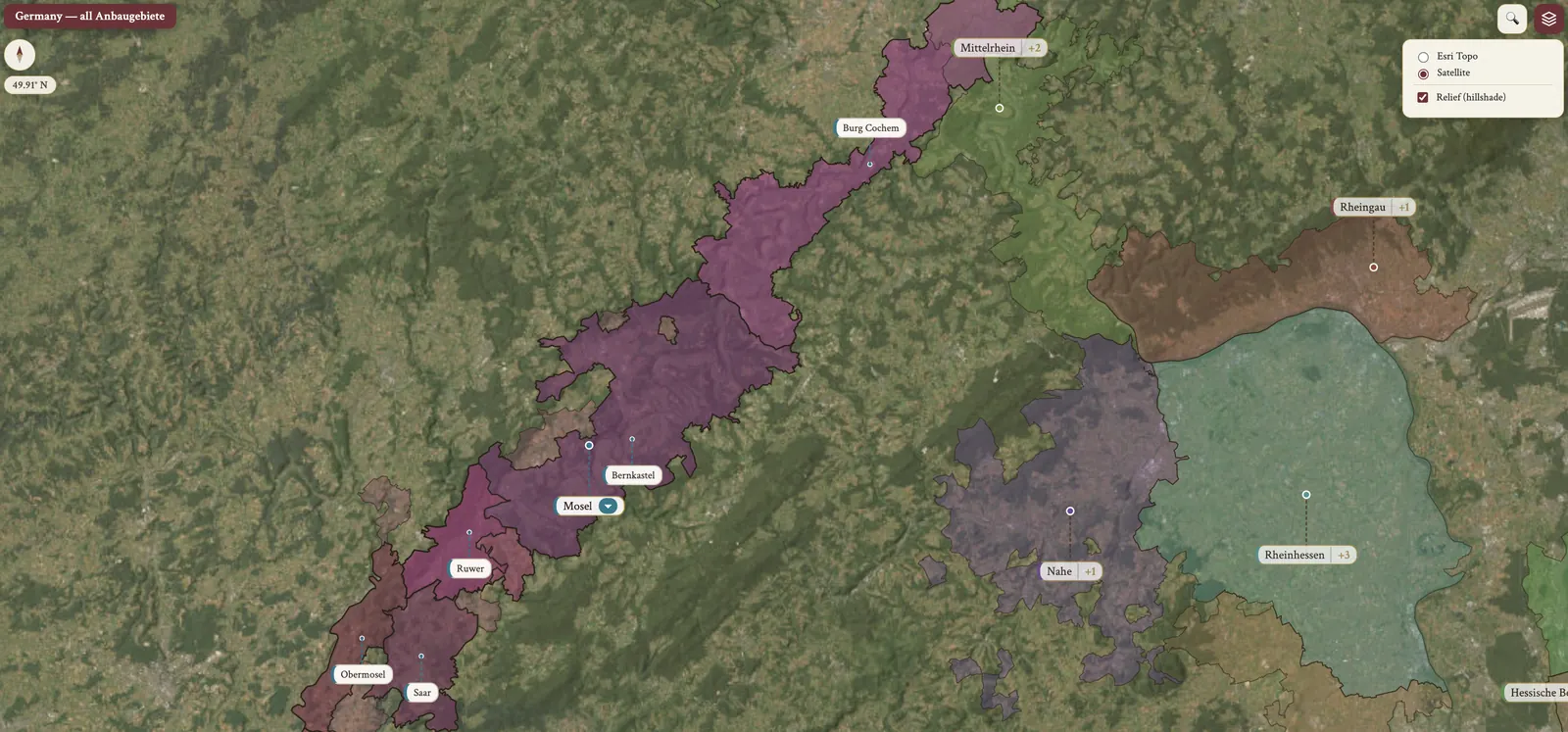
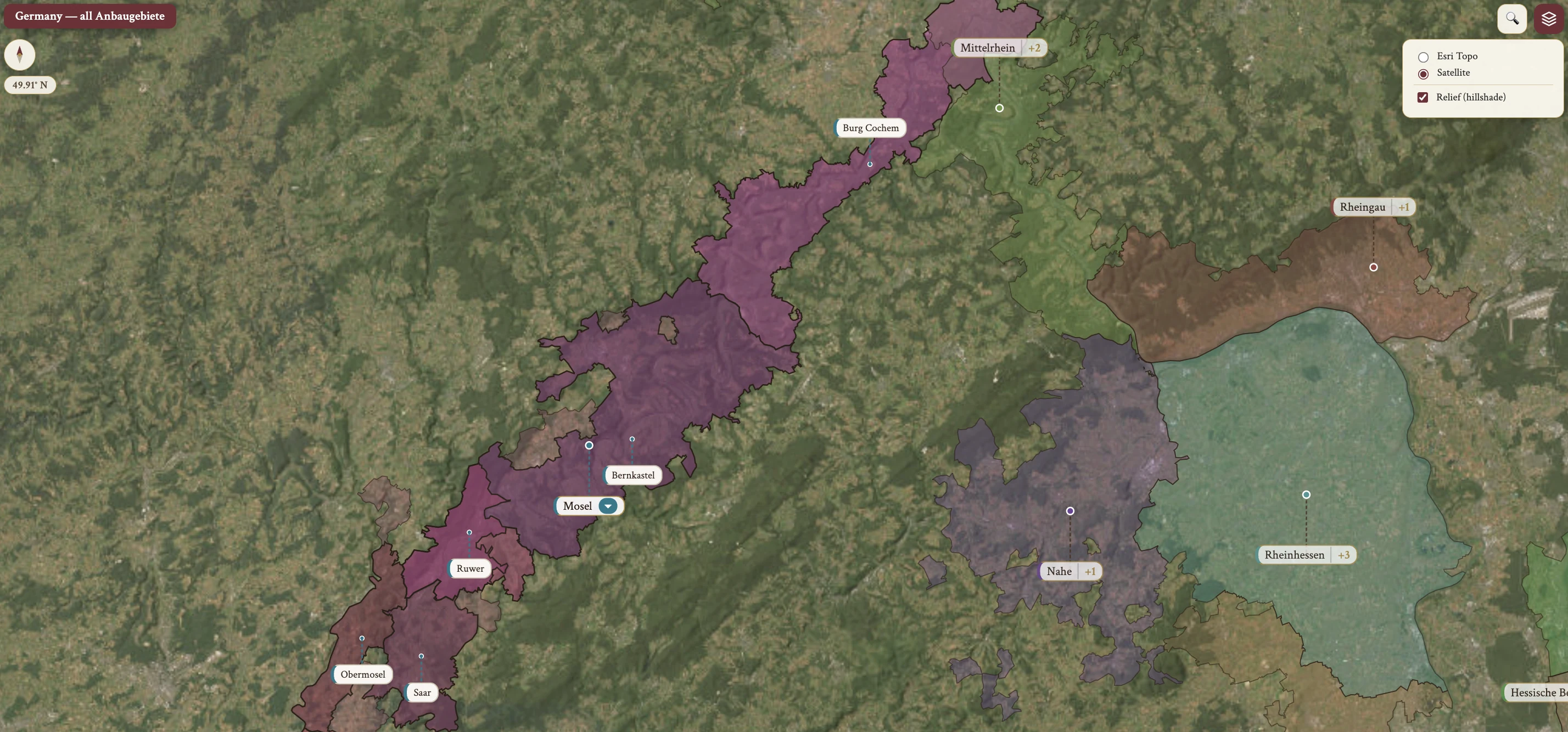
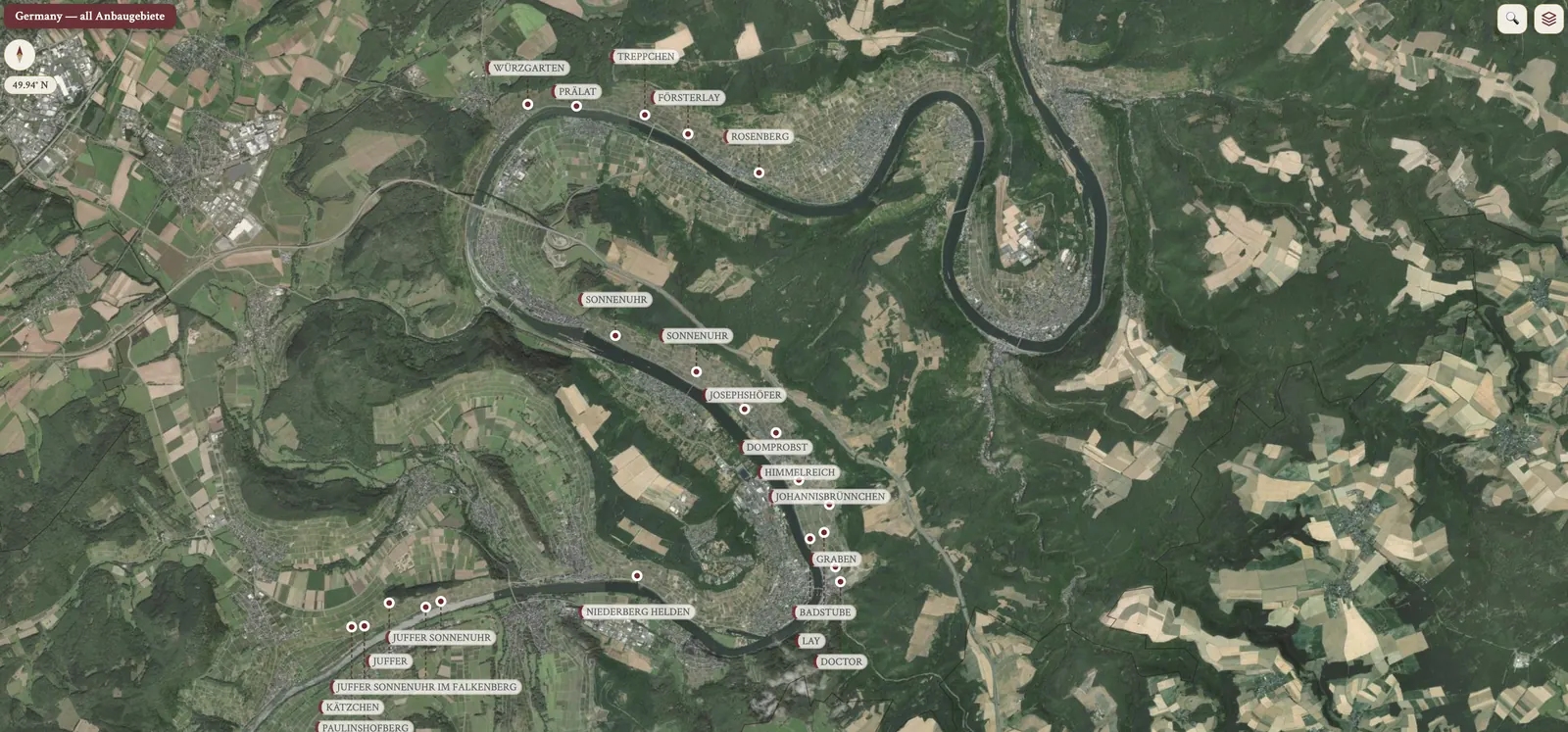
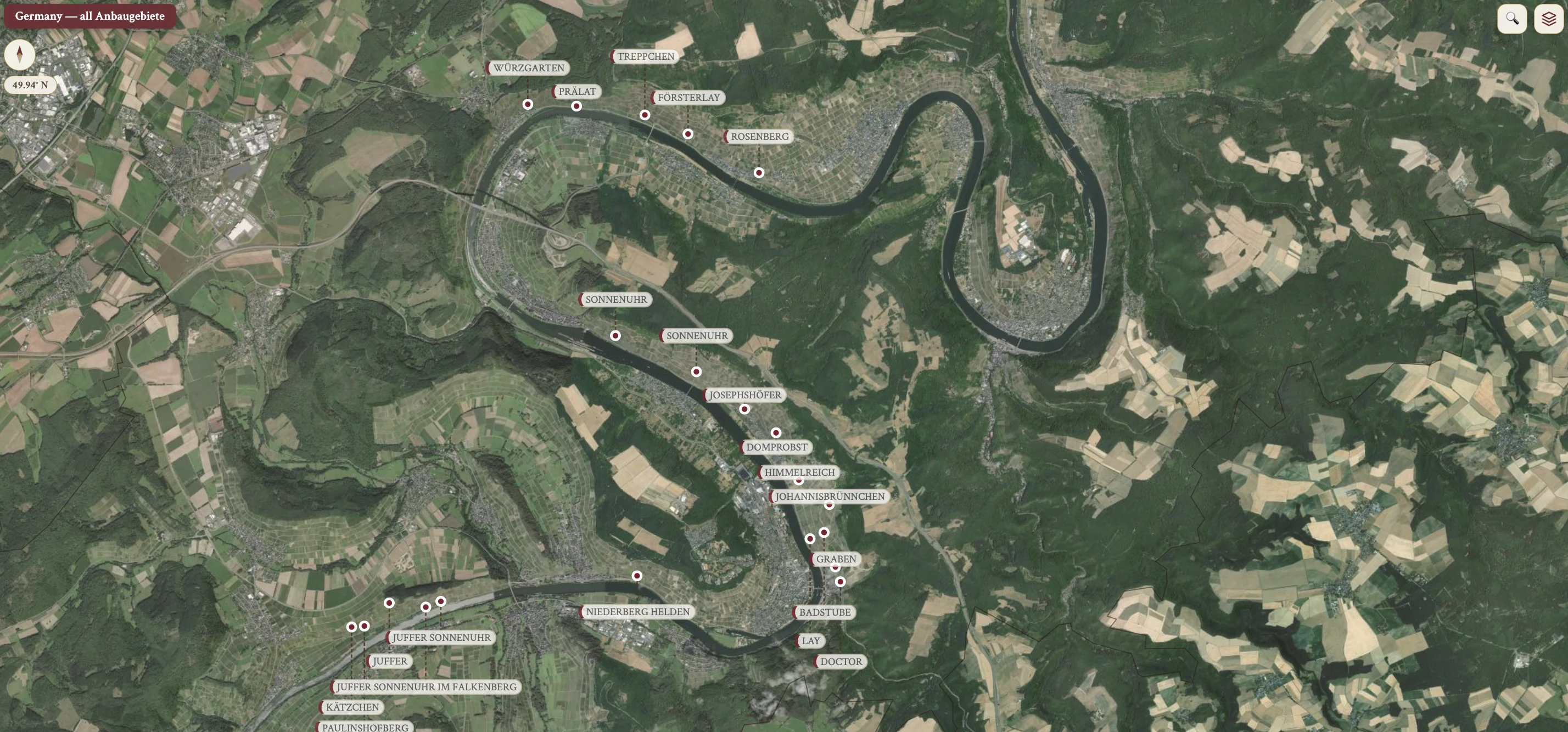
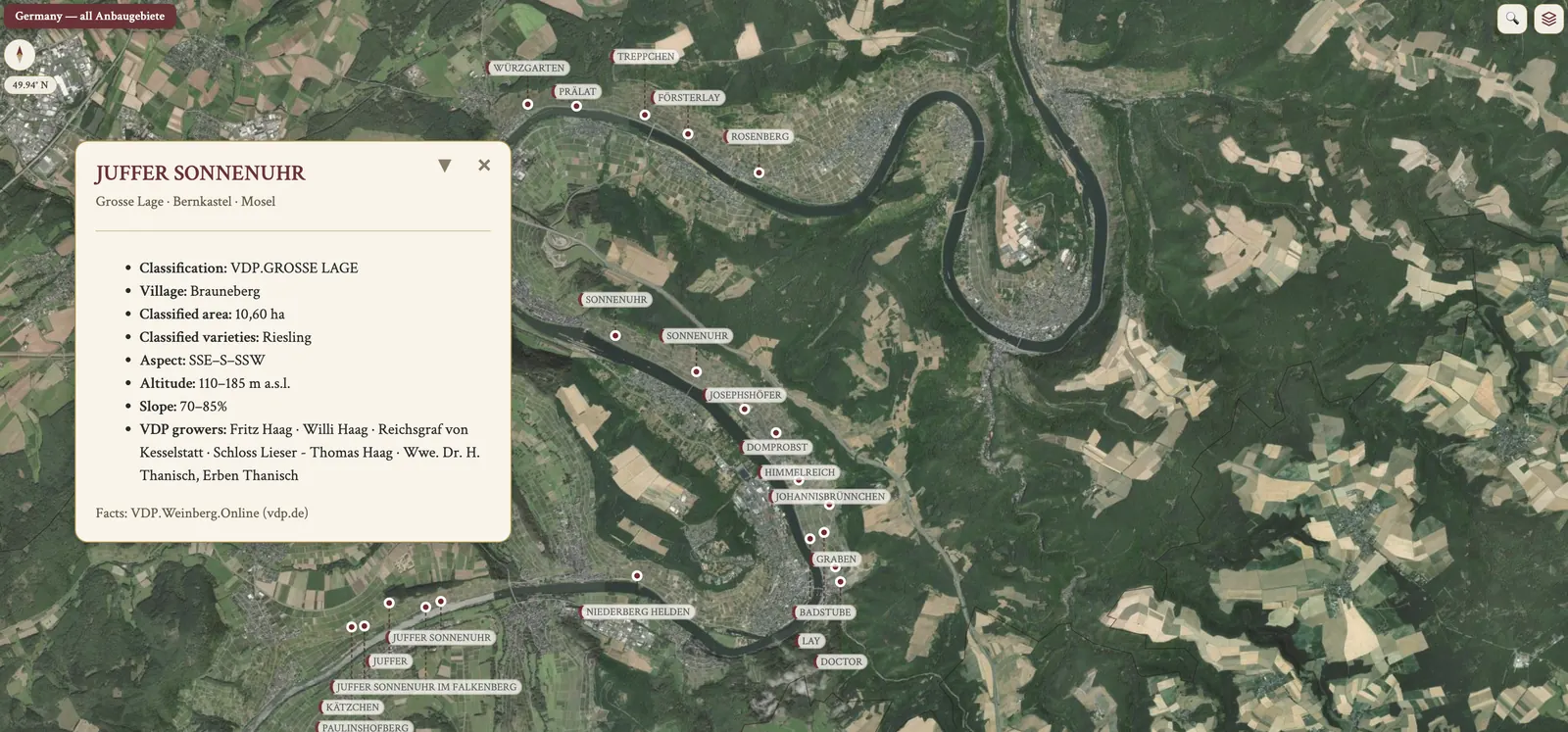
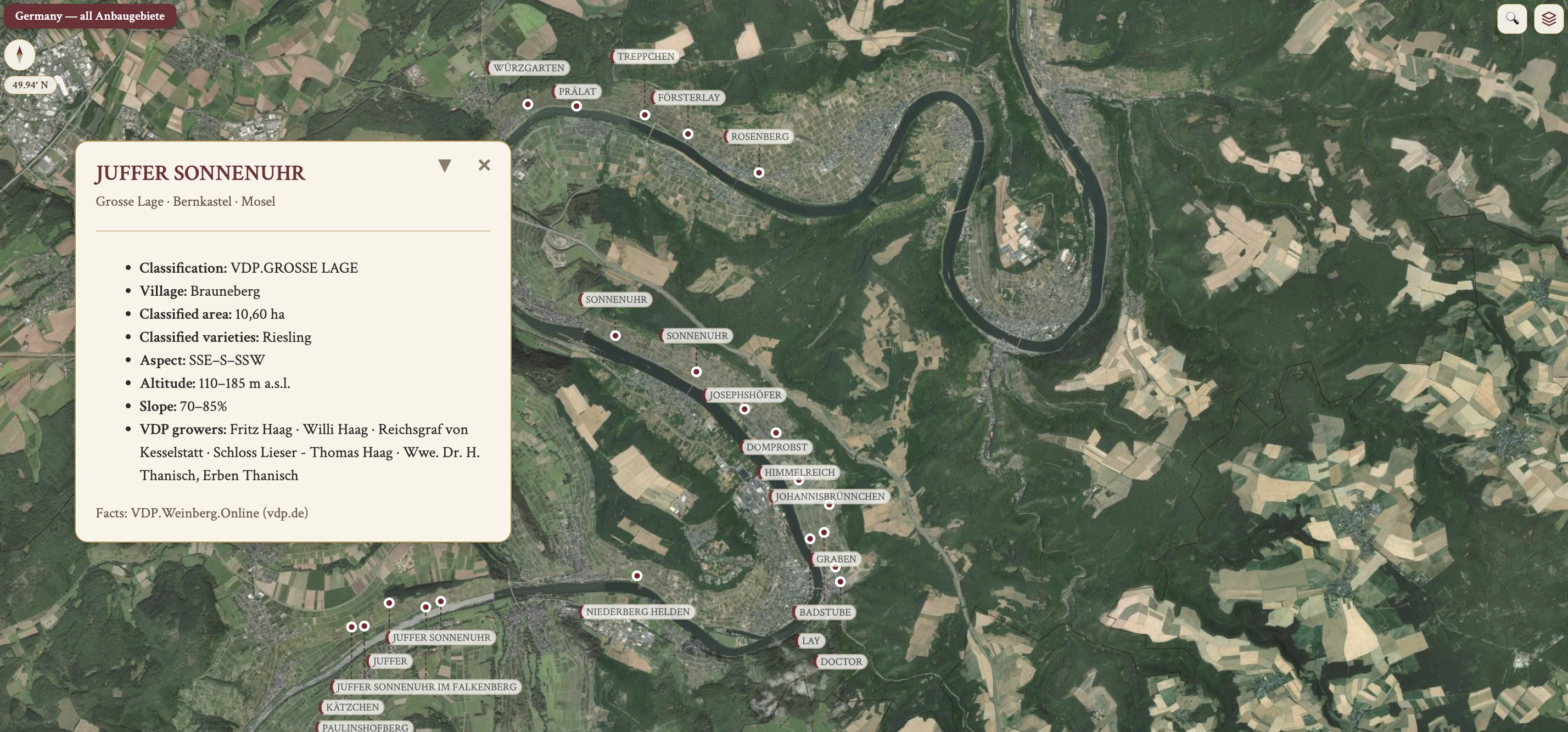
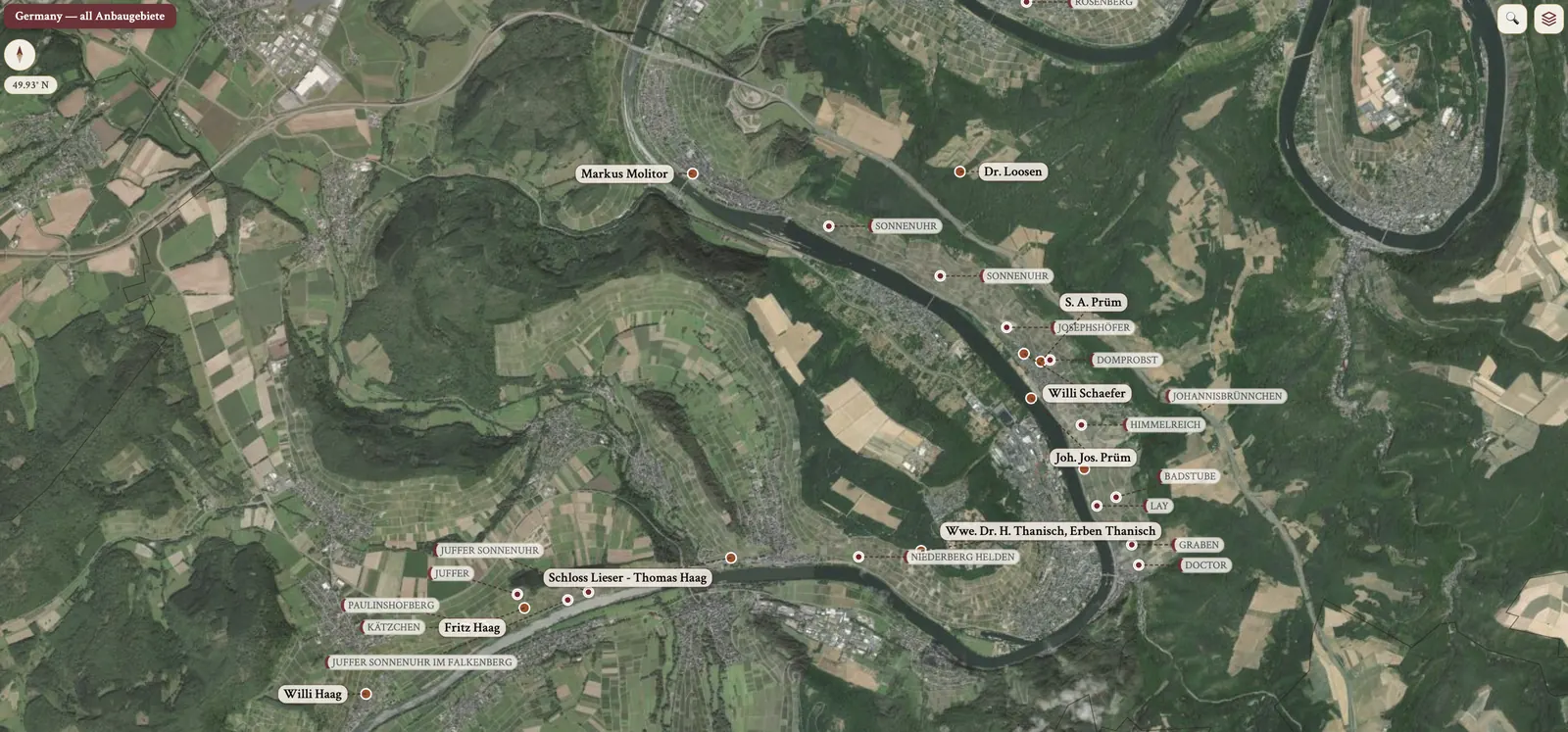
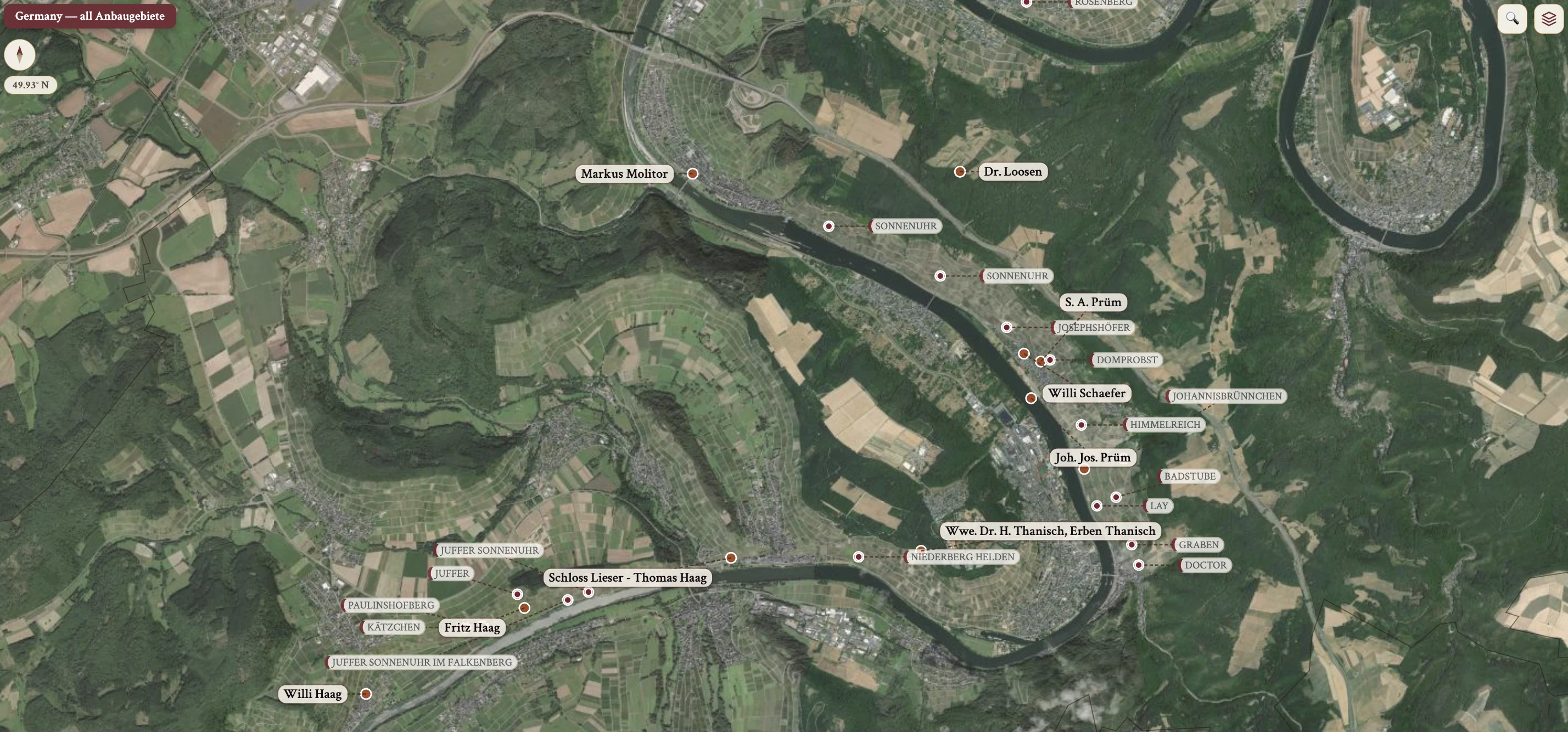
The Mosel maps from Your Own Wine Encyclopedia — every name tag opens a study card. Below, the chapter's own geography, climate and geology notes.
From the encyclopedia
Overview
The Mosel is one of the most northerly wine regions in Germany, and site selection is essential to ensure ripening at this latitude. White grapes account for 91% of plantings and Riesling alone for 62%; Müller-Thurgau and Elbling, ranked 2nd/3rd depending on source, fill the rest.
The region is divided into 6 Bereiche along three river sections — Obermosel, Mittelmosel and Terrassenmosel — plus the Saar and Ruwer tributaries, which are labelled simply "Mosel". It is home to the world's finest off-dry and noble-sweet Rieslings, and dry-style production is rising rapidly.
These are the most expensive wines in Germany, driven by steep-slope labour costs and the very low yields for BA/TBA. The Mosel is also one of the top-5 producing Anbaugebiete; the top 5 — Rheinhessen, Pfalz, Baden, Württemberg and Mosel — account for 88% of German production.
History — Trier and the Monastic Vineyards
Augusta Treverorum — Trier — was founded c. 16 BCE under Emperor Augustus and named after him, and the Romans planted vines along the Mosel; it is one of the oldest wine towns in Germany. In the late 3rd century, under Diocletian's Tetrarchy, Trier became one of the main imperial capitals in the West.
Monastic ownership shaped the great sites. In the 7th century the lands of today's Grünhaus, on the Ruwer, were granted to the Benedictine Abbey of St Maximin in Trier, traditionally linked to King Dagobert I. In 966 Grünhaus is first documented as an estate of St Maximin Abbey, and it remained in monastic hands for centuries. In 1335 Elector Baldwin of Trier granted vineyards at Eitelsbach to the Carthusian Order, founding the Karthäuserhof estate. On the Saar, the Scharzhof and the Scharzhofberg vineyards belonged to religious institutions through the Middle Ages and were already recognised as high-quality sites.
History — Secularisation and Private Ownership
Secularisation moved those holdings into private hands. In 1797 Jean-Jacques — Johann Jakob — Koch acquired the Scharzhof estate after French revolutionary secularisation. In 1811, following secularisation under French rule, Karthäuserhof was sold at auction and acquired by Valentin Leonardy; it remains in the same family line for over 200 years. Maximin Grünhaus was auctioned in the early 19th century, after Napoleonic secularisation, and passed into private ownership.
In 1882 Carl Ferdinand von Stumm-Halberg bought Maximin Grünhaus; via marriage it passed to the von Schubert family, who still own it. Through inheritance and marriage over the 19th century the Scharzhof was divided into Alter and Neuer Scharzhof, the Neuer Scharzhof passing into the Müller family — today's Weingut Egon Müller–Scharzhof.
History — the Grosser Ring and the Wine Law
In the 19th c. golden era, pre-phylloxera Mosel Rieslings commanded prices equal to or above 1st-growth Bordeaux on London and New York wine lists. The Grosser Ring was founded in 1908 as the Mosel chapter of what would become the VDP, predating the national VDP of 1910 by two years.
The 5th German Wine Law of 1971 had several impacts on the Mosel. The Bernkasteler Doctor was preserved as a 5 ha minimum exception; its three proprietors successfully petitioned in 1984 to have the expanded boundaries shrunk to 3 hectares, and the excluded eastern growers received the adjacent designation Alte Badstube am Doktorberg.
The invention of the Grosslage caused consumer confusion in the Mosel: Piesporter Michelsberg is a Grosslage, low-quality commercial territory described as a rather unfortunate smear on the integrity of Piesport, as against the genuine Einzellage Piesporter Goldtröpfchen. The law also banned additional Prädikat qualifiers — feine and hochfeine — from labels, and Mosel producers adopted the Goldkapsel as an unofficial workaround, indicating additional sweetness from higher must weights, most common on Auslese.
Climate
The Mosel climate is cool continental, at the northern ripening limit, tempered almost entirely by its steep slopes and the thermal mass of the Mosel river; without these, grapes would not ripen. The river reflects sunlight onto south-facing slopes and radiates heat at night, and it mitigates frost; the dark slate retains and re-radiates heat.
Cold air drafts blow in from the Hunsrück, on the Rheinhessen side, and from the Eifel, on the Ahr side. In 2023 a hot summer came with rainfall during harvest.
Topography & Geography — the Three Sections
Mosel sub-regions, Bereiche and villages are conventionally listed north to south — downstream to upstream, mouth at Koblenz to source at the French border. This is the opposite of the actual river flow: the Mosel itself flows south-west to north-east, south to north, from the French/Luxembourg border to Koblenz.
In that order the three sections begin with the Lower Mosel — the Terrassenmosel or Untermosel — of extremely steep terraced sites near Koblenz. It is home to the Bremmer Calmont at about 69°, one of Europe's steepest vineyards, on a hill of about 380 m altitude near Burg Cochem; its important gemeinde is Winningen, with Röttgen and Uhlen.
The Middle Mosel, the Mittelmosel, is the largest and most famous section, the roughly 120 km stretch from Trier to Zell, and it holds all the prestige sites. The Upper Mosel, the Obermosel, lies near the Luxembourg border, where Muschelkalk and calcareous soils replace slate — it sits within the Paris Basin, alongside Chablis and Champagne — and much Elbling is grown there for Sekt base.
Topography & Geography — Steep Slopes, the Saar and the Ruwer
The best vineyards lie on steep south-facing slopes of up to 70° gradient. They are labour-intensive and low-yielding, which gives the highest production costs in Germany and the most expensive wines in the country. Flatter sites, such as those around Piesport, allow cheaper labour and mechanisation, and give simpler, inexpensive Müller-Thurgau for merchants at higher yields.
The Saar and the Ruwer are tributaries of the Mosel and are today labelled simply "Mosel". They are sheltered side valleys of south, south-east and south-west aspect at higher altitude, which makes them cooler and gives even higher acidity. The Ruwer is regarded as better for dry wines than the Saar.
Soil
Devonian slate is the signature, in four colour variants, each with subtle aromatic and character differences. Blue and grey slate is found in the Middle Mosel, in parts of the Saar — the Scharzhofberg is weathered grey slate — and at Wehlener and Zeltinger Sonnenuhr and at Apotheke in Trittenheim; it gives racy, mineral, green-fruit Rieslings.
Red slate, the Rotliegendes, lies under Ürziger Würzgarten, Erdener Treppchen, Erdener Prälat and the Herrenberg of Maximin Grünhaus in the Ruwer. It is iron-rich, and gives spice, opulent fruit and a warmer mid-palate. Brown slate occurs in pockets, often blended with grey.
Calcareous Muschelkalk dominates the Obermosel and Moseltor, where it replaces slate and supports Elbling.
Grape Varieties
Riesling is the signature at 62% of plantings, behind the world's finest off-dry and noble-sweet expressions. Müller-Thurgau is 2nd, on the flatter Piesport-area sites, for inexpensive blends and as Liebfraumilch base. Elbling is an ancient variety, 2nd/3rd most planted, grown primarily in the Upper Mosel — the Obermosel — for Sekt base on calcareous Paris-Basin soils.
Mosel Riesling — Style
Mosel Riesling is paler in colour, lighter-bodied, lower in alcohol and higher in acidity than Rheingau or Pfalz. Its floral and green fruit character is pronounced, and the balance of acidity and flavour intensity gives exceptional ageing potential.
The reputation is strong for sweeter styles, though dry production is rising — even in the Mosel more wines are fermented to dryness. The world's finest off-dry and sweet Rieslings still come from top Mosel producers.
Riesling Comparisons
Three comparisons place the style. Set against Alsace Riesling, the Mosel is paler, lower in alcohol, often with RS, higher in acidity, floral and green-fruited, on blue/grey slate; Alsace is fuller-bodied, usually dry and increasingly off-dry, higher in alcohol, on granite/schist/limestone, with exotic fruit.
Set against Clare and Eden Valley Riesling, Australia is dry, high in acid, with lime and mineral character and higher alcohol; the Mosel is often off-dry, more floral with more green and stone fruit, and lower in alcohol.
Set against Rheingau dry Riesling, the Rheingau is fuller, with riper fruit and more oak-friendly, on the Taunus shelter and the wider Rhine; the Mosel is leaner, more tense, more mineral and lower in alcohol.
Viticulture
Einzelpfahlerziehung — single-post or staked training, each vine tied to one upright pole — is used on the steepest Mosel slopes. It is hugely labour-intensive, and the skill is gradually being lost. Helicopter spraying is still used on the steepest slopes; it may affect neighbouring properties, and it explains the very low organic share.
The biodynamic pioneer is Clemens Busch of Pünderich, in the Lower Mosel, who farms a contiguous block of the Marienburg and colour-codes his labels by slate colour — blue, grey and red. Mechanisation means winches and small caterpillar tractors only; on the flatter sites at Piesport, cheaper labour and machine harvest enable bulk Müller-Thurgau.
Winemaking Terms
The region's winemaking terms begin with the Fuder, the traditional 1,000 L cylindrical Mosel oak cask; compare the Rhine Stück, 1,200 L and oval. Slow or stuck fermentation is typical for top Riesling — high acid and extreme must weights leave residual sugar and modest alcohol, which gives the classic off-dry style.
The Goldkapsel, or gold capsule, is used in the Mosel and especially for Auslese, which has a very wide must-weight range. It is an unofficial indicator of higher must weights, riper fruit and more botrytis. Markus Molitor uses capsule colour differently: white for dry, grey-green for feinherb or off-dry, gold for sweet or botrytised — a sweetness guide, not a quality tier.
Oechsle Minimums
The Oechsle minimums for Riesling, in °Oe, run Kabinett 70–73, Spätlese 76–80 and Auslese 83–88. BA is 110 and TBA 150–154, the highest in Germany alongside the Ahr. Eiswein is 110, the lowest threshold in Germany.